
haven
Posts 15
Comments47
Hey, fair point. To add to it, I expect we're only reaching <1% of India's fishes currently, and even those still have many other causes of suffering than those our program addresses.
However, we are still mostly expecting to scope other countries, as opposed to other regions in India or China. This is because our I expect our country teams will be somewhat self-contained, and I thus expansion in one to be limited by factors other than cross-org things like finances or leadership staff. For instance, right now we could have expanded much more in India, but have been holding off doing so as we refine our program and develop new ones.
Overall, I expect we will give each country's team the mandate to expand as much as they can (which will itself involve scoping new regions within a country). If we start to hit org-wide bottlenecks on that, we may need to reconsider our strategy.
Fish Welfare Initiative Updates
- Farm program RCT results: We recently completed a randomized controlled trial with 53 farms to understand to what extent our farm program, the Alliance for Responsible Aquaculture, is actually improving water quality on fish farms. The primary result is that our program appears to be having a strong positive effect.
- "Chill kill" project update: We posted an update on our chill kill project, which aims to develop a less inhumane way of slaughtering fishes.
- Pause of our policy work in India: We recently made the hard decision to pause our policy work in India. This is primarily to allow us to better focus on our farm work.
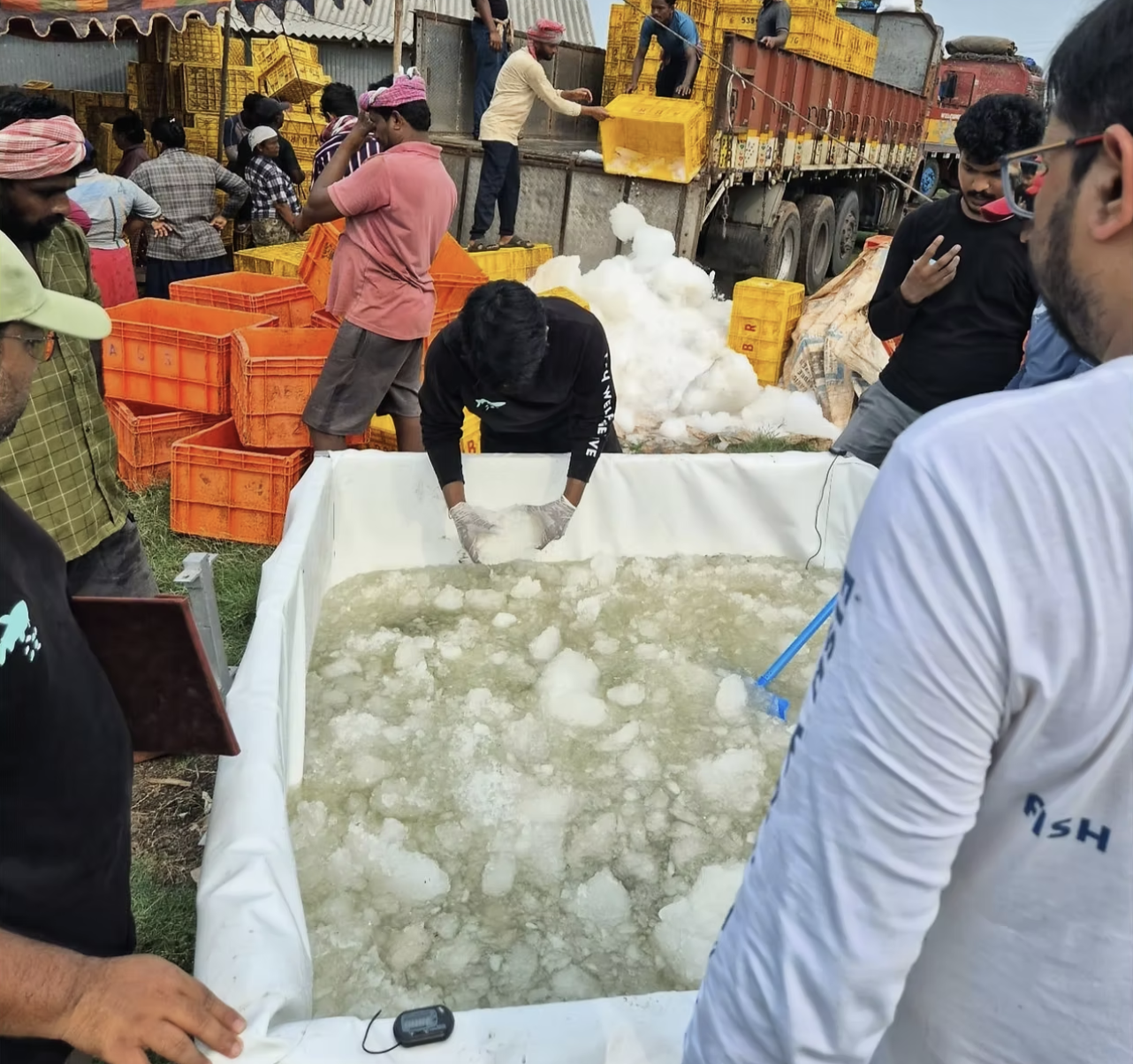
FWI staff Chaitanya, Dinesh, Mani, and Subrata preparing a chill kill trial during a live "harvest" in Andhra Pradesh, India.
Fish Welfare Initiative Updates
- Satellite-based water quality monitoring: After two years of extensive effort, we have failed to develop sufficiently accurate technology, and are thus pausing development on this intervention for now.
- Water quality ranges updates: We recently conducted a literature review of the ideal water quality ranges for Indian major carps, and made slight changes to our standards.
- Hiring: We are likely going to be hiring for an entry-level operations associate shortly. We think an EA-minded recent graduate could be a good fit for this role. We are favoring applicants in Asia, but wherever you are based if you think you could be a good fit we encourage you to reach out.
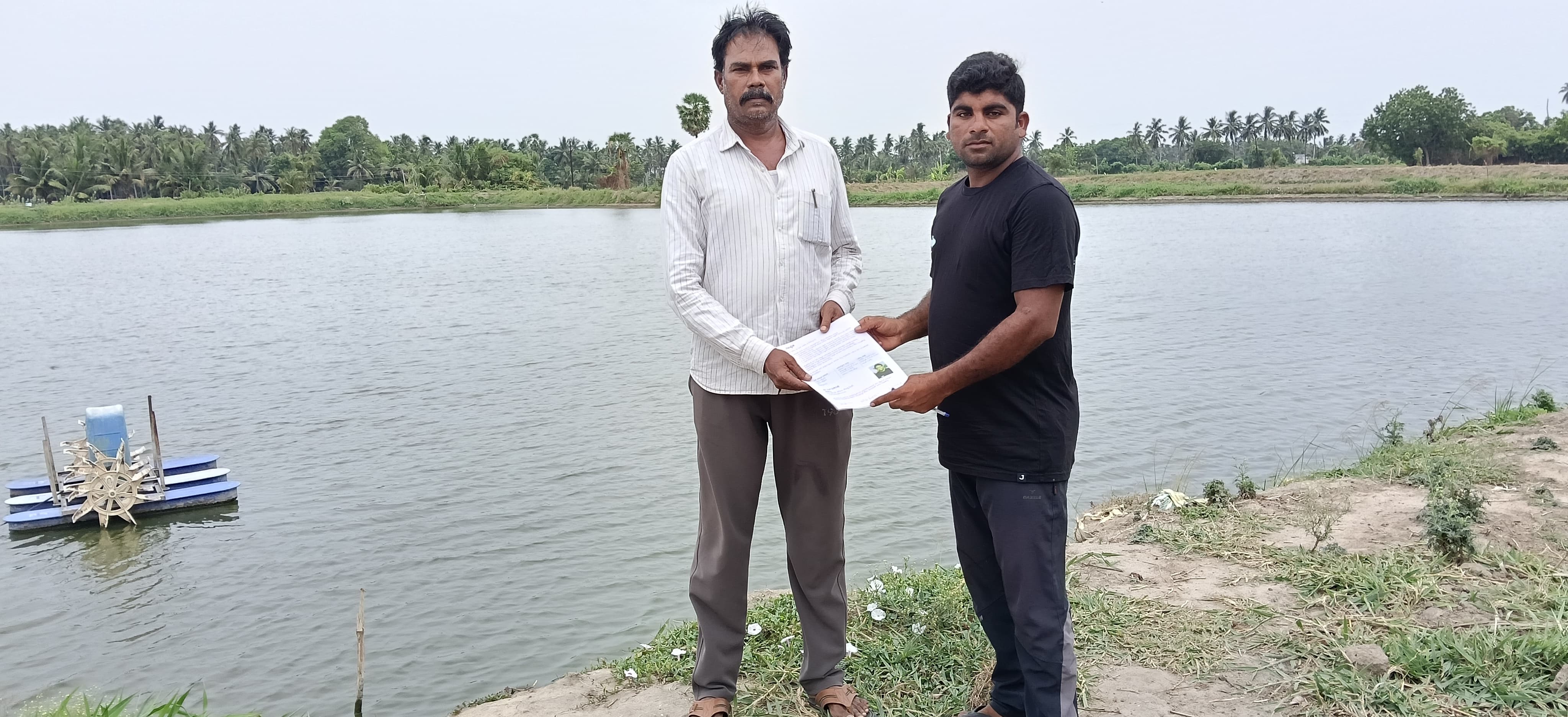
Caption: Our staff member Chandu (right) pictured with a farmer in Nellore, Andhra Pradesh, India. This farmer recently enrolled in our farm program, through which we will work with him to improve water quality and maintain a stocking density cap.
Fish Welfare Initiative Updates
We're hiring for a role that we think may be a great fit for some in the EA community: Director of Programs. This role will involve leading and scaling our programs, first in India and then abroad, to implement welfare improvements on thousands of farms. International applicants are welcome, though time living in India will be expected. Leadership experience required; experience running agricultural programs a huge plus.
Learn More and Apply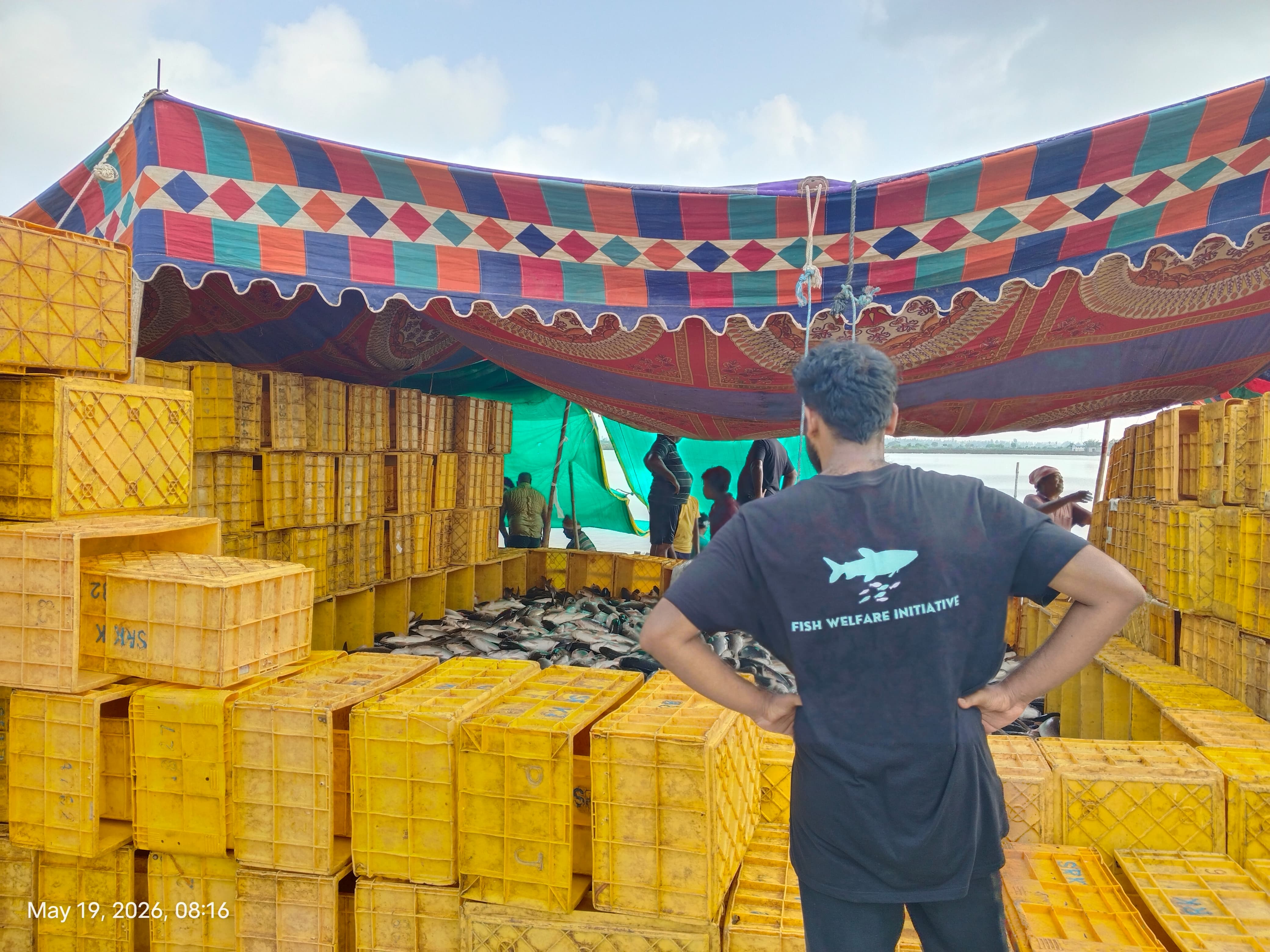
FWI staff observing a "harvest", in which the fishes are pulled from the water and asphyxiated to death. We are working to reform these practices with our ongoing "chill kill" project (see update from last year—we should have another update in the coming months).
Fish Welfare Initiative Updates
We are hiring for a Welfare Assessment Manager! (Note Indian applicants only.) This role will be tasked with conducting welfare assessments for farmed fishes in various contexts.
Apply NowHere are also some recent project updates:
- Feed fortification studies: We aim to develop an intervention based around our custom-formulated feed, which we hypothesize will improve water quality and nutrition. We are currently conducting two studies to assess this: a lab-based efficacy study (120 fishes) and a farm-based effectiveness study (12 farms). Both are progressing on track. See previous posts.
- Remote Sensing of Water Quality: We aimed to develop an intervention to remotely sense (via satellites) or predict water quality. Unfortunately, our in-house modeling did not yield any viable models. We are doing some final wrap-up work, but don't expect any breakthroughs. We expect to publish a full writeup of our results by the end of June. See previous posts.
- Improved Slaughter (Chill Kill): We aim to develop an intervention that replaces air asphyxiation with immersion in an ice bath at slaughter (still causes significant suffering, but less than the alternative). Our main bottlenecks remain a) logistical feasibility, and b) trader and consumer demand. To test the former, we are planning a trial of 1,000 fishes in the coming weeks—our largest yet. See previous posts.
- China Work: As part of our efforts to continue understanding and engaging the industry, we recently visited a rainbow trout farm and observed our first harvest event. We are also continuing to research interventions on various priority species, focusing on pond loach, sturgeon, and mandarin fishes.
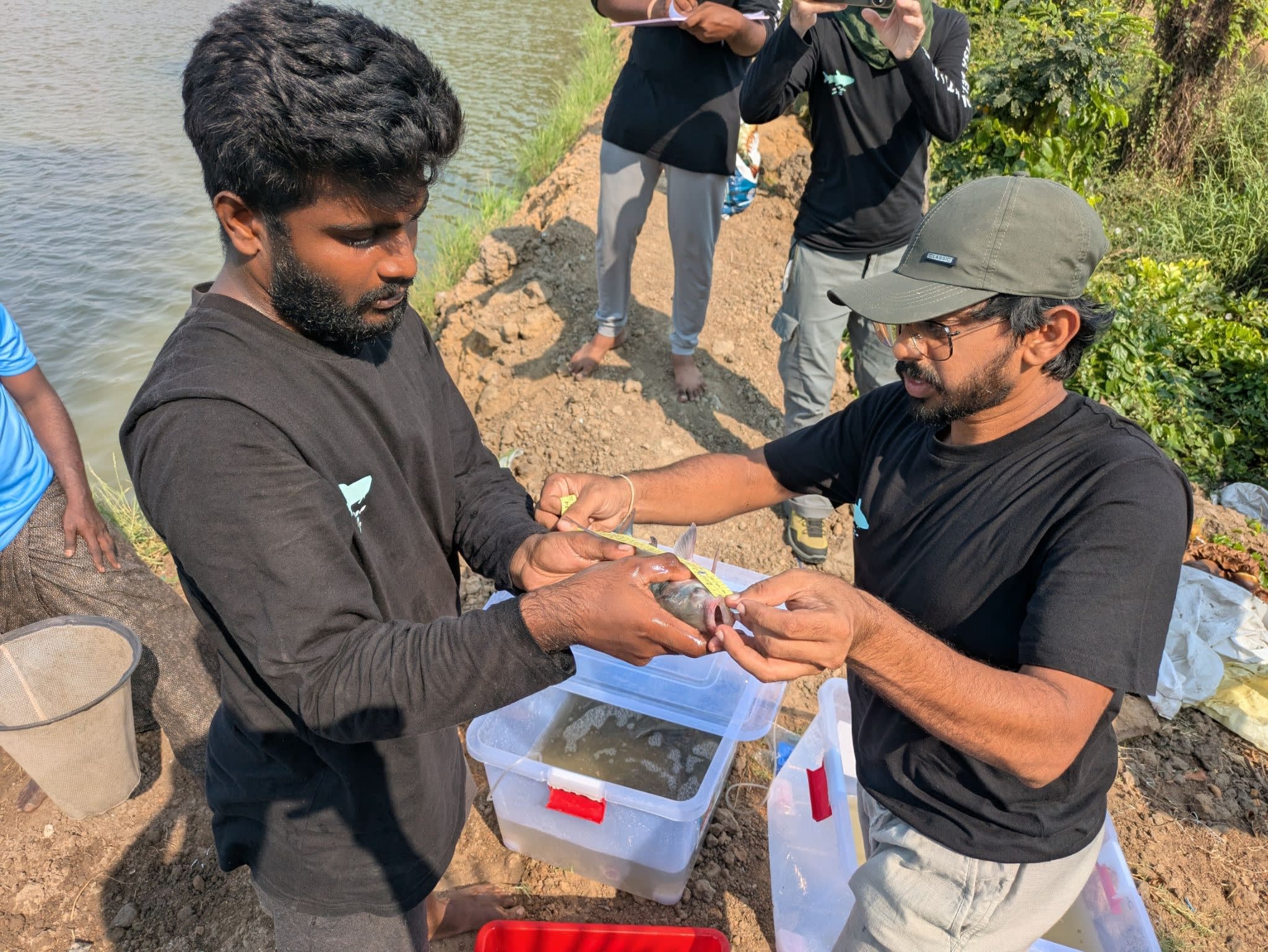
Our staff Roshan and Gokul sampling fishes recently in the feed fortification pond-based study, in order to assess health and growth—proxies for welfare. Handling fishes in this way does cause them significant stress, but we believe the information is worth the costs (though these are tricky ethical tradeoffs that we sometimes struggle with).
Update: Thanks to the hard work of 7 unpaid interns, our website has been miraculously restored. The hacked page will be preserved here for posterity.
Fish Welfare Initiative Updates
We recently published two new datasets:
- Our farm program dataset, comprising of 10K+ (anonymized) data points on fish farms in Andhra Pradesh, India collected from 2021 to 2026.
- Our continuous water quality dataset, comprising of near continuous water quality data taken from farms in Andhra Pradesh, India over 2 months.
We also recently published our 2025 farm program M&E report.
From Fish Welfare Initiative (FWI):
Updates:
- We have launched new studies on feed fortification.
- We posted updates on our various other studies, including on our use of satellite imagery to remotely monitor water quality.
- We published our 2026 priorities and our 2025 year in review.
Open Roles:
- We are hiring for an Operations Associate! Applicants from India and the Philippines are preferred, but international applicants are welcome. This is a good role for an early-career EA person. Deadline: Feb 20.
Hey Vasco! I just read the summary here, so my apologies if I'm missing something important.
I think I disagree with the line of reasoning you're following. For instance, you say:
>>I estimated its HSI has been 0.0292 % as cost-effective as HIPF accounting for effects on the target beneficiaries, and soil ants, termites, springtails, mites, and nematodes.
It would be very surprising to me if we can know with any degree of confidence that exploratory research into highly speculative areas is >3000X more cost effective than Shrimp Welfare Project's main program—a program which seems to be one of the most cost effective on the planet!
I don't doubt that every step in specific chain of reasoning is mostly correct. Rather, I think where I get off the boat here is that I think the uncertainty in these flowthrough effects tends to dominate after a certain point. I get the sense you are willing to take these much more seriously and literally.
Another area of disagreement is the general framing of suggesting that we should always just fund the one most impactful thing. I agree that this makes sense on the margin, but I expect we're generally more likely to get to a better world in the end if we take a portfolio approach and fund and encourage lots of projects that pass a certain bar. A large part of this is driven by the fact that you get seriously diminishing returns on projects (e.g. I'd be surprised if CEARCH could cost effectively deploy SWP's full annual budget).
So I'd probably frame all of this as more "Both CEARCH's program and SWP's program perform very well on these metrics, and we should consider funding them."
Fish Welfare Initiative Updates
Expansion and Hiring: We recently published plans for international scoping to guide our future expansion. We are also hiring a Global Growth Manager to lead this.
Lice study: We published initial results from our "sentinel pole" lice study, which uses in-water poles to detect lice eggs before the farmers otherwise would. Lice are a common parasite affecting farmed fishes.
"Sentinel poles", which are used to detect lice eggs earlier than famers otherwise would, at our recent study.