
TL;DR: theoryofchangebuilder.com is a free, AI-assisted tool for building a theory of change that clearly lays out your goals in interactive flowchart format. Start from a blank canvas, a strategy doc, or an existing ToC, then add elements, iterate, edit, and embed the result on your website or funding application.
Why we built this
Making a theory of change is the kind of important task that sometimes isn’t perceived as urgent and gets pushed indefinitely. If you've wanted one for a while but never got around to it, or you've drafted one in a Google Doc that's too dense for anyone to actually read, or you've tried laying one out in Miro and gave up halfway through dragging boxes — this tool is for you.
What it does
- Provides structure. A template flowchart structure and optional step-by-step AI guidance for building a ToC from scratch.
- Generates a draft from your existing materials. Paste in a strategy doc, program description, or pitch deck; the AI proposes an initial graph of nodes and links you can edit.
- AI-optional. You can drag nodes and edit text manually without ever talking to the AI.
- Embeds assumptions and evidence in every node. Click any node to see what has to be true for the next step to follow, what evidence supports it, and how confident you are. This is the part most static ToCs struggle to cleanly incorporate.
- Embeddable. Iframe the interactive version on your website. Donors and partners can explore your logic at a glance or click to understand it more in-depth.
- Portable via JSON export. If you've used your free credit and don't want to add an API key, export the graph as JSON, paste it into whatever LLM you already pay for, ask for the changes you want, and paste the result back into the tool to re-render the interactive flowchart.
Why not just ask an LLM?
An LLM can also help you get a good first draft, but here are a few things the tool provides that would be harder to do with an LLM alone.
- Edit manually. Drag boxes, redraw arrows, fix a word. No need to re-prompt to move one element.
- Show high-level strategy quickly, with optional depth: take in at a glance, with the detail tucked inside each node and connections (as opposed to providing no detail or long footnotes that get messy and hard to track). People don't have to read a lot of text to grasp your approach and start giving feedback.
- Website-ready. Embed the flowchart in a clean, interactive format.
- Collaborate. Send the edit link to team members to make changes to the same version or create a copy for a different version.
(Getting your LLM to improve the graph JSON before re-uploading it into the tool could help get better results for cheaper, though, as mentioned in the previous section.)
What it looks like in practice
Here's Ambitious Impact's theory of change rebuilt in our format. [1]
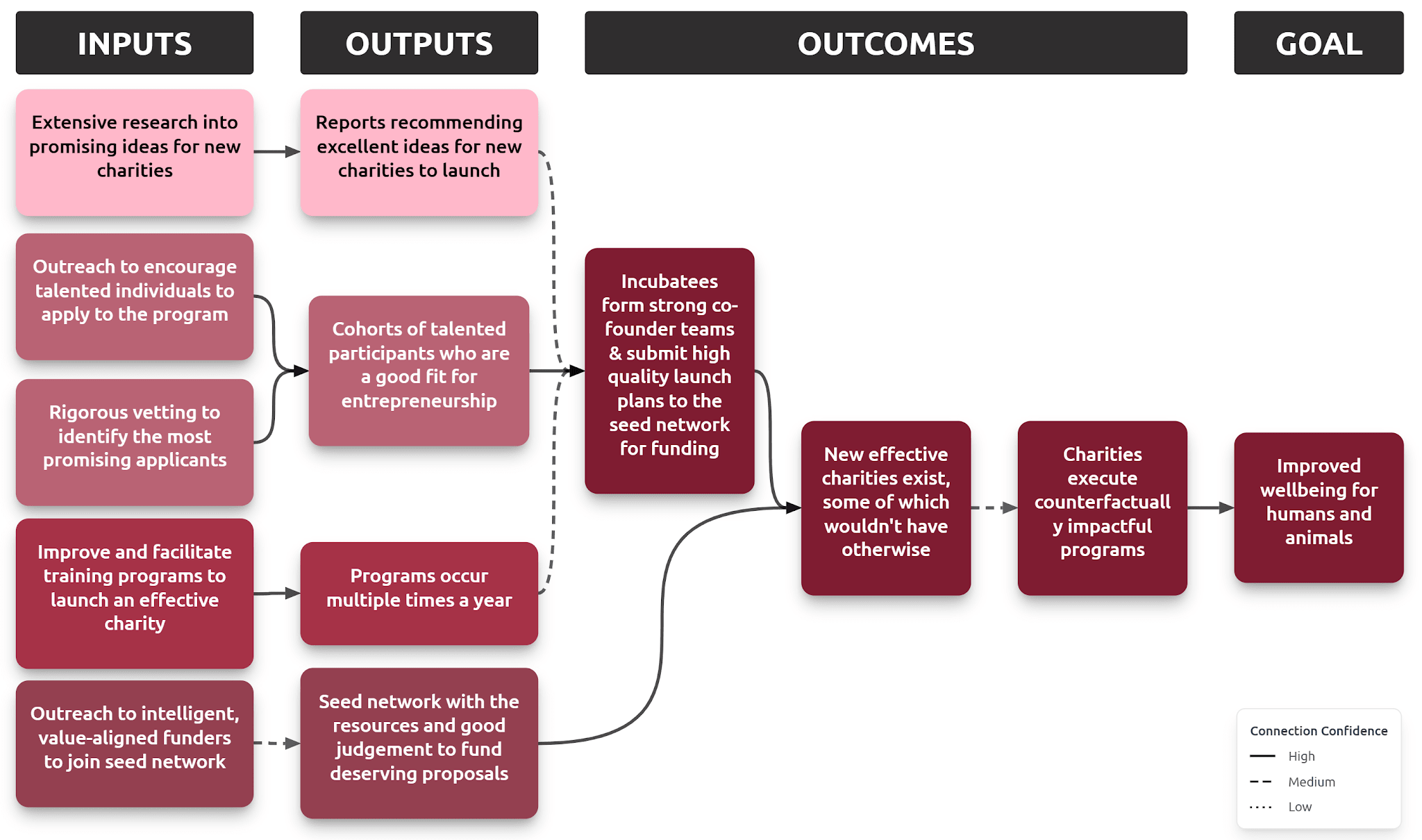
Some EA orgs are now using ToCs built with the tool on their own sites. As an example, the Center for Reducing Suffering posted their ToC on their website.
Ambitious Impact's Research Training Program (now discontinued) used a beta version of the tool with a recent cohort of 14 global health and animal welfare researchers. Morgan Fairless, who ran the program, said this:
“My team at Ambitious Impact builds dozens of ToCs a year. We've always felt a tool like Theory of Change Builder would be useful, and are excited to keep testing how it can speed up and improve the robustness of our ToC thinking.”
What it costs
Free up to ~$5 of API usage per user. How far that goes depends on how heavily you use the AI generate function and which model you pick — could be one detailed, mostly AI-generated ToC draft, or several ToCs made manually with some AI process guidance and feedback. After that, you can add your own Anthropic API key and pay the costs directly (typically a few cents per generation), or keep editing manually for free indefinitely.
Current state of the project
This is a small, volunteer-run project with no funded development time. We have less than $700 left for free-tier API — probably at least a few months of runway, but it depends on how much the tool gets used. So:
- Bug reports and feature requests: [email protected]. We'll read them, but might not act on them quickly.
- Donations could also help us extend the free tier so more people can use it without their own API key: contact [email protected].
- If you'd consider funding part-time development, this would help us make more improvements (e.g., UI fixes, comment feature for feedback, better MEL integration)
What you can do right now
Go to theoryofchangebuilder.com and try it on a real program or project. A first sketch can be quick. If you already have a ToC that's just not clean enough for your website, paste it in and get the AI to help structure it. If you don't have one yet, this is a low-friction way to get a first version you can improve over time. Either way, you can bookmark it for the next time you need to think through the path for impact of a new project or program.
Fair warning: the UI isn't super intuitive yet. Fixes are coming. Until then, here's how to deal with the two flowchart editing features people get stuck on:
- To add a box, double-click anywhere on the canvas.
- To draw an arrow, Ctrl-click the first box (left column), then Ctrl-click the second (right column).
- To add a column or edit the default structure template, Cian made a one-minute clip showing the basics.
If it's not the right fit for you, consider sharing it with someone whose theory of change you wish you understood better.

Built by Cian Dally (original developer); Moïri Gamboni (infra, maintenance, and improvements); Zoé Roy-Stang (PM, ops); with input from beta testers from the EA community.
Acknowledgements: We’d like to thank CEEALAR and Impact Hubs for creating affordable and engaging spaces for us to meet collaborators and cowork.
- ^
We didn't make their original ToC; we re-rendered it because it's a good example of what clear strategic communication looks like for an org many readers will know.