
Who this article is for
Anyone planning to raise AI risk issues on X. Anyone weighing whether an insider gets a different reception from an expert commenting on someone else's incident.
Key findings
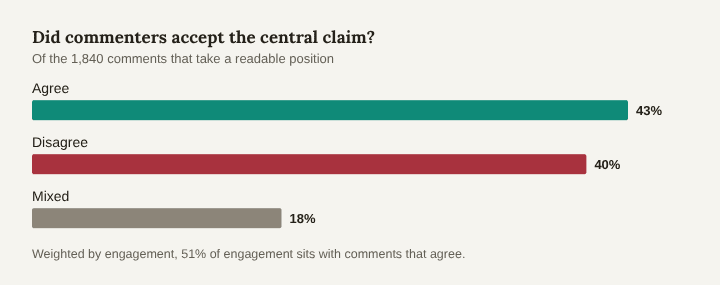
- Of the 1,840 replies where we could tell what the writer thought, 43% agreed with Coxon that the labs are racing recklessly towards superintelligence, 40% disagreed and 18% were mixed.
- Counting likes, agreement rises to 51%. That is still well below our earlier research, where agreement ran from 68% to 98%.
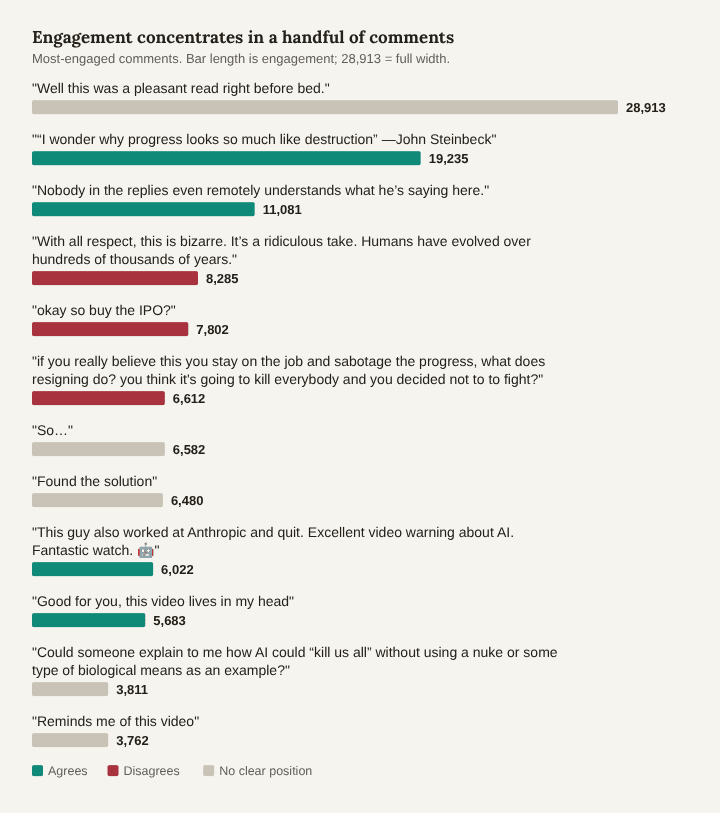
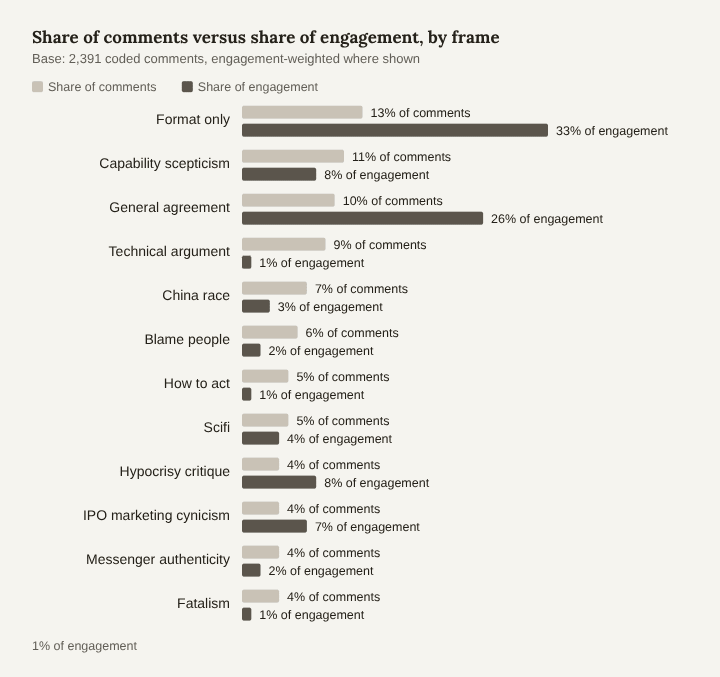
- The most-liked reply, with 28,913 likes, was a joke: "Well this was a pleasant read right before bed." Jokes, one-liners and bare agreement were 23% of replies but took nearly 60% of likes.
- The most common objection, from one in five sceptical replies, was that AI can't improve itself into the superintelligence Coxon warns of. Next, at 13%, was that slowing down would just hand the lead to China.
- A third of agreeing replies were afraid. A third of disagreeing replies were angry, and almost none were afraid. The sceptics weren't shrugging Coxon off; many were angry about what he said.
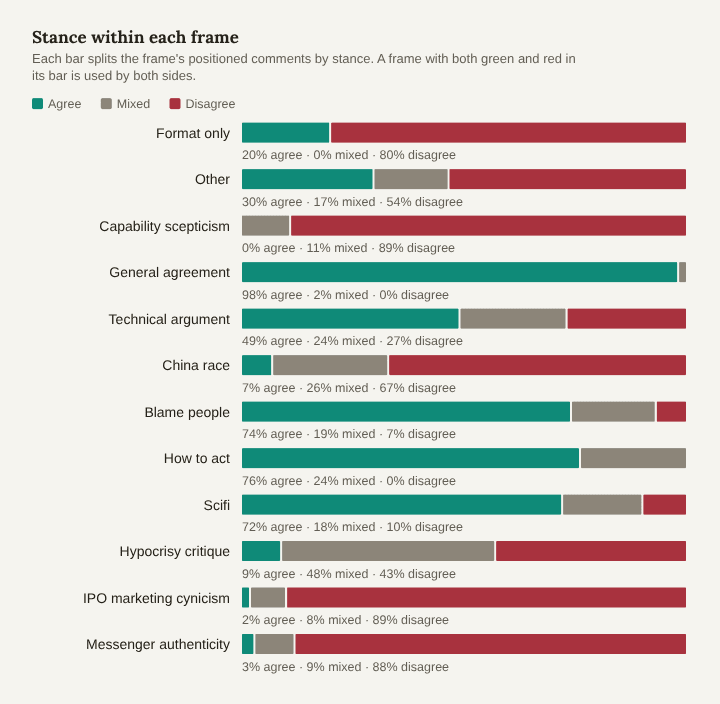
- Replies that blamed human greed, not the technology, mostly agreed with him (74%).
What communicators can take from this →
What happened
On 9 September 2026 Jacob Coxon, who spent three years doing pretraining research at OpenAI and Anthropic, posted a seven-part thread announcing he had resigned from Anthropic. It opened: "Neither company is acting responsibly. They are racing straight to self-improving superintelligence and gambling with our lives."
The rest of the thread said the fear inside the labs is sincere, explained why researchers stay anyway, and called for coordination between labs, possibly including a temporary ban. Read the thread.
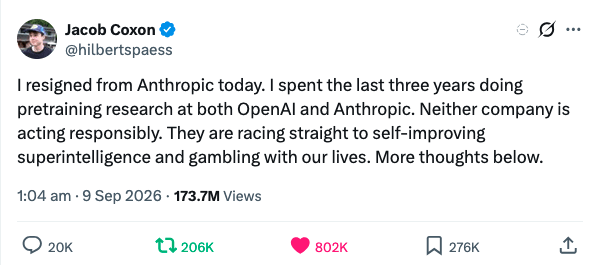
The opening tweet had 20,553 replies at the time of data collection.
This is the first X study in our research, and the first where the messenger is the story, as Coxon is talking about his own decision rather than a third party.
Methodology
We read the reply feed in a signed-in browser across all four of X's sort orders.
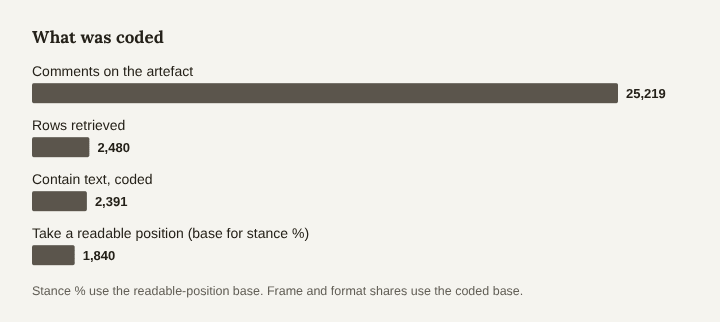
We collected 2,480 comments after removing ads and Coxon's own posts.
An LLM then coded each comment, categorising them using stance, frame and emotion.
Our research team checked a random sample of 40 and agreed with 38.
View our full research methodology →
Disagreement with Coxon
Replies split almost evenly: 43% agreed with Coxon that the labs are racing recklessly towards superintelligence, and 40% disagreed. Counting likes, it was 51% to 38%. Our earlier studies were far more one-sided: 98% of comments that took a view on the Soares reel agreed, and 68% on the Amanpour segment.
We believe that many of the people replying work in or near the AI industry and treat Coxon as one of their peers.
Humour
"Well this was a pleasant read right before bed." got 28,913 likes. The runner-up, with 19,235, was a line attributed to John Steinbeck: "I wonder why progress looks so much like destruction".
Bare agreement was 10% of replies and 26% of likes. Jokes, one-liners and bare agreement together were fewer than a quarter of replies but took well over half the likes.
Sceptics doubted the technology
Of the 1,058 replies that disagreed or were mixed, 20% said AI couldn't improve itself into the superintelligence Coxon warns of. No objection was more common. The next, at 13%, was that slowing down would hand the lead to China.
"With all respect, this is bizarre. It's a ridiculous take. Humans have evolved over hundreds of thousands of years. We aren't going to die out because a token prediction model gained sentience. Get a grip."X reply, 8,285 likes
"Dude all we have to do is turn off the Data Centers and then they are gone. How is this the end of civilization?"X reply
A smaller group read the thread as marketing timed to Anthropic's expected IPO.
"okay so buy the IPO?"X reply, 7,802 likes
Fear and anger
A third of the replies that agreed with Coxon were afraid. A third of those that disagreed were angry, and hardly any (1%) were afraid.
Replies that blamed greed, billionaires or the urge for control, rather than the technology, mostly sided with him: 74% agreed.
"This is exactly why AI needs to be people-owned, not controlled by a handful of billionaires. AI needs democracy. The future of AI shouldn't be shaped solely around how much profit Big Tech can extract from it."X reply, 787 likes
Others asked why he quit if he believed it. That group was 48% mixed, 43% disagree and 9% agree.
"if you really believe this you stay on the job and sabotage the progress, what does resigning do? you think it's going to kill everybody and you decided not to fight?"X reply, 6,612 likes
These repliers accept enough of the premise to argue about what Coxon should have done.
What communicators can take from this
- Tackle the "capability" objection head-on: One in five sceptical replies doubted that AI can improve itself into superintelligence. Fewer raised China or questioned Coxon's credentials. Repeating that AI is dangerous won't reach these people. Explaining how self-improvement could happen might.
- Distinguish "why quit?" from "is the threat real?": Replies asking why Coxon walked away instead of staying to fight were arguing with his decision, not his warning. Most had accepted the danger. They need a reason to believe that resigning does more good than fighting from the inside.
- Treat people who blame human greed as allies: Replies that blamed greed or the urge for control, rather than the technology, agreed with Coxon 74% of the time. They accept the threat and blame people for it. They are a friendly audience.
Data and citation
Codebook and dataset: method page.
Cite as: Common Signals, '"Neither company is acting responsibly": how X received Jacob Coxon's resignation from Anthropic', September 2026.
Related research
- How Instagram received Nate Soares's caveman-speak explainer of AI risk
- "Please honor commit": how the OpenAI agent-swarm story landed with the audience most likely to believe it
- "A problem they created": how a news audience received the accountability version of the OpenAI and Hugging Face incident
- OpenAI and shut? What an independent report did to the marketing-stunt argument
AI Disclosure
An LLM was used to structure and review this article, with the first and final edits made by a human.