
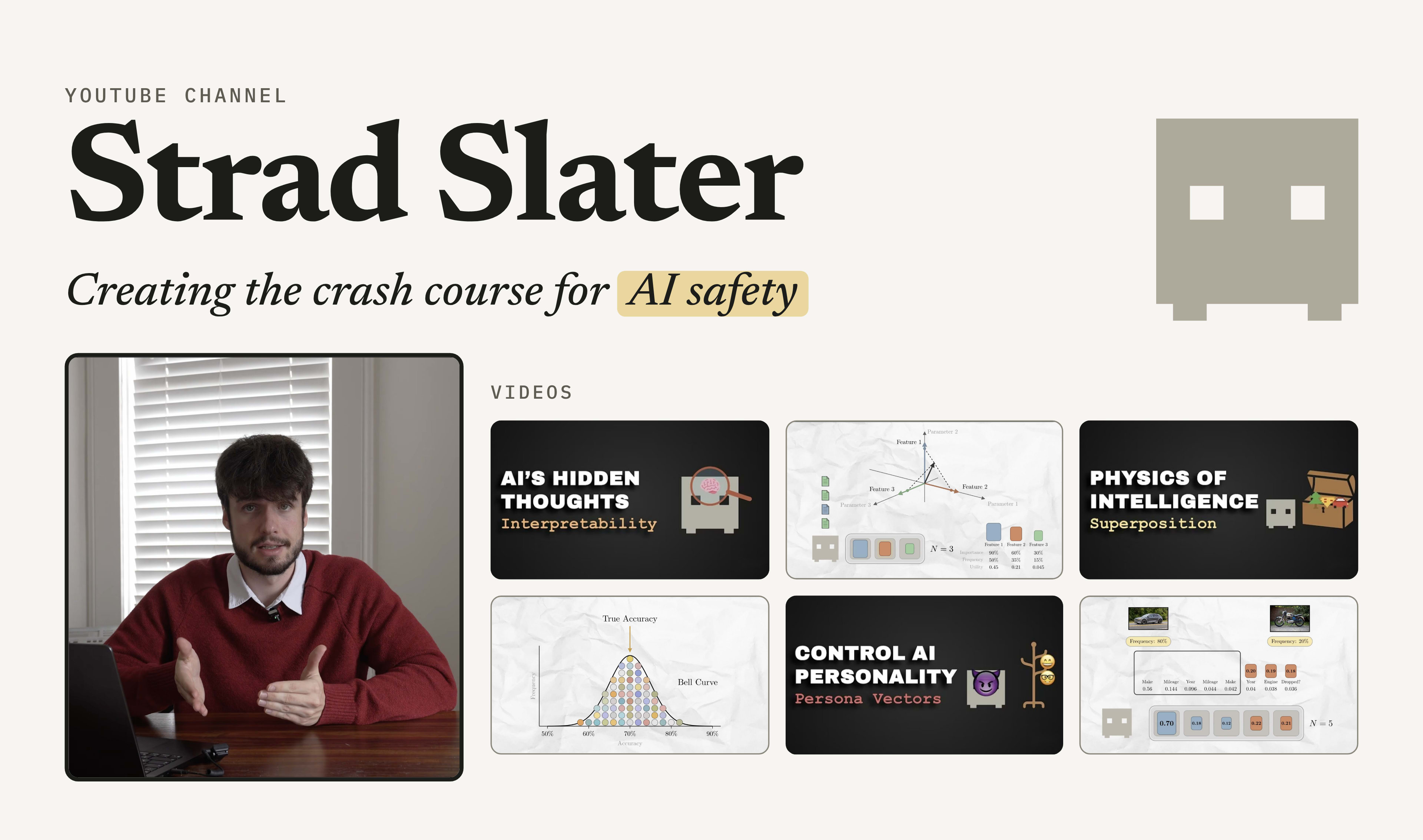
TLDR: Quit my job as a software engineer at Oracle to make Crash Course–style video courses on AI safety. Currently I have a YouTube channel (https://www.youtube.com/@stradslater) where I make long-form technical explainers on interpretability in the style of Crash Course and 3Blue1Brown. Now I want to make a 6-16 episode miniseries on each subfield in technical AI safety research to give newcomers a digestible introduction to each field. For context, I’m imagining my courses being used as an on-ramp to more technical studies such as ARENA’s course or directly reading research papers. I will start with a 16-episode course on interpretability (planning to launch beginning of January 2027, depending on funding) and I'm currently looking for any researchers in the field who could give feedback on my proposed curriculum for the course. If that’s you I would love to chat!
*The proposed syllabus is in the "Interpretability Course" section below
The Gap in AI Safety Education
Where's a good place to go if you want to learn World History? Easy. Crash Course World History with John Green. What about Chemistry? Khan Academy’s Chemistry Series. Linear algebra? 3Blue1Brown’s “Essence of Linear Algebra” series.
Now what if you want to learn about Interpretability? Well, here's how I learned.
- I started with this hour long podcast from Anthropic’s Interpretability team: http://youtube.com/watch?v=fGKNUvivvnc
- Then I found this video with Lex Fridman interviewing Chris Olah on the topic: https://www.youtube.com/watch?v=riniamTdUSo
- Then I read this overview from Neel Nanda: https://www.neelnanda.io/mechanistic-interpretability/glossary
- Then this essay on the need for interpretability by Dario Amodei: https://darioamodei.com/post/the-urgency-of-interpretability
- Then this paper on the platonic representation hypothesis: https://arxiv.org/abs/2405.07987
- And then another one on the linear representation hypothesis: https://arxiv.org/abs/2311.03658
- And a lot more papers:
You’ll notice that my learning path is quite chaotic and consists of various mediums with a broad range of technical depth. I couldn’t find one place that introduced all the fundamentals of interpretability, in depth and in order.
Creators like Rob Miles have made great one-off videos, but they’re short and high-level. Articles tend to be either quick overviews or scattered deep dives with no clear order, and they can’t show the full visual side of interpretability.
Neel Nanda’s video walkthroughs and the ARENA course are fantastic resources that I learned a lot from, but they’re designed for people ready to commit serious time to becoming researchers. They’re long, technical, and hands-on. They aren’t meant to be an accessible first introduction.
What I've Done So Far
Given this gap, I decided to try and make a loose series of articles documenting the fundamental topics in interpretability as I did my own learning. You can see some of the articles I made below:
- “Mechanistic Interpretability — Make AI Safe By Understanding Them”: https://medium.com/@stradslater/mechanistic-interpretability-make-ai-safe-by-understanding-them-15db469b86ff
- “The Hidden Problem Inside Every AI Model: Superposition”: https://medium.com/@stradslater/the-hidden-problem-inside-every-ai-model-superposition-cbe0251ecdfd
- “The Universality Hypothesis — Do All AI Models Think The Same?”: https://medium.com/@stradslater/the-universality-hypothesis-do-all-ai-models-think-the-same-0d8ea915d4b8
- “Inside the Linear Representation Hypothesis: How LLMs Turn Concepts Into Directions (Part 1)”: https://medium.com/@stradslater/inside-the-linear-representation-hypothesis-how-llms-turn-concepts-into-directions-part-1-5b93e4679ae2
- “The Causal Inner Product: How LLMs Turn Concepts Into Directions (Part 2)”: https://medium.com/@stradslater/the-causal-inner-product-how-llms-turn-concepts-into-directions-part-2-8b82b55c87ae
- “Sparse Autoencoders: The Tool That Helps Untangle the Brain of an LLM”: https://medium.com/@stradslater/sparse-autoencoders-the-tool-that-helps-untangle-the-brain-of-an-llm-b5d4d01ca6b6
- “Activation Patching: How We Test Causality Inside Language Models”: https://medium.com/@stradslater/activation-patching-how-we-test-causality-inside-language-models-eac042cb2d1a
- “A Mechanistic Explanation for Grokking in Neural Networks”: https://medium.com/@stradslater/a-mechanistic-explanation-for-grokking-in-neural-networks-64f51f3d90a2
It’s not perfect and the technical depth varies from article to article. I was writing as I learned so there was no top-down curriculum in my head at the time. But it was my first step toward making in-depth educational content on the fundamentals of the field.
Through this process, I found I really enjoyed learning about the field and making content about it. But I realized that writing is not the best medium for what I’m trying to do. Interpretability is a math-heavy field full of beautiful geometric ideas, and those are much easier to show than to describe. Plus, the 8th grade filmmaker in me was dying to come back.
So I decided to pivot from articles into video and started a YouTube channel. (https://www.youtube.com/@stradslater)
Shortly after starting, I decided to quit my software engineering job at Oracle to pursue the channel full-time. For the past 10 weeks I’ve been part of the Frame fellowship (An AI safety comms incubator, https://www.framefellowship.com/) in SF to continue working on and growing the channel.
I initially focused on interpretability only, in videos such as:
- “The AI That Knew It Was Being Tested” (Interpretability Overview): https://www.youtube.com/watch?v=W8lDAxidZWY
- “How AIs Cram Knowledge Into Their Heads” (Superposition): https://www.youtube.com/watch?v=GgjaGE5V8Cw&t=10s
- “Anthropic Built a Tool to Read What Claude Isn't Saying” (J-space): https://www.youtube.com/watch?v=s_0rSqMSzss&t=425s
- “AI Models Have an "Evil" Lever” (Persona Vectors): https://www.youtube.com/watch?v=stWouadL5mM
- “Do AIs Learn the Same Thing?” (The Universality Hypothesis): https://www.youtube.com/watch?v=tG3yqRsjHCE&t=434s
Then I realized that the lack of an introductory video series for interpretability is a broader problem with technical AI safety research as a whole. Other fields that are just as interesting and important, like AI control, evals and scalable oversight, don’t have an easy-to-follow introduction either.
With this in mind, I decided to loosely start a scalable oversight series in the same way I loosely made articles about interpretability. So far I've released two with a 3rd one filmed and on its way.
- “How Do You Test an AI That’s Smarter Than You?” (Sandwiching): https://www.youtube.com/watch?v=4A-Ic08g4q0&t=250s
- “Grading an AI Using Only Wrong Answers” (Partitioned Human Supervision): https://www.youtube.com/watch?v=XZv2GGbxpME&t=628s
- Third one on Iterated Amplification coming soon…
The idea is to have roughly 6-8 videos in this series, but that will be further solidified as I continue doing research. I also would like to redo this series to be more structured and follow a format similar to what I describe in the next section:
Mini Series on Technical AI Safety Research
I’m creating Crash Course-style courses for AI safety. As time goes on and as I do more research and talk to experts in these fields, the specifics of the following proposal will change, but as of now I would like to make courses on the following topics:
- The Alignment Problem
- ML Math Foundations
- Interpretability
- Evaluations
- Model Organisms of Misalignment
- Chain of Thought Monitorability
- AI Honesty
- Alignment Training Methods
- Scalable Oversight
- AI Control
- Adversarial Robustness
- Formal Verification of Safe AI
- Agent Safety
Each topic will get its own 6–16 episode series, designed to build on one another while still making sense on their own. Each series will be similar in style to Crash Course videos with me as the host (check out my most recent video for an idea of the aesthetic: https://www.youtube.com/watch?v=zNb86CJ6rjg&t=24s) and 3Blue1Brown-inspired animations to help visualize the math and technical details that come with these fields.
I’ll begin with interpretability because it’s where I have the most experience. Starting with what I know lets me focus on learning how to make a great series, so I’m better prepared for the topics where I’ll need to do more research. Each episode will cover one core idea in the field, in an order that lets a newcomer start from zero and build up step-by-step. Here is a preliminary syllabus of the course, which is subject to change before production starts after review from researchers:
Interpretability Course:
- Ep1. What is Interpretability and Why do we Need it? (grown not built, history from vision models)
- Ep2. Transformer Anatomy (residual stream, attention, MLPs, logit lens)
- Ep3. Features and Circuits (induction heads)
- Ep4. Linear Representation and Probing (OthelloGPT, truth directions)
- Ep5. Superposition and Polysemanticity
- Ep6. Sparse Autoencoders
- Ep7. AI Explaining AI (automated interpretability, activation oracles)
- Ep8. Activation Patching (testing causality)
- Ep9. Circuit Tracing (transcoders, attribution graphs)
- Ep10. Toy Models and How Circuits Form (grokking, modular arithmetic, training dynamics)
- Ep11. Steering (steering vectors, function vectors, refusal direction)
- Ep12. What Models Represent About Themselves and Us (emotions, personas)
- Ep13. Interpretability used in Safety (auditing hidden goals, deception probes, model diffing)
- Ep14. Open Questions: Universality and Nonlinear Features
- Ep15. Interpretability Limitations
- Ep16. Where are we at? Current Frontier (J-space, latest NLA results, manifold steering, weight-based interpretability, etc.)
These fields move fast, so alongside each course’s core syllabus, I’ll add bonus episodes whenever major new findings come out.
Theory of Change
I’m doing this in part because I think it will help the chances of AI going well. Here’s how.
AI safety has gained a lot of publicity recently with the Hugging Face Incident and Jacob Coxon’s resignation from Anthropic. With this increase in public awareness I believe there will be a growing demand for information about AI, how it works and how we can make it safe, from a more general audience.
A dedicated channel with structured series on each research area would serve as a one-stop public resource for people looking to understand how AI safety works.
This is a useful resource to have because of the following audiences:
- People who aren’t knowledgeable about AI but want an in-depth introduction to the ways researchers are trying to make it safe.
- Journalists and other content creators making content on AI and AI safety who want better technical context to make more accurate and informed content.
- Policymakers who need technical context on safety strategies, for example when deciding what standards companies must meet before deploying new models.
- STEM-interested high school and college students, and others who want to pivot into technical AI safety looking to find an in depth introduction to watch before diving into more hands-on resources such as ARENA.
These audiences shape how society handles AI whether that's through their votes, reporting, policies or research. The more accurately they understand AI safety, the better those outcomes will be.
Right now, people have to sift through technical papers, podcasts and scattered articles, as well as figure out on their own how it all connects, the way I did. Most people simply won’t do that. A structured video series removes that barrier, turning weeks of piecing things together into a clear path anyone can follow.
How you can help
Feedback: I try to learn from each video and iterate and improve my content quickly. So I welcome any feedback on any of my current videos or videos to come!
AI safety domain expertise: If you have any expertise in any of the subfields I plan to make courses on or AI safety in general, I would love to connect! As I build each course, I’ll be reaching out to researchers for advice on structuring the curriculum and for help checking my scripts for accuracy.
YouTubers/YouTube Strategy: If you make educational content, or have expertise in YouTube strategy, and have any advice on how to best market your courses, package videos, structure content, etc. I would love to connect! It would be nice to get insights on how to best grow and run an educational content channel.
Funding: I quit my job to work full time on this project, so I’m self funding after the Frame fellowship ends. Currently planning on applying to a few grants such as BlueDot Impact’s Career Transition Grant. If anyone else has any advice on funding or if you yourself would be interested in funding part of this project I’d love to connect!
Sharing: If you know someone who’d find these videos useful, like a student, a teacher, or someone curious about AI safety, sharing the channel helps a lot.
The best way to reach me is on the EA Forum or my email [email protected]