
The EA forum measures the level of AI usage in forum posts using the product Pangram. But how much does Pangram's "AI-Generated" label really indicate the degree to which an author has outsourced their thinking?
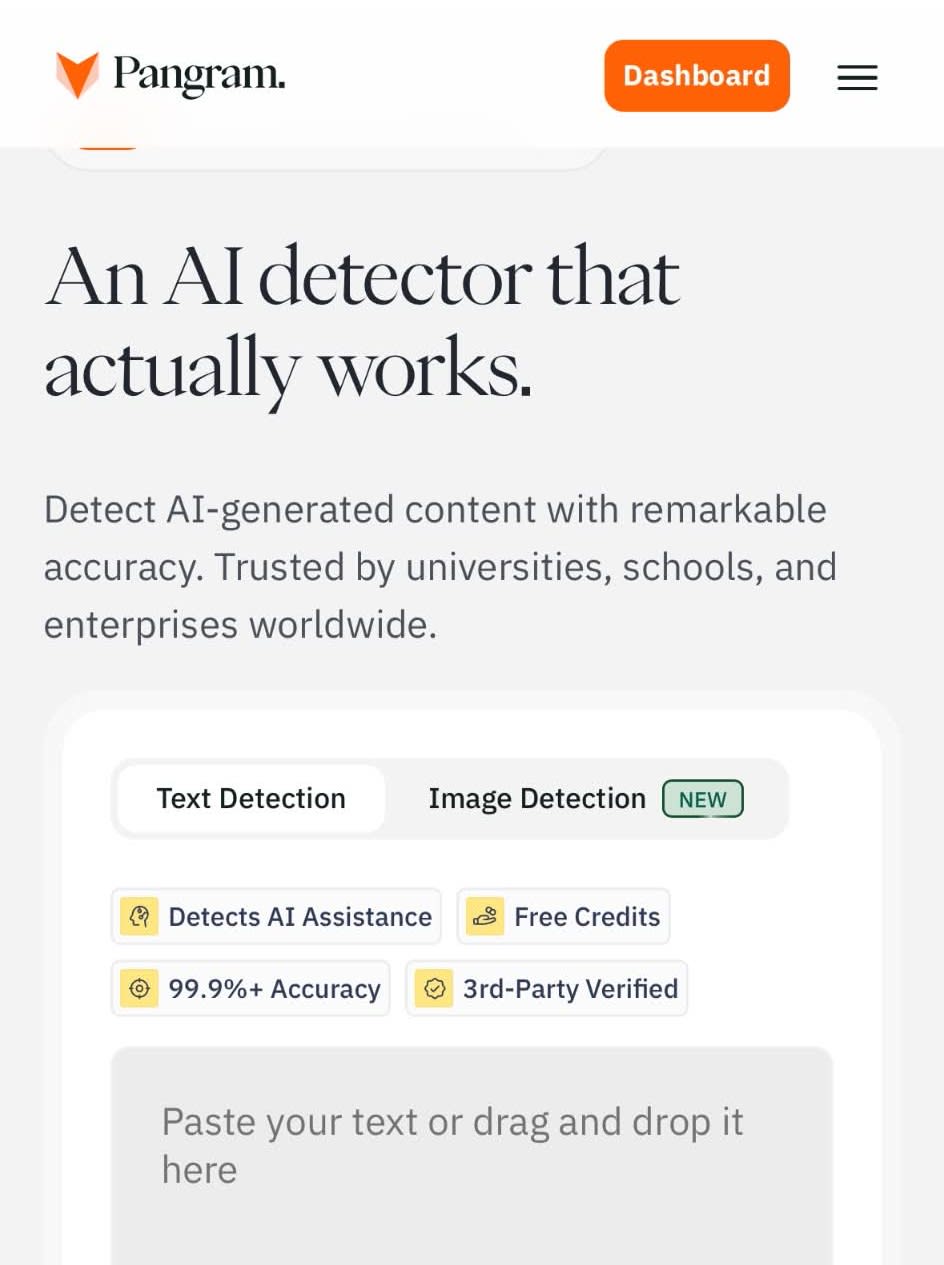
When they tested their 4.0 product, Pangram found that, by their definition, the proportion of AI-Assisted documents it classified as AI-Generated was 0.01%, 4%, or 7%, depending on the experiment. Then they omitted the experiments that found 4% and 7% false positive rates (FPRs) on their website outside their technical report, while advertising that the product detects AI-Assisted writing. Before I contacted them about this issue on September 17th, their claim on their website was more misleading—"99.9%+ Accuracy" was displayed directly adjacent to the phrase "Detects AI Assistance" on the text detection input box that many people don't read past.[1] Similar claims remain repeated elsewhere on the main page instead of by the text box itself. I do not know if my message was the cause of the change.
Their experiment that found the 0.01% FPR might be more appropriate for identifying human-written text rather than AI-Assisted writing. For example, the prompt they gave to Claude for this experiment was "Fix spelling, punctuation, and clear grammar errors only." In my experience, human editors normally provide conceptual feedback as well. Since we generally don't cite human editors, shouldn't the label AI-Assisted indicate more assistance from AI than would be provided by a human editor?
In my experience, our community also heavily relied on Pangram before their 4.0 release on July 29th. The previous version had FPRs for the AI-Assisted vs. AI-Generated labels for these experiments of 0.2%, 15%, and 22% respectively.
At least an order of magnitude is a big difference! But it may be much worse than that.
It’s likely that the false positives will be concentrated in the work of writers who write in a way that particularly confuses Pangram — the most elite writers not seeing false positives for their writing does not establish that their experience is typical. Sometimes I write in a style that Pangram defines as AI-Assisted writing in their experiments that found 4% and 7% FPRs. I spend so much time on these pieces that I am able to match almost every sentence to Pangram's definitions. They believe they can identify the AI involvement in every sentence, so every sentence gets an AI-Generated, AI-Assisted, or Human-Written label. I have run about 5,000 words of my writing that uses this process through Pangram 4.0, and it labels about 30% of this text AI-Generated, often with high confidence. Pangram claims to have much lower FPRs than false negative rates, so it is implied that this is an underestimate. The vast majority of my instances of false positives would not have been labeled false positives by Pangram’s paper—the 4% and 7% FPRs only counted instances where the entire excerpt was mislabeled AI-Generated. In general my excerpts are labeled Mixed. If my experience is common, the problem is much worse than a 4% or 7% FPR would indicate.
Sometimes I keep so much of the rewording from the LLM that reasonable people can disagree about whether that part is AI-Generated or AI-Assisted. However, these parts seem to be no more likely to be labeled AI-Generated than my distinct phrases or sentences that have zero AI input are. I have included a footnote with examples of these sentences with zero AI input that are objectively mislabeled. [2]
Pangram's definitions of AI-Assisted rely on more objective measures than the subjective task of comparing prompts. However, to give a sense of the writing style that so confuses the product, Claude's prompt for the experiment that found a 4% FPR was "Substantially rewrite for polished academic style while preserving meaning." My process is similar. First, I provide an LLM many thousands of words of my writing and ask it to emulate my style in its suggestions. After I've produced writing I would have called finished a year ago, I give an LLM a prompt like "Please make the wording of the blander parts of this excerpt more poetic and visceral, to match the parts of it that are most in that style. Do not remove core concepts or add additional ones." After receiving a draft produced by such a prompt, I spend roughly six more hours per 1,000 words editing it. Overall, I reject the vast majority of suggestions the LLM gives me. I have included a footnote with a representative example of my process. [3]
I believe the AI-Assisted label describes my process well. I incorporate the LLMs’ input more often than I do with human editors, so—especially given that they could be sentient soon—I want to list them as co-authors. But many people besides me think there is a large difference between this writing and having an LLM entirely generate a piece on its own from a brief prompt. I have never met someone in our community who values a product that can distinguish between the two and was previously aware of how often Pangram struggles with this task. Some people do not value a product that can distinguish between the two, and only care about whether any AI input was used. That debate is beyond the scope of this post.
Like others, I have noticed that when I run my work by Pangram in chunks of a few hundred words instead of the whole piece, the FPR increases dramatically despite the writing being identical. Pangram acknowledges that its results are more uncertain for shorter passages. We should remember that Pangram's headline accuracy figures are unlikely to apply to the X posts and emails many of us are now using the product for.
Because of my high FPRs with Pangram, I only use AI editing in the way Pangram defines as AI-Assisted in fiction. It is better than having my more important work dismissed as “AI slop”. Because I come from a relatively disadvantaged background for our community, this makes it hard for me to compete with writers who have enough education to not require as much editing assistance. I am particularly concerned about how overreliance on Pangram might affect people like a friend of mine. He is a brilliant scientist whose native language isn't English. He once relied on me to help him sound fluent in his papers. I never had enough time for him, and he was overjoyed when AI editing could finally give him the English help he needed. He needed to use AI editing in the way that Pangram found 4% and 7% FPRs for. Indeed, one of the prompts Pangram used in the experiment that found a 4% FPR was "Sound fluent." Overreliance on Pangram could be depriving us of the insights of people like him, as well as native English speakers who are simply too busy doing interesting research to waste time specializing in writing instead.
If AI editing typically made human writing worse, these points would be weak. However, in my experience, AI editing is very good now. I've experimented with almost every new Claude and ChatGPT update, and in 2026 their wording suggestions have gone from almost useless to usually better than the best I can produce. AI-assisted work frequently pops up on bestseller lists now. I invite people basing their opinions of the quality of AI assisted writing on examples from prior to the last six months to experiment with Fable and Astra and notice the difference for themselves.
Many people find Pangram’s results plausible because they believe they can notice whether something is AI-generated themselves as well, using AI writing tells. But this is a difficult task with such rapidly changing models, and many people who dislike AI editing tells describe a visceral feeling of stress when they see them. This is automation of a skill many of us have put a lot of love into developing—it is reasonable to feel some discomfort. But basing decisions on something as subjective as noticing AI tells while experiencing such stress seems likely to be error-prone. Someone posted a real Monet painting with the claim that it was AI and asked for an explanation of why it was inferior to the real thing. People responded with a flood of scathing critiques. Why wouldn’t a similar cognitive bias be happening with writing? Perhaps Pangram gives people who would normally be more careful a reason to abstain from deeper reflection.
I actually think Pangram is a very impressive product. I've looked at about a dozen papers evaluating them, and believe their paper was perhaps the best. For example, they did an unusually good job of producing an AI-Assisted sample that is similar to how AI editing is really used. They are attempting a very difficult technical problem and doing it well. But I think being aware of the limitations of the product would be helpful when we evaluate the degree to which writers have outsourced their thinking, and which writers to trust.
- ^
Pangram's text box prior to September 17th. The 99.9%+ accuracy claim has since been removed from the text box itself, but similar claims remain repeated prominently elsewhere on the main page.
- ^
Examples of my sentences that have zero AI input that Pangram labels 100% AI-Generated when part of their whole piece:
"It had not been enough."
"It is a celebration of some of the most essential things that make me who I am."
"But this was no speech in front of Baghdad’s greatest scholars or the courage it had taken in her youth to carve out a name for herself among men."
"Not the brilliant woman he once respected."
"This is what I am now. This is what they made me."
"Something new had entered the world, and he could feel it."
"He was the god of the people with the gleaming spears. But he had grown weary of blind worship."
"We entered the pool and emerged changed, touched by the divine in a way we would indeed carry for all eternity."
- ^
The following is an example of my writing process that resulted in a passage that Pangram 4.0 called 100% AI-generated, part of a 3,000 word submission that was overall labeled Mixed. For context, all changes in meaning from the original draft are references to other parts of the piece. I selected the first passage Pangram flagged to avoid accidentally providing a biased sample. My editor warned me that the phrase I kept from Claude would be misunderstood by many people. However, I kept it because it was a particularly perceptive emulation of my writing style and reference to the themes of the book, and I originally didn’t plan to share my work publicly.
Pre-AI draft: Erhan’s spies told him this was where Nasreen was now working, and he climbed the steps to her office hoping to find some documents left behind in a hurried evacuation. If his scholars could decipher some of her work, perhaps it could keep famine away for a while.
Claude's draft: Erhan’s spies said this was where Nasreen worked now, and he climbed the stairs to her office with a thief’s hope in his throat: papers left behind, a ledger, a packet of notes—anything his scholars could worry into meaning before winter made a mouth of the countryside.
My final Draft: Erhan’s spies had told him this was where Nasreen was now working, and he climbed the steps to her office with a kind of hope that felt like thirst: for papers left behind, a ledger, a jar of precious seeds—anything his scholars could worry into meaning before another harsh winter came to collect what war had spared.
Thanks I think your overall point
My problem is that AI editing still brings about a regression to the mean, and still means we lose some of the human's voice. I agree it could make writing technically "better" in one sense, but that's not my problem with AI writing. Whether AI makes writing better or not isn't important to me when it comes to this question of pre-labelling writing. My problem is that voice-authenticity and writing diversity is lost when AI is involved.
IMO AI makes writing sound more sam-ey and for me at least less interesting. Others might be more excited to read AI edited/written work. That's great!
I'm OK with AI detectors overcalling it somewhat, if someone actually is using a lot of AI in the editing process. This doesn't mean they have done anything "wrong", its just tells me in advance that AI is heavily involved
If someone is using AI in the writing process, that's fine it's no sin. I just think everyone should be able to know and then we can choose in advance how or whether we should read it. Pangram has been a game-changer and I appreciate it a lot!