
TL;DR
- We recently set out RP’s strategic priorities and the three new bets we’re making in 2027.
- In this post, we outline what we need to make them happen.
- We need more support from individual donors, this year in particular.
- We’ve redirected roughly three-quarters of our 2026 unrestricted funding toward our new bets, and we no longer seek funding from EA-institutional grantmakers that may receive donations through our Cross-Cause Fund (to prevent any conflicts of interest).
- Much of our work is also in frontier areas that institutional funders often can’t or won’t fund because of factors like scope limitations or risk aversion.
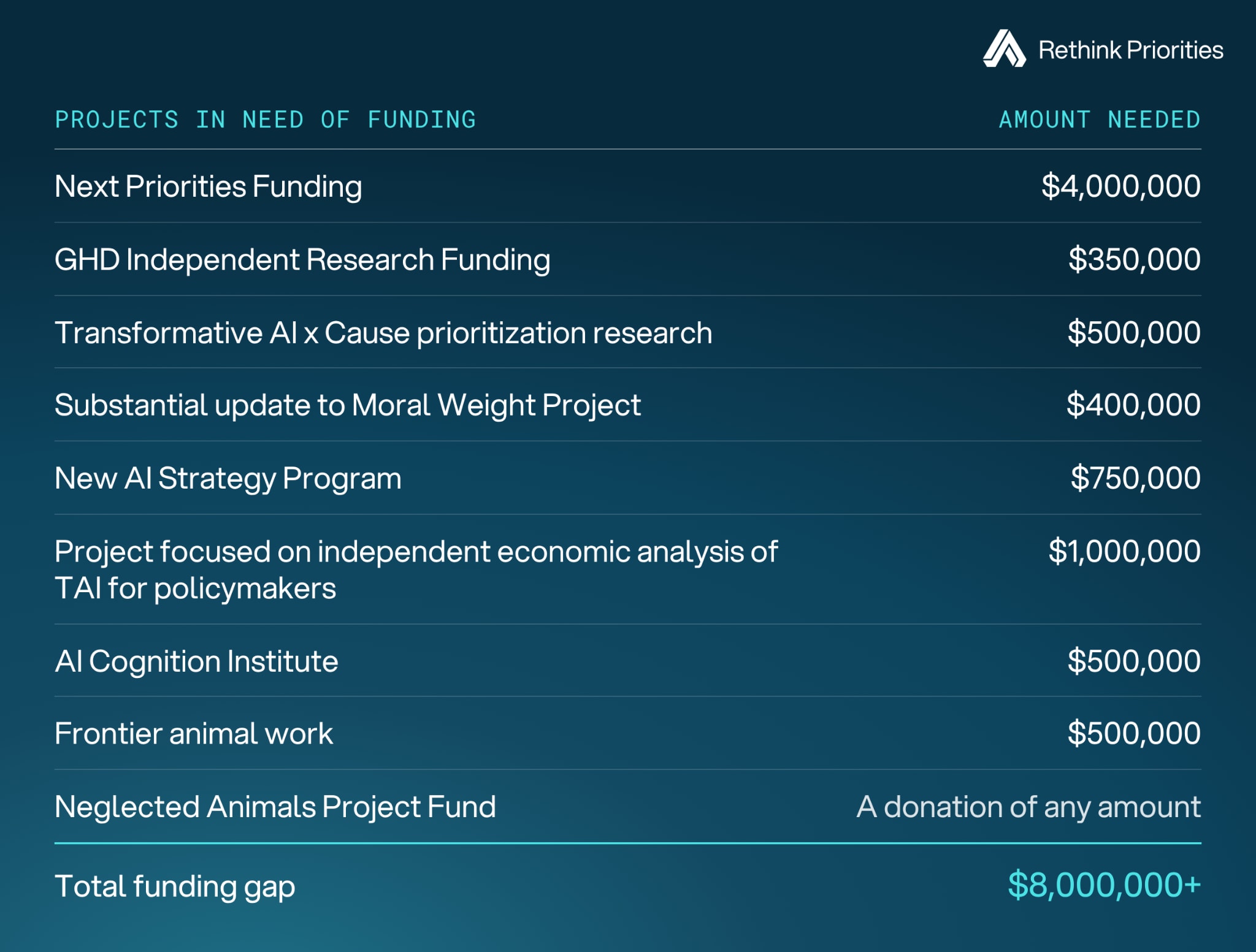
- Two funding gaps are our highest priority, because they are very hard to fund through grants and so offer the best counterfactual value for your donation:
- Next Priorities Funding ($4M): Unrestricted funding to uncover the next high-impact areas and interventions across causes, to move quickly on the most promising bets and to continue our work on the cross-cause model.
- GHD Independent Research Funding ($350,000): Our most underfunded area: identifying strategic gaps and highly cost-effective interventions in global health.
- Other key opportunities in need of support include: research on how transformative AI changes cause prioritization, a substantial update to the Moral Weight Project, our new AI Strategy Program and its project on the economics of transformative AI, the AI Cognition Institute, and our frontier animal work and Neglected Animals Project Fund.
- We need more support from individual donors, this year in particular.
You can donate here for unrestricted funding (highly encouraged). To donate to a concrete project, you can follow relevant links in the sections below. If you have questions, contact our development team or visit our donate page.
RP progress
Since its founding, Rethink Priorities (RP) has helped redirect millions of dollars in grants to more cost-effective global health options, produced welfare range estimates for animals that foundations and governments have begun using in their decision-making, coordinated ~$1.9 million from 14 funders for farmed animal welfare work across 16 EU countries, and brought farmed shrimp welfare to the attention of advocates and funders, inspiring the first organization dedicated solely to it. In 2026, RP advanced research on digital consciousness, AI in global health, and wild animal welfare. We also took a strategic lead in neglected animal welfare, launched the Cross-Cause Fund, helped 14 promising projects grow, and more.
Read about our key achievements this past year.
Our plans
2027 will likely continue to bring rapid advances in AI capabilities, creating both significant risks and major shifts across the areas EAs often care about. At the same time, more money entering the philanthropic space presents an exceptional opportunity to redirect resources and emerging initiatives to where they can do the most good.
Adapting too slowly to these circumstances may squander the EA movement’s chance for unprecedented impact.
In response, we plan to grow our core GHD, Animal Welfare, and Worldview Investigations teams to take on emerging priorities across causes. We’re also making 3 new strategic bets that we think will close crucial gaps in the EA ecosystem and help impact-focused philanthropists do more good than they otherwise would:
- Scaling the Cross-Cause Fund to $50M+ in donations, so the new philanthropic capital is allocated across causes through explicit, research-based modeling to maximize impact.
- Launching an AI Strategy Program dedicated to identifying and acting on high-leverage, neglected strategies for navigating transformative AI (TAI).
- Growing our Special Projects program to onboard 10 new initiatives a year, so promising initiatives and organizations can launch faster.
Read more about our 2027 strategy.
We’ve made deliberate trade-offs to move these goals forward; now we need your support
RP always needs more support from individual donors. To this day, we have had the privilege of counting on the recurring support of a number of large, institutional funders. This kind of support can also be a structural limitation: our activities hinge on the financial health and strategic priorities of a handful of institutions. In addition, the bulk of our work is in neglected, frontier areas, where our goals often go beyond what institutional funders can or want to support.
This year, that need has become only more pressing. As laid out in our previous post, RP is building essential cause-prioritization infrastructure that the EA movement and broader charitable ecosystem urgently need to address the huge opportunities and challenges ahead.
- We’ve redirected resources internally toward our new strategic bets for 2027, spending approximately three-quarters of our 2026 unrestricted funding on these new opportunities and putting our Surveys and Data Analysis services on the back burner to free up staff time for these projects. The new programs we’ve launched are not self-sustaining: for example, we charge no management or usage fees for users of the Cross-Cause Fund and Donor Compass, which means we’re entirely dependent on other donors to maintain and improve these tools.
- In accordance with our conflict of interest policy, we’ve also forgone seeking or receiving funding from all institutional grantmakers that may receive funds donated to our Cross-Cause Fund (including, but not limited to, The EA Animal Welfare Fund; The Navigation Fund’s Animal Welfare Fund; Longview Philanthropy's AI Fund).
We’ve made these choices because we believe in the strategic bets we're making, and we want to give each of them the best chance of success we can. We've also taken steps to manage conflicts of interest because we believe they should be addressed responsibly and transparently.
This has left us with several funding gaps, both in our existing programmatic work and in our ability to further develop the new bets we’ve just launched.
Our highest-priority funding gaps in 2027
Two areas need the most support this year:
- Much-needed priorities research for decision-making across causes through our Next Priorities Funding pool.
- Independent Global Health and Development research, through our dedicated funding pool – our most underfunded area.
Both are very hard to fund through grants, because grantmakers typically fund specific research programs rather than exploratory research. These projects will depend heavily on support from individual donors like you this year, so we think they offer especially high counterfactual value for your donation.
We are convinced some of the best interventions and approaches are yet to be uncovered. That’s why, with your help, we want to do bold research on what EA’s next priorities should be.
Next Priorities Funding
- The gap: $4M of unrestricted funding to uncover the next high-impact areas or interventions, fast-track the most promising bets, and continue our cross-cause work.
- The challenge: Few funders back research into new and cross-cause questions that nobody has looked into yet, which is where some of the greatest impact may lie. In a fast-shifting environment, one-off grants for narrow investigations may not keep up with the impact opportunities a broader approach can offer.
- RP's plans: With Next Priorities Funding, RP can play its role as a bold priority-setter. We can take on complex, new and cross-cause topics where we suspect the greatest potential for impact lies, and move quickly when a promising bet emerges.
- Why RP: RP has a track record of turning flexible, unrestricted funding into field-shaping work, including the Moral Weight Project and the Digital Consciousness Model.
- Counterfactual value: You enable big bets that benefit entire fields to take off fast, rather than waiting for a funder to commission them.
Donate to Next Priorities Funding
GHD Independent Research Funding
- The gap: $350,000, equivalent to ~20% of the team’s time directed to independent research
- The challenge: A lot of funding is expected to flow into global health and development, but there’s a risk that after saturating the most high-impact options, it will start moving to relatively lower-impact opportunities. We want to serve as a trusted, independent voice to uncover neglected areas in need of funding, and highlight existing interventions best positioned to absorb significant funds for maximum impact.
- RP's plans: We already have an established list of priority areas and have started research in some of them, such as:
- Identifying cost-effective opportunities at the intersection of traditional philanthropy and third-wave funds
- Exploring how benchmarking affects model, product, user, and impact evaluations of AI tools deployed in global health and development (AI for Health, AI for Climate)
- Tackling the growing burden of fungal diseases (global disease burden estimates)
- Health Systems Strengthening
- Why RP: Our comparative advantage is exposure to a wide range of GHD areas, and a team with diverse expertise spanning economics, epidemiology, and climate. We can spot gaps across whole fields as well as between interventions.
- Counterfactual value: RP’s GHD department has historically relied on commissioned work to cover its budget, and our independent research in this area has been relatively underfunded compared to other cause areas. With more support, we can leverage our network and expertise to advance neglected, cost-effective interventions in this space.
Donate to the GHD Independent Research Funding
Other key opportunities in need of (additional) support
Your donation to these projects will help us build crucial additional capacity for teams faster than grants alone would allow.
Note: The AI Strategy team will have a more detailed post on their strategy and their big bet idea later this week.
Transformative AI x Cause prioritization research
- The gap: $500,000 to answer how transformative AI will change cause prioritization
- The challenge: Transformative AI could reshape which causes matter most, how much they matter, and how soon. Yet these effects are barely understood, right as a new wave of philanthropy needs guidance on where to give.
- RP's plans: Research how AI futures change the case for different causes, including economics, climate, and well-being effects, for example. We will use the findings in the model behind RP’s Cross-Cause Fund (CCF).
- Why RP: RP and its Worldview Investigations Team (WIT) have a strong track record in this area. For example, the Moral Weight Project is used by several organizations, AI labs have looked at the Digital Consciousness Model, and the Cross-Cause Fund is likely the most rigorous tool for giving across causes. WIT has also newly recruited world-leading experts on these questions.
Counterfactual value: Few or no other groups do this type of work, and cause-specific grantmakers rarely fund it, so individual donors play an outsized role.
Donate to cause prioritization work
Producing a substantial update to the Moral Weight Project
- The gap: $400,000 to bring on more expertise to deliver rigorous, updated animal moral weights
- The challenge: Funders working in animal (or AI) welfare need to know how to compare the welfare of different beings. The first version of the Moral Weight Project (conducted by RP between 2020 and 2022) provided the best estimates to date, but it rests on a single theory of welfare and covers a limited set of species. Several major animal grantmakers and organizations use this work and would benefit from updated and less theory-dependent figures.
- RP's plans: First, we will map the range of approaches to estimating moral weights far more systematically and produce improved welfare estimates for 10 species from pigs to nematodes. We will also cover non-hedonist and theory-neutral approaches (e.g., ones that go beyond neuron counts). Second, we will develop methods for aggregating across theories, extend them to AI systems, and provide guidance on responsible use. The results will consist of robust, decision-relevant moral weights, showing which conclusions hold across approaches and which depend on assumptions.
- Why RP: The first version of the Moral Weight Project is the most extensive attempt to estimate animal welfare ranges and is used by several organizations. The second version will build on existing work and in-house tools that have been developed since (Moral Parliament Tool, Digital Consciousness Model).
- Counterfactual value: To our knowledge, no other group produces comparable moral weight estimates, so this work likely won’t happen without dedicated funding.
Donate to MWP
Please add a note “for the new Moral Weight Project” when you donate.
New AI Strategy Program: Building an all-in-one transformative AI strategy hub with advisory, fiscal sponsorship, incubation, and acceleration
- The gap: $750,000 toward helping the field spot neglected strategies for navigating transformative AI (TAI) and turn them into thriving projects and organizations
- The challenge: The AI safety field lacks landscape-wide, regularly updated strategy research that any organization can use. In particular, new organizations in the field get too little strategic and operational support, and very little is currently available to help them scale.
- RP's plans: We will take a two-pronged approach to fill these gaps: First, we’ll research and regularly update neglected, high-leverage strategies, and share them openly through a graphical strategy explorer. And second, we’ll expand incubation and acceleration, provide strategy advising, and launch new projects such as the project on the economics of TAI described below.
- Why RP: Our Special Projects program has helped deploy $30M+ across 20+ projects, including Epoch AI, the Institute for AI Policy and Strategy (IAPS), and Apollo Research.
- Counterfactual value: We’re not aware of anyone else who offers field-wide, continuously updated, openly shared strategy research; no other AI safety fiscal sponsor or incubator offers strategy advising, and none combines fiscal sponsorship, incubation, and acceleration.
Launching a project focused on independent economic analysis of TAI for policymakers
- The gap: $250,000–$1,000,000 to launch a new project giving policymakers fast, independent economic analysis of TAI
- $250K funds our first trial projects and core hires through mid-2027.
- An additional $250K would fund a small policy desk for the full year.
- An additional $250K–$500K, depending on funder interest, would also allow us to build up our measurement, deeper research, or field-building capability, as well as secure first-class senior advisors to help shape the project’s direction.
- The challenge: Policymakers often make intrinsically economic decisions about TAI (such as how fast frontier AI should advance) without rigorous, nonpartisan economic analysis. Economics could also do much more research to help us understand how to reduce catastrophic AI risk, but this research is still in its early stages. Similar work, but for law and AI, has a dedicated institute (LawAI) focused on legal analysis for AI policy and broader fieldbuilding. Several academic centers research the economics of AI, but none seem to combine policy analysis with deeper research capability and a deliberate program to bring economists into work on TAI and its risks.
- RP's plans: We will start as an independent desk producing fast, decision-ready analysis for policymakers. Our first study, on the economics of pacing frontier AI, will be published in the next month or two. With more funding, we’ll move into deeper economic research on reducing AI risk, measuring impacts of AI, extending our work to more jurisdictions, and broader fieldbuilding.
- Why RP: This project came out of our landscape scan of around 170 strategies for navigating transformative AI. We build on RP’s track record of accelerating organizations such as IAPS, Epoch AI, and Apollo Research.
- Counterfactual value: Your donation will let us run this trial project sooner, so we can test the hypotheses its theory of change rests on faster and have greater impact at a critical time in the technology’s trajectory. Institutional funders usually want to see results from trials like these before committing larger sums.
Donate to economic analysis of TAI
AI Cognition Institute (AICI): Additional research on assessing cognitive capabilities of advanced AI systems
- The gap: $500,000 to scale our rigorous empirical research on digital consciousness and the foundations of AI cognition
- ~$400K for staff salaries; ~$100K for stakeholder engagement, including conferences, events, and mentoring
- The challenge: AI consciousness and welfare research is pre-paradigmatic, with no shared framework for weighing the evidence. Few groups combine philosophical depth and empirical methods, inform key AI companies, and meet demand for this type of research, which is outpacing capacity.
- RP's plans: We plan to produce an updated and shovel-ready Digital Consciousness Model (DCM) tool for AI companies in 2027, DCM forecasts of when future systems may cross precautionary thresholds, and an extension of the Moral Weight Project covering AI. We also plan to do direct mechanistic interpretability research on AI cognition and forecast the possible numbers of future digital minds. We want to develop a credible model of expert consensus for AI consciousness and welfare, and help to build a stronger talent pipeline.
- Why RP: Our AICI team has active collaborations with several AI companies to utilize the DCM to evaluate model consciousness (including Google DeepMind), as well as Cambridge Digital Minds, PRISM, and the Center for Mind, Ethics, and Policy at NYU. We also have a strong candidate pool: in our last hiring round, seven applicants met our bar and we could only hire two.
- Counterfactual value: Researchers and decision-makers seek answers in this space, but AI companies have said they won’t do this work in-house any time soon. We have funds to cover our baseline growth, but flexible funds will let AICI hire and execute more ambitious projects sooner.
Donate to AI Cognition Institute
Scaling our frontier animal work
- The gap: $500,000 to help fill key knowledge gaps and scale frontier animal projects across species, new fields, and talent programs
- The challenge: Some of the biggest opportunities to help animals are in areas the animal welfare efforts have barely reached. Farmed insects, shrimp and fish, as well as wild animals make up the vast majority of animals affected by human activity, but the evidence needed to improve their welfare is largely nonexistent. Basic questions on interventions remain open, such as how to make electrical stunning reliably effective for farmed fish, or how to proceed responsibly in new fields like breeding for welfare. Without answers, advocates risk scaling interventions that don’t work, or missing those that would. These fields also lack skilled professionals and proven interventions, especially in neglected regions, and few other programs build capacity specifically for them.
- RP's plans: Our 2027 research will aim to close key knowledge gaps and identify new opportunities, and our strategic guidance and coordination will help emerging areas start on solid ground and direct funding to resolving key bottlenecks. We will formally launch a Talent Program (successfully trialed in 2026) and kickstart a new Founders Program to bring skilled people and new projects into the areas of greatest need.
- Why RP: Our frontier animal work builds on our track record of getting to areas like these early: we made significant progress on invertebrate welfare, launched and supported new organizations, and today play a coordination role in European fish welfare.
- Counterfactual value: We already have institutional support for our core program, so additional donations would let us expand and accelerate this work, such as by supporting 2–3 more founders or talent associates, or resolving key welfare science questions more quickly. Our Cross-Cause Fund conflict-of-interest policy prevents us from seeking support for this work from two major animal welfare funders.
Donate to frontier animal work
Please add a note “for frontier animal work” when you donate.
Neglected Animals Project Fund
- A donation of any amount to enable early-stage, time-sensitive work and regranting for farmed insects and shrimp, and wild animals in 2027
- The challenge: Some of the most counterfactually valuable opportunities for insects, shrimp, and wild animals are small, time-sensitive, early-stage projects that only happen when experts actively seek them out.
- RP’s plans: RP Neglected Animals Project (NAP) Fund will support early, time-sensitive interventions in underexplored areas of animal advocacy to build welfare capacity and set precedents before harmful industry norms become entrenched. The work will include our own research and stakeholder coordination supporting new interventions and impact-focused organizations, as well as regranting, with most donations going to organizations and individuals starting or scaling welfare work in new industries and regions.
- Why RP: Our neglected animals research expertise and close engagement with advocates help us identify promising opportunities and test their tractability before funding them. So far, the NAP Fund has helped us respond quickly to policy research needs, contribute to shaping a country’s national welfare guidelines for a commonly farmed and neglected species, and support the launch of new welfare work in several neglected, high-production regions. We can share more detail on the fund’s impact and plans with interested donors. Please get in touch at [email protected].
- Counterfactual value: As major funders shift toward grants of $500K or more, these projects are increasingly likely to go unfunded or never start at all. Our Cross-Cause Fund conflict-of-interest policy also prevents us from seeking support for this work from two major animal welfare funders.
Donate to Neglected Animals Project Fund
Please add a note “for Neglected Animals Project Fund” when you donate.
How to give
Make your gift through the links listed in the sections above or go to our donation page for more options. We also encourage unrestricted donations directly to our Next Priorities Funding:
DONATE NOWDonations to Rethink Priorities are tax-deductible in the United States and the United Kingdom.
Under certain conditions, donations can also be tax-deductible in Canada, Germany, Switzerland, and the Netherlands. We also offer tailored support to determine tax-deductibility options in other countries. Contact us at [email protected], and we’ll advise you on your particular circumstances to maximize the impact of your donation.
Other ways to give
Donate through a DAF, donate stock through Every.org, or choose cryptocurrency.
Get more information
If you have any questions, do not hesitate to reach out to our development team for more tailored support:
- Whitney Childs - Global Health and Development
- Hannah Tookey - Animal Welfare
- Janique Behman - All other areas
- Kieran Greig - Wider organizational strategy and plans
- [email protected] - For general inquiries, technical questions, etc.
More ways you can help
We’re always looking for feedback on our work, as well as for new partners and potential hires. You can help us by:
- Asking questions and raising disagreements about our work
- Sharing our work and job opportunities with others
- Making introductions to potential partners (for which you may email [email protected])
Thank you!
Thank you for considering a donation to Rethink Priorities!
Your gift allows us to remain independent and to pursue the opportunities where we can have the greatest counterfactual impact.
Acknowledgements
Thank you to Hannah Tookey, Whitney Childs, and Janique Behman for preparing and writing content for this post; Elisa Autric for writing; Ula Zarosa, Jonathan Nelson, and Janique Behman for feedback; and Shane Coburn and Ula Zarosa for editing.