
Pseudo-Philosophy vs Arguments, Reasons, and Evidence (And an Invitation to Debate)
If you enjoy my newsletter and want to support it please consider a paid subscription. All proceeds will go to effective animal welfare charities. Thanks for reading!
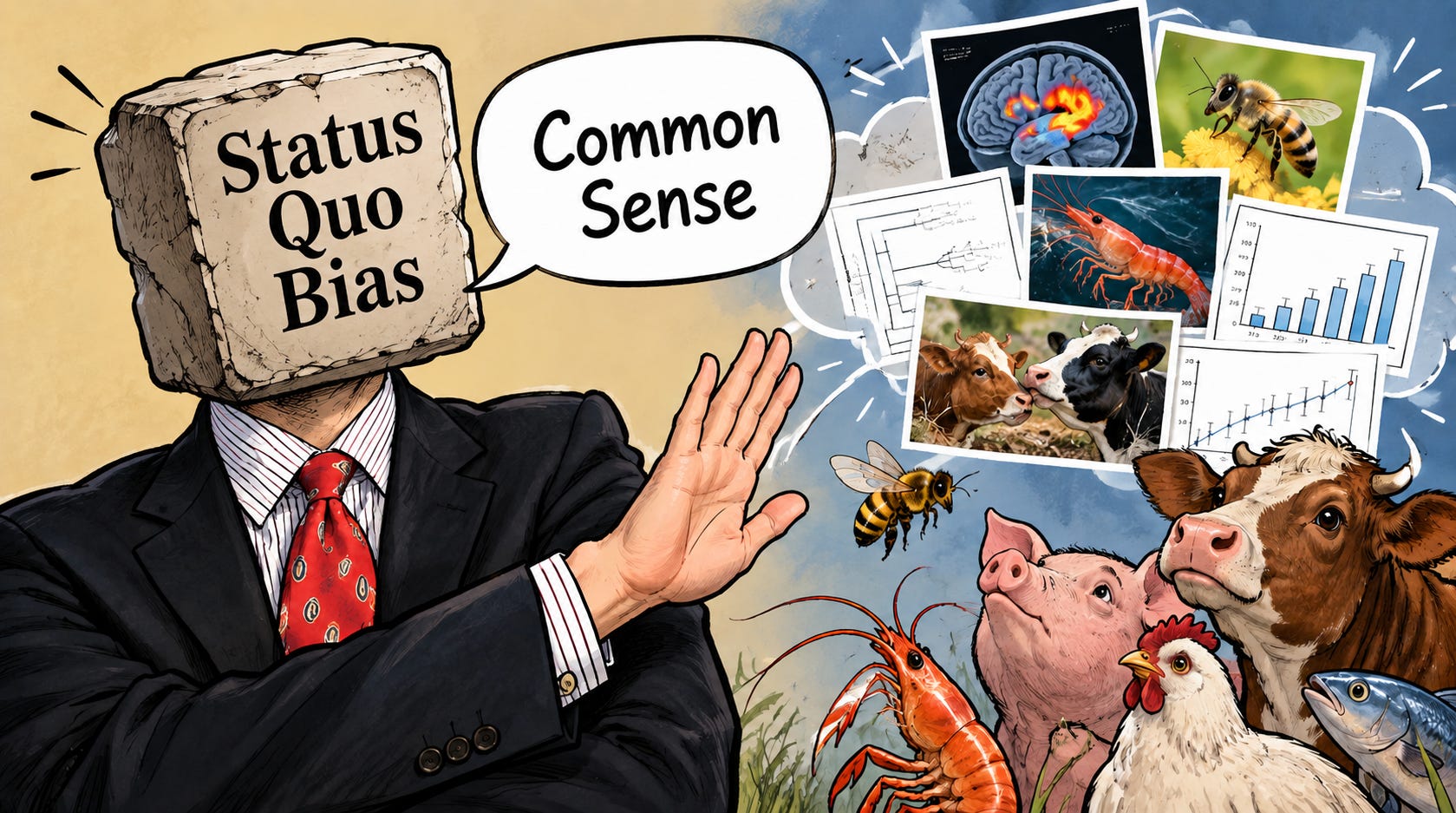
What to make of ‘common sense’ objections to effective altruism?
The economist Bryan Caplan has weighed in yesterday with his own assessment of the effective altruism movement, which has recently received a lot of hostile comments on social media platforms, especially X, where it has suddenly become the favourite target of conservative activitists.
In his essay titled EA: The Good, the Bad, and the Buggy Caplan begins by praising EAs for being “some of the most cheerful, friendly, curious, and smart people you will ever meet” and for their impact in making the world a better place through philanthropy. But then he goes on to offer his criticism:
But despite their high IQs and winning personalities, EAs are sadly short on common sense. Like other humans, they’re prone to groupthink and paranoia. As a result, many have basically lost interest in philanthropy that demonstrably saves many human lives at low cost, and started obsessing about AI risk. […] AI is such a promising technology that EA-inspired efforts to curtail it are likely to outweigh all of the good that EAs achieved back when they sensibly focused on deworming, anti-malaria, and Give Directly. That’s very sad, showing that without common sense, even high-IQ good intentions still pave the path to bad outcomes.
As I’ve argued in my recent essay, this common perception that EAs have abandoned everything but AI risk is simply false. In 2026, only 30% of their funding went to existential risks, which is not exclusively concerned with risks due to AI.

Why is the Department of War Against Effective Altruism?
Caplan might think that many EAs are too confident in their assessments of these risks. I wouldn’t even object to that. I am happy to acknowledge high uncertainty. But he does the opposite, expressing high certainty that such risks don’t exist. But it’s absurd to think we can make these risk assessments from the comfort of our armchairs without actually knowing much about the arguments and evidence, especially when actual people in the development of AI, with relevant expertise have raised those same concerns. This is not some weird fear only EAs have. About 9% of the general population in the UK think AI might doom us all.
Yet, as we shall soon learn, making overconfident judgements about ethics is pretty much Caplan’s philosophical methodology.
For his main target is the focus of EAs on animal welfare. So as to avoid the charge that I am misrepresenting him, let me offer his argument in full:
But EAs have another set of views which, if taken seriously, wouldn’t merely strangle progress, but make humanity massively worse off: their extreme moral commitment to animal welfare.
Ten years ago, I wrote a reductio ad absurdum of the pro-animal welfare position. If all animals morally matter, what about bugs? At the time, the main response was, “Bugs don’t feel pain.” A decade later, however, plenty of EAs are just embracing the reductio, often with further bizarre epicycles. Unlike their AI doom crusade, however, I’m not even slightly worried about the real-world harm of this failure of common sense. Meat and dairy will remain legal, and bug (and shrimp!) welfare will remain fringe topics of idle intellectual curiosity. While fanatical commitment to bug welfare could easily rationalize all kinds of totalitarian horrors, even the loudest champions of this absurd position take it with a grain of salt.
What is extreme about EAs opposition to factory farms and the suffering of animals more generally? Caplan insists that it is “extreme.” Caring about bees, who more and more researchers think are sentient, and shrimps, who the UK government officially declared as sentient, is too outlandish for him. Now, one should immediately worry that none of this is really an argument. How does Caplan respond to that charge?
Let me end by responding to all the EAs who object, “You don’t have an argument, Bryan. Not on AI. Not an bugs.” Because I really do love you guys.
First, the point of an argument is to reason from highly obvious premises to not-so-obvious conclusions. But if your conclusion is extremely non-obvious, then its denial is correspondingly extremely obvious. “If A, therefore B” only works if “Not-B, therefore not-A” isn’t more plausible.
Second, how do you find maximally obvious premises? Not via argument, which is circular, but via common sense. Science rests on the validity of perception, reason, and memory. Morality rests on the value of human well-being and prima face human rights. If you demand an argument for any of these, the right response is: “It’s obvious. The end.”
I’ve rarely seen such a daring and confident statement for what I’ve called out as pseudo-philosophy across several of my earlier blog posts. (Some examples:)
Most A Priori Philosophy Is a Waste of Time and Space
Why All Philosophers Ought To Be Radical Naturalists
Of course, some conclusions of proposed arguments may seem so absurd that we can be almost certain that something has gone wrong with the premises. But that’s only true if we have good reasons for believing the negation of that conclusion. Caplan doesn’t offer any. He only states that it is self-evident that morality is concerned with humans. Such poor philosophical reasoning would hardly get a passing grade in any philosophy seminar. I have called out many philosophers for using their intuitions as evidence for some philosophical view. Caplan goes to an extreme. He feels it’s just common sense and therefore unassailable.
Caplan’s philosophical method in ethics is the same as that of a German child growing up in Nazi Germany and attending the Hitler Youth who believes that it is just common sense that our moral circle extends only to Aryans. Or that of some farmer growing up in the American South, when slavery was still legal, who unreflective thought that it was just common sense that whites have the right to enslave blacks.
No doubt, these arguments against effective altruism’s concern for animals are common, especially in recent weeks. But they are sheer philosophical nonsense. It’s the same ‘objection’ one can raise to any movement (except a mild conservativism perhaps that tries to keep everything the same - eternally). If EA’s are “short on common sense,” then Bryan Caplan is short on rational reflection. All one has to do to to counter these types of ‘arguments’ is to point out that appeals to ‘common sense’ are entirely determined by one’s cultural upbringing. It is why analytic philosophers, despite their best intentions, frequently resort to defending the status quo.
Analytic Philosophy Is the Ideology of the Status Quo
But all that is just pseudophilosophy that no one should take seriously. Indeed, it should raise the credence of effective altruists that they are right, for they have actually tried to think through these issues and biases they might have unreflectively absorbed in their upbringing. Indeed, that’s the lesson Tyler Kolota took away from Caplan, and he is completely right:
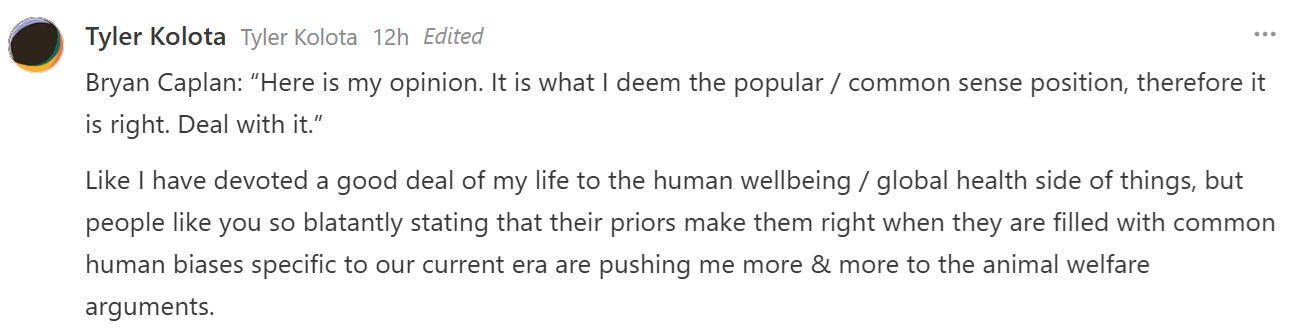
Finally, let me close by inviting Bryan Caplan to a friendly debate on morality and effective altruism.
Since he is happy to endorse ideas that most would consider to go against common sense when it comes to economics, I have hope that I can change his mind. I’m happy to defend caring about improving the poor conditions in shrimp agriculture.
If you enjoy my newsletter and want to support it please consider a paid subscription. All proceeds will go to effective animal welfare charities. Thanks for reading!
Thanks for the post!
I'll add that in another survey of ours we found that the median probability of AI leading to extinction was 15% (for US respondents). In a separate survey, we also found strong public support for a pause. Those surveys are from three years ago though, I would expect higher concern now.
We also found that many of the UK public also think this. A majority think they are likely sentient, an even larger majority think they can feel pain.