

James Herbert
Bio
Participation1
I'm currently a co-director at EA Netherlands (with Ricardo van Mildert). We're working to build and strengthen the EA community here.
Before this, I worked as a consultant on urban socioeconomic development projects and programmes funded by the EU. Before that, I studied liberal arts (in the UK) and then philosophy (in the Netherlands).
Hit me up if you wanna find out about the Dutch EA community! :)
Posts 30
Comments385
IMO it goes Wix/Squarespace site < vibecoded site < nicely vibecoded site.
Sure I discount a little when a site is vibecoded. But I discount even more when it's Wix/Squarespace - 'you're using Wix in 2026?? You could make a substantially nicer and easier to maintain website in an afternooon'.
And I think when I see a professionally made site I might do a little discount as well? Beyond a nicely vibecoded site, the marginal improvement probably isn’t worth the marginal cost, so I find it hard to believe a professional build was a good use of money.
Yes, I think any increase in marcomm efforts should be spent on external-facing stuff; not spin, just constantly explaining what we're about so there isn't a comms vacuum and people first hear about EA from EA-aligned orgs, rather than people who dislike EA-aligned orgs.
80k and others have been excellent at this for years. GWWC seem to be getting much better at it. EA Australia as well.
For comparison, 80k has spent around $2–3M a year on marketing since 2022 (roughly 11–16% of its budget), and GWWC around $300k (roughly 13%), with plans to scale to millions. Both figures are from their recent job ads.
On hiring, from what I've heard from speaking to some people at CEA, the difficulty has been finding people who are good at comms and who fully understand EA. Honestly, this feels like letting perfection get in the way of good enough. But I can of course sympathise, hiring is hard, comms is hard, and a mess-up here has big implications.
Not sure if it's yet the worst in its history but I agree this is serious.
Based on publicly available info, CEA's marcomms spend in 2025 was about 4% of its total, so roughly $0.8–0.9M. That's about the same in absolute terms as its Communications budget in 2023 ($0.89M). The share has gone up mainly because the rest of the budget shrank. (The two teams may not be scoped identically, so treat this as approximate.)
My 2 cents: I think marcomms should be closer to 10% of spend, maybe 15%. On current numbers that's roughly $2–3M.
I'd take most of it from events. Events were about half of CEA's budget in 2023, the last year with a public breakdown, and they're largely internal-facing. EA is pretty well coordinated as a community. Our comms are not good. I think we could spend a bit less on coordination and a lot more on being understood.
CEA says the constraint is hiring, not money. That may well be true. But EAN brought in comms capacity and got results we're happy with, on a central budget of under €200k. So I'd like to understand more about what's making this hard at CEA's end, and whether there are routes around it, e.g. agencies, contractors, or funding comms capacity in national groups. Asked in the nicest possible way.
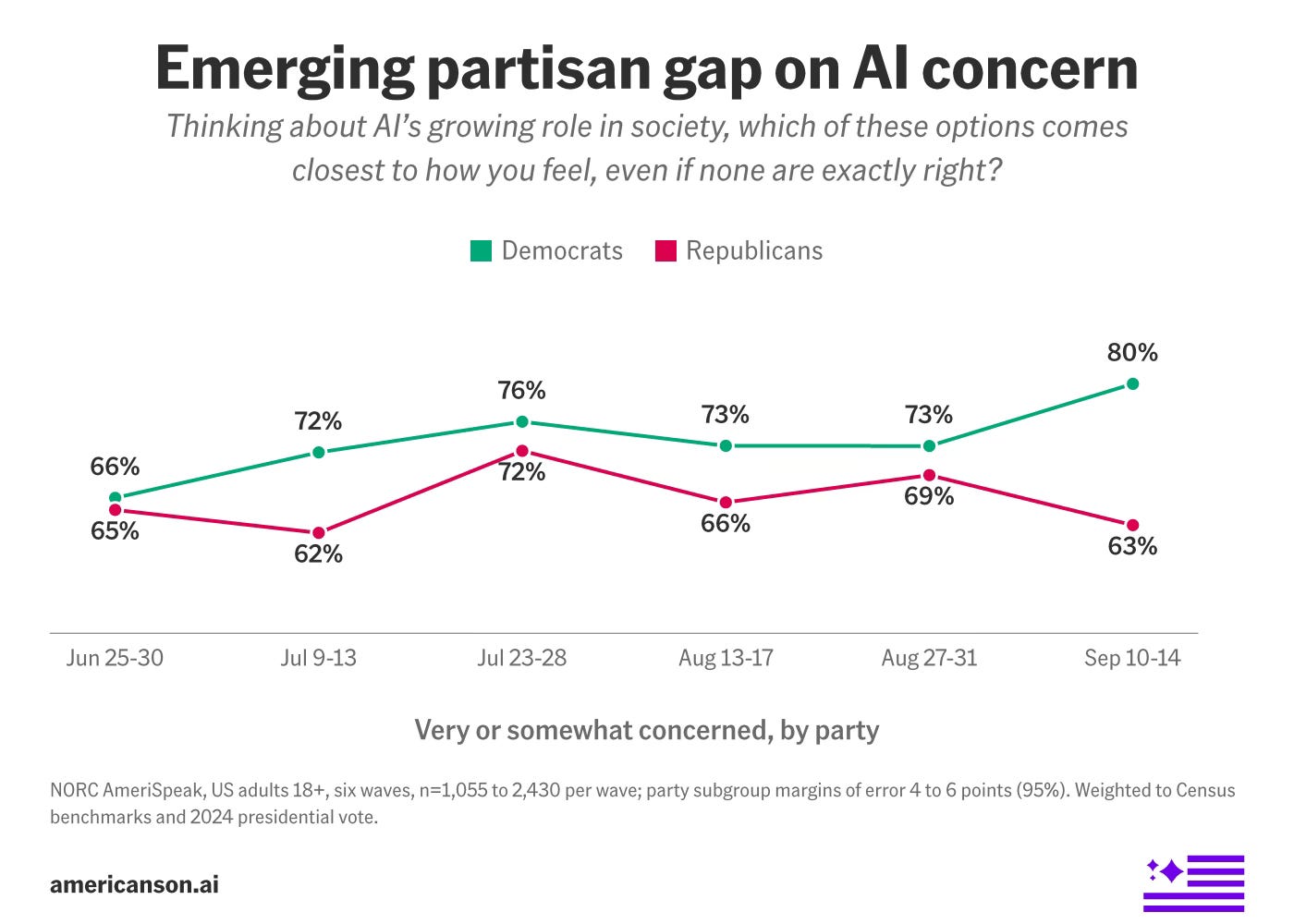
Post Coxon-resignation, polls on the American general public suggest (1) more Americans than ever are prioritising AI harms and (2) there's an emerging partisan gap in concern about AI, though a gap is not new among 'very concerned' Americans.
On (1), compared to the same survey two weeks BC (Before Coxon), there was a significant jump in the number of Americans saying “AI harms” should be a top priority for government: AI harms as a top priority increased from 36% to 43% (+7 points). Overall, 80% of Americans now say “AI harms” should be a priority for the government.
On (2), for the first time since June, there’s a significant partisan gap in concern about AI, with 80% of Democrats saying they’re concerned and 63% of Republicans. The gap is driven largely by Democrats becoming more concerned, while Republicans' concern remains high (63%) and relatively unchanged.
If we want EA to be a decentralised movement, it’s worth looking at how other movements/structures move money from the centre to national, regional, and local orgs. Here are a few comparisons.
In the big federations, money flows up. Amnesty’s national sections sent just over a third of what they raised to the international budget in 2013. Greenpeace works in a similar way. Because the sections fund the centre, they also have a formal say in how it’s run.
EA works the other way round. Most of the movement building money comes from one funder, Coefficient Giving, and passes through CEA. Three examples have a similar shape (it's hard to find something perfectly analogous to EA):
At CEA, operational spending in 2025 was $21.8m, Claude tells me that Community Building Grant costs fell 22% that year. I don’t know what share of CEA’s budget goes to local and national orgs, and I couldn’t find a published figure. In 2026 the CBG portfolio covers 11 orgs and is closed to new applicants.