
TL;DR
- EA Netherlands commissioned Bath Social & Development Research (Bath SDR) to interview 24 people who had taken our intro course, organised a group, or used our Amsterdam co-working office. Eleven more people did AI-assisted interviews. What follows is a summary of the final report.
- The most frequently reported positive effect was a sense of belonging to a like-minded community.
- 18 of 24 linked EAN to a change in their career or study plans. Eight had actually changed job (with strong evidence of movement into AI Safety). 13 changed how they donate.
- 20 of 24 in-person respondents reported an improved clarity around what makes for more impactful life and work linked to EAN activities.
- The introductory course and student groups were cited as primary entry points and drivers of this engagement.
- The mechanisms were mostly people, not content: a conversation at a conference, a referral at the office coffee machine, the intro course cohort rather than its syllabus.
- Our programmes look more like on-ramps than catalysts. They helped people already inclined towards EA act on it. We found little evidence they moved people who weren't.
- The limits are real: a self-selected, highly engaged sample, no counterfactual, and counts that are people's claims rather than effect estimates.
Why we did this
Most of what the EA community knows about how community building affects people comes from surveys, such as the Open Phil EA/LT Survey or the EA Survey. We wanted to supplement this with interviews.
We also wanted to test the middle part of our theory of change. EAN aims to offer activities to three groups:
- Proto-EAs: people likely to find EA ideas appealing. They are reached mainly through the intro course.
- Organisers: mostly student group organisers.
- Practitioners: people already working on EA-related problems, many of whom use our co-working office.
The theory is that this builds community involvement and knowledge in the short term. In the longer term, it should lead to career moves into high-impact work, stronger groups and more effective giving. We asked Bath SDR to look for evidence of those pathways, and for anything that contradicted them.
What we did
Bath SDR used the Qualitative Impact Protocol (QuIP). Interviews start from outcomes: what has changed in your career, your volunteering, your giving? Respondents then say, unprompted, what drove each change. The interviewers knew as little as possible about EAN's programmes and never raised EA themselves.
They ran 24 video interviews in December 2025 and January 2026: eight people each from three pools.
| Group | Who | Pool | Interviewed |
|---|---|---|---|
| Intro course | Completed the course, 2021–2024 | 348 | 8 (4 men, 4 women) |
| Organisers | Group organiser, 2021–2025, mostly students | 45 | 8 (6 men, 2 women) |
| Co-working | Used the Amsterdam office | 126 | 8 (5 men, 3 women) |
We sent the invitations, but people signed up directly with Bath SDR. So we don't know who took part. Afterwards, members of our WhatsApp community (about 620 people at the time) were invited to an AI-assisted interview through QualiaInterviews. Eleven gave usable answers. These are kept out of the counts below, but they raised the same stories as the main interviews. That suggests the 24 had reached saturation.
Bath SDR coded each interview as chains of cause and effect, using causal mapping. They then combined the chains into maps.
Limitations:
- Self-selection. People opted in, and almost all were highly engaged. Some intro course respondents said much less about EA than the other two groups.
- Co-working users are pre-selected. You mostly need an EA-related job to use the office. So their career changes are the weakest evidence of EAN's effect, even though they produce the biggest numbers.
- Not fully blinded. Respondents knew EAN had commissioned the study, even though the interviewers never raised EA.
- No counterfactual. Many people were already heading towards EA careers. The counts are people's claims about what caused what, not estimates of EAN's effect.
How to read the causal maps
- Each box is a factor someone mentioned. The number in brackets is how many people mentioned it.
- Each arrow is a link someone made: "this led to that". Thicker arrows mean more people made that link.
- A star marks an EAN activity, as opposed to EA in general.
- Every multi-step path is one person's own account, not stitched together from different people.
- These are people's claims about what caused what. They are not estimates of effect sizes.
What we found
Most of the changes people described ran through other people. Courses and reading gave them a framework. Other people gave them the job lead or the next step.
How people find EA and EAN
Most people came to EA already looking for it. Ten described a long-standing motivation to do good, often from their upbringing: parents who volunteered, a religious background, or values around social justice and animal welfare. Six came through friends already in EA, and two out of dissatisfaction with their work. Fifteen described a search for more meaning, usually in their work or giving.
What they found first was content, not EAN. 80,000 Hours was the most-cited specific source, mentioned by nine people. Others named podcasts, Peter Singer, Rutger Bregman and GiveWell. Several described finding EA with something like relief: a framework and a community they had been looking for.
"I Googled what good charities are and GiveWell popped up, and then I clicked on some links and found EA and then I remember just reading the EA forum for literally the entire night until it was morning and thinking 'why have I never found out about this'?"
EAN came next, as a place to act on those ideas. Eleven people said an EAN activity connected them to the community. Most often it was the intro course (five) or a student group (four). Eight said EA content led them to the community, and three said friends did.
Giving
13 of 24 people said their approach to donating had changed. So did 8 of the 11 people in the AI interviews. The intro course was the most-cited EAN driver: five people linked it directly to giving more, or giving differently.
Several had taken the Giving What We Can pledge. Others, mostly students, said they planned to once they had an income. Three were encouraging others to give more, in some cases, their parents. One course participant said the strict cost-effectiveness framing didn't change how they give.
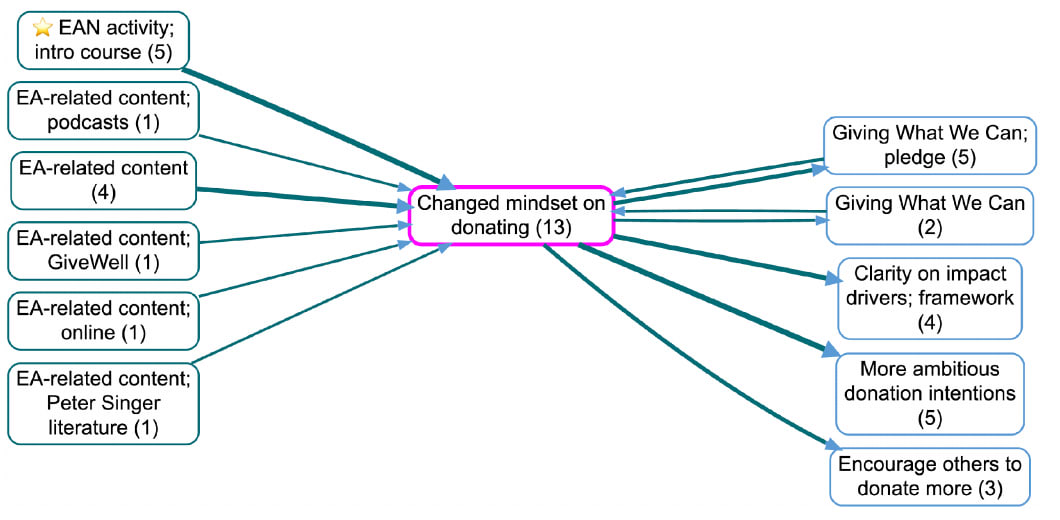
Map 4. What led to a changed mindset on donating, and what it led to (all 24 respondents).
"It has really changed the amount of money which I am willing to give, it opened my comfort zone of donating." (intro course participant)
Careers
18 of 24 people linked EAN to a change in their career or study plans. That was all 8 organisers, 7 of 8 co-working users and 3 of 8 intro course participants. Eight had actually changed job in the last three years, six of them co-working users. Many moved into AI safety.
Nobody took a single route. Most people who changed job described three or more EAN touchpoints, often alongside 80,000 Hours and their own long-standing motivation. Ambitious Impact (AIM) programmes came up repeatedly. Four co-working users got a job or started an organisation through AIM, and three of them found AIM through EAN.
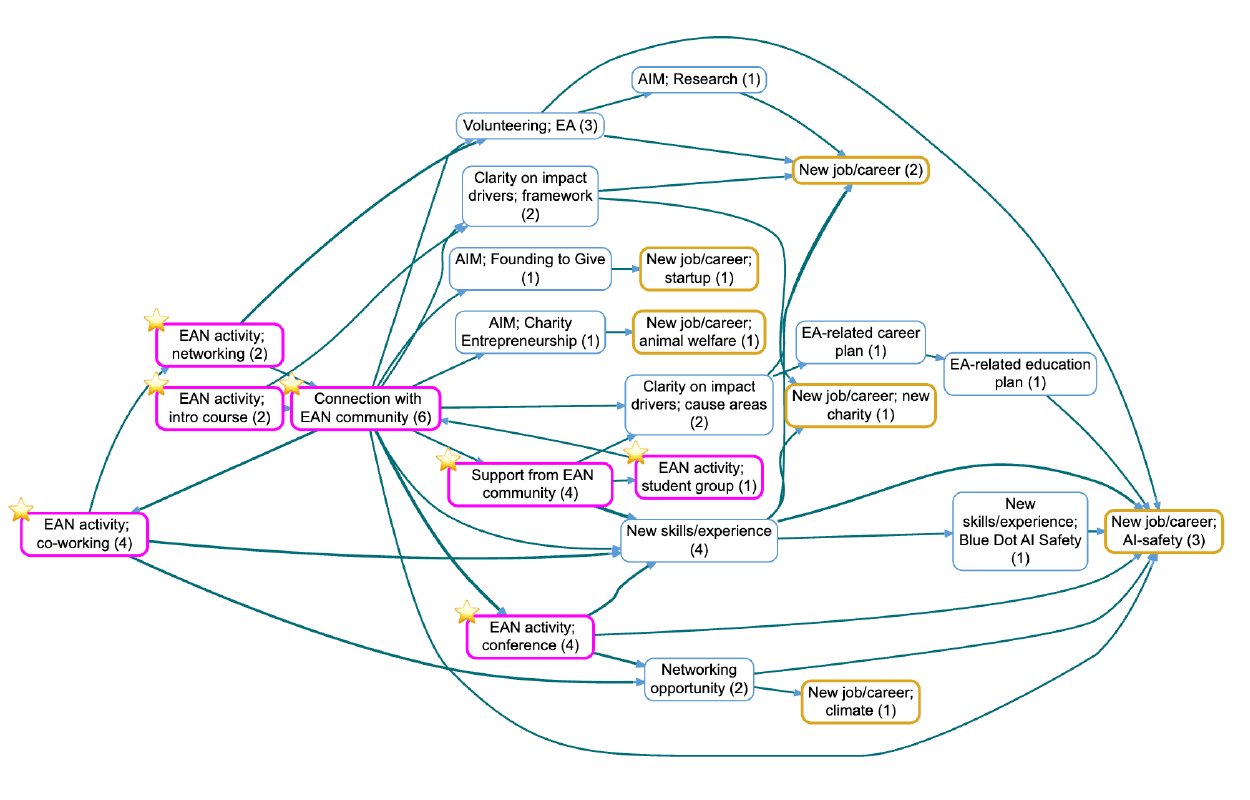
Map 7. Paths from EAN activities to a new job or career (eight respondents).
The specific trigger was usually a person. One co-working user got a job offer after someone at the office mentioned that they were looking for work. Others got their first role in AI safety through contacts made at conferences or networking events. One person's whole pathway is below.
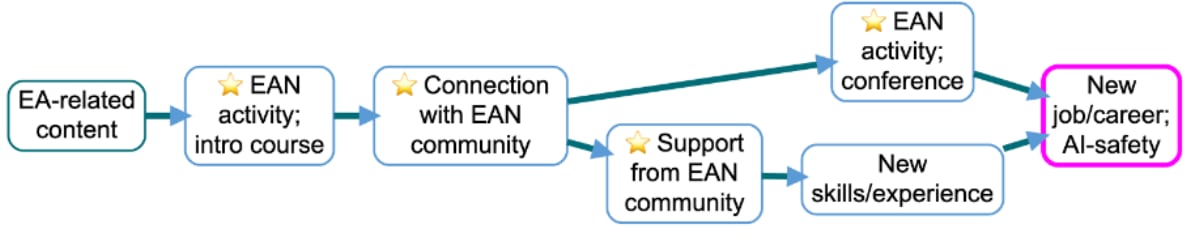
Map 16. One intro course participant's pathway to their first AI safety job.
"I just talked to somebody at an EAN conference that said that I could also do this … and that was not something I would have thought about because I didn't see myself as a technical person."
Organisers
Organisers described running a student group as a low-stakes way to test themselves. They gained social confidence, facilitation skills and project management experience. Three said it changed what they chose to study, and four said it changed their career plans. One called it "effectively doing a tiny startup" in a safe space.
Community as the multiplier
The most common effect overall was a sense of belonging. That led on to more activities: a social, then a conference, then volunteering or a job. 20 of 24 people said they now think more clearly about prioritisation, counterfactual value or cause areas, and 15 linked that to an EAN activity.
Several intro course participants already knew much of the material from podcasts and reading. For them, the value was the cohort.
"The relational aspect for me has been much more important than a lot of the skills … the biggest value for me has just been meeting these people, talking to them."
On-ramps, not catalysts
The people who went furthest were already inclined towards EA before they met us. Our programmes gave them a way in and lowered the friction. We found little evidence that they turned less motivated people into highly engaged ones. Some intro course participants engaged briefly and then stopped.
What didn't show up
Nobody mentioned EAN's media appearances. Few mentioned our own social media, although one person found the course through an Instagram ad. People mostly found EA through 80,000 Hours, podcasts, books and friends, and then found EAN as a place to act on it. This isn’t too surprising, as we only started investing in communications in 2025.
Concerns people raised
All but one of the in-person interviews were positive about EAN overall. Three concerns came up, and they were mostly about EA rather than EAN specifically.
- Big tent and small tent. Four people described two sub-communities in EAN. One leans towards rationality and AI safety; the other towards giving and animal welfare. Some in the first group felt events had become less substantive as more casual members joined. One person left EA for several years over what they saw as group-think at conferences. One organiser said EAN should stay "a home for both", but that this takes active effort.
- Moral burden. Several people described EA as a weight to carry at times: always being able to do more, and finding it hard to switch off. Most said they had found a balance. Some AI interview respondents described financial stress from putting impact ahead of income.
- The job market. People committed to switching careers worried about competition and saturation in EA roles. They wanted clearer information on roles in the Netherlands and Europe. Talking plans through with people at the office helped during these transitions.
What we're doing with this
The evaluation has shifted where we put weight:
- Bringing people together physically. We now value the co-working office, events and conferences more. Many of the career changes in the interviews started with a conversation in a room.
- The intro course. We value it more too, mainly as a way into the community rather than for its content.
- The rationalist community in the Netherlands. Given the big tent / small tent tension, we're thinking about what we can do to support it.
- A job board. We've started building one. It pulls remote and Netherlands-based roles from 80,000 Hours and similar boards, and adds high-leverage roles in the Netherlands that those boards don't list. Respondents asked for clearer information on roles in the Netherlands and Europe.
What's in the full report
The full report is 42 pages, with 17 causal maps. Most of the detail is in its findings section, which this post only summarises. That section has four parts:
- How people find EA and EAN. What first drew people in, a breakdown by group of the content they cited (80,000 Hours, podcasts, Peter Singer, Rutger Bregman and others), and what led them to the EAN community.
- How people engage with EAN activities.
- Conferences and other events: what people got out of EAGx, socials, thematic groups and workshops, including two comments questioning whether conferences are good value.
- The intro course: its effects on how people think about impact, broken down by concept (prioritisation, counterfactual value, cause areas), plus the full set of donation quotes and feedback on course depth.
- Student groups: how running a group shaped organisers' study choices, career plans and skills.
- Connecting to the community: how belonging led on to volunteering, new skills and career moves.
- The impact of EA engagement on education and career choices.
- Career changes: a causal map for each of the eight people who changed job, and AIM's role.
- Career and education plans: how EAN activities shaped 12 people's plans.
- Concerns. Longer quotes on the big tent / small tent tension, disengagement, moral burden and the job market.
It also includes the full methodology, the interview guide and an anonymised summary of respondents (education, career field and donation behaviour). The coded data sits in Bath SDR's Causal Map database.
If you'd like a copy, email me at [email protected] or message me on the Forum.
Thanks to Fiona Remnant and Rebekah Avard at Bath SDR, and to everyone who gave up an hour to talk to them.