I work with CE/AIM-incubated charity ARMoR on research distillation, quantitative modelling, consulting, MEL, and general org-boosting to support policies that incentivise innovation and ensure access to antibiotics to help combat AMR. I also work with global health funds and charities to develop cost-effectiveness analyses to inform grantmaking and support evidence-based legislative advocacy.
I was previously an AIM Research Program fellow, was supported by a FTX Future Fund regrant and later Open Philanthropy's affected grantees program, and before that I spent 6 years doing data analytics, business intelligence and knowledge + project management in various industries (airlines, e-commerce) and departments (commercial, marketing), after majoring in physics at UCLA and changing my mind about becoming a physicist. I've also initiated some local priorities research efforts, e.g. a charity evaluation initiative with the moonshot aim of reorienting my home country Malaysia's giving landscape towards effectiveness, albeit with mixed results.
I first learned about effective altruism circa 2014 via A Modest Proposal, Scott Alexander's polemic on using dead children as units of currency to force readers to grapple with the opportunity costs of subpar resource allocation under triage. I have never stopped thinking about it since, although my relationship to it has changed quite a bit; I related to Tyler's personal story (which unsurprisingly also references A Modest Proposal as a life-changing polemic):
I thought my own story might be more relatable for friends with a history of devotion – unusual people who’ve found themselves dedicating their lives to a particular moral vision, whether it was (or is) Buddhism, Christianity, social justice, or climate activism. When these visions gobble up all other meaning in the life of their devotees, well, that sucks. I go through my own history of devotion to effective altruism. It’s the story of [wanting to help] turning into [needing to help] turning into [living to help] turning into [wanting to die] turning into [wanting to help again, because helping is part of a rich life].
I'm open to free tailored 1-1 advising calls on how to figure out the most impact you can have with your career -- a few people have told me they found this very helpful. This is my way of karmically paying forward the generosity many, many people have shown me through these years.
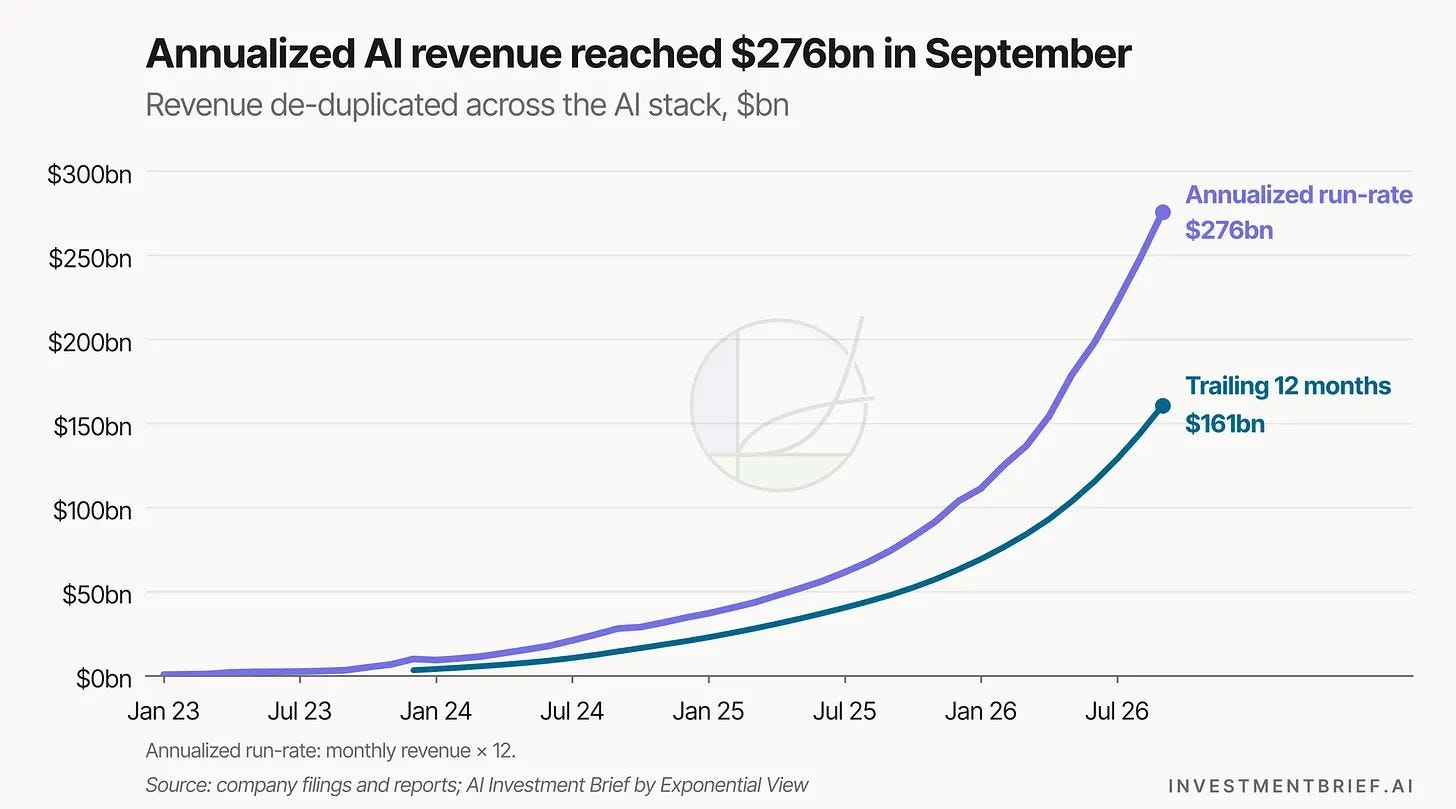
Tangentially, I found it useful to contextualise $514 billion of revenue by looking at the world's largest listed companies. It would put Anthropic ahead of every company today except Amazon and Walmart.
For what it's worth, there's this chart of Anthropic's ARR that's been circulating recently, from a company called TickerTrends. I have no idea how believable the (proprietary) underlying data is though.
The table below gives a sneak peek of our posts evaluating the cost-effectiveness of programs for students and professionals. The table combines results from the programs considered in these posts, hypothetical implementations of similar programs, and ‘baseline’ programs. Baseline programs involve directly funding a talented research scientist or PhD student working on anomaly detection research for 1 year or 5 years respectively.
Program
Cost (USD)
Benefit (counterfactual expected QARYs)
Cost-effectiveness (QARYs per $1M)
Atlas
9,000,000
43
4.7
MLSS
330,000
6.4
19
Student Group
350,000
50
140
Undergraduate Stipends
50,000
17
340
Trojan Detection Challenge
65,000
26
390
NeurIPS ML Safety Social
5200
150
29,000
NeurIPS ML Safety Workshop
110,000
360
3300
Hypothetical: Power Aversion Prize
50,000
490
9900
Hypothetical: Cheaper Workshop
35,000
250
7000
The “power aversion prize” is a hypothetical program mirroring the Trojan Detection Challenge, except with $15k less award funding and a more relevant topic. The “cheaper workshop” is identical to the NeurIPS ML Safety Workshop, except with $75k less award funding.
There are many important caveats to this table, detailed in the posts. These caveats include:
Different programs might perform relatively better or worse at different scales of budget (a fact which is obscured above, with one budget presented per program). For example, although a low-cost social might be more cost-effective than a low-cost prize, the opposite might be true for high-cost implementations of these programs.
Since the QARYs framework focuses on benefits for technical AI safety research exclusively, we will not account for other benefits of programs with broader objectives, such as the Atlas Fellowship.
The parameter values are currently based on CAIS’ worldview: for instance, the research discount rate (discussed below), the research ability of participants, and the relevance of different research avenues. Other organizations may disagree and have different values for these parameters.
[on the research discount rate being a big crux -- seems pertinent depending on your views on timelines or DIAL etc]
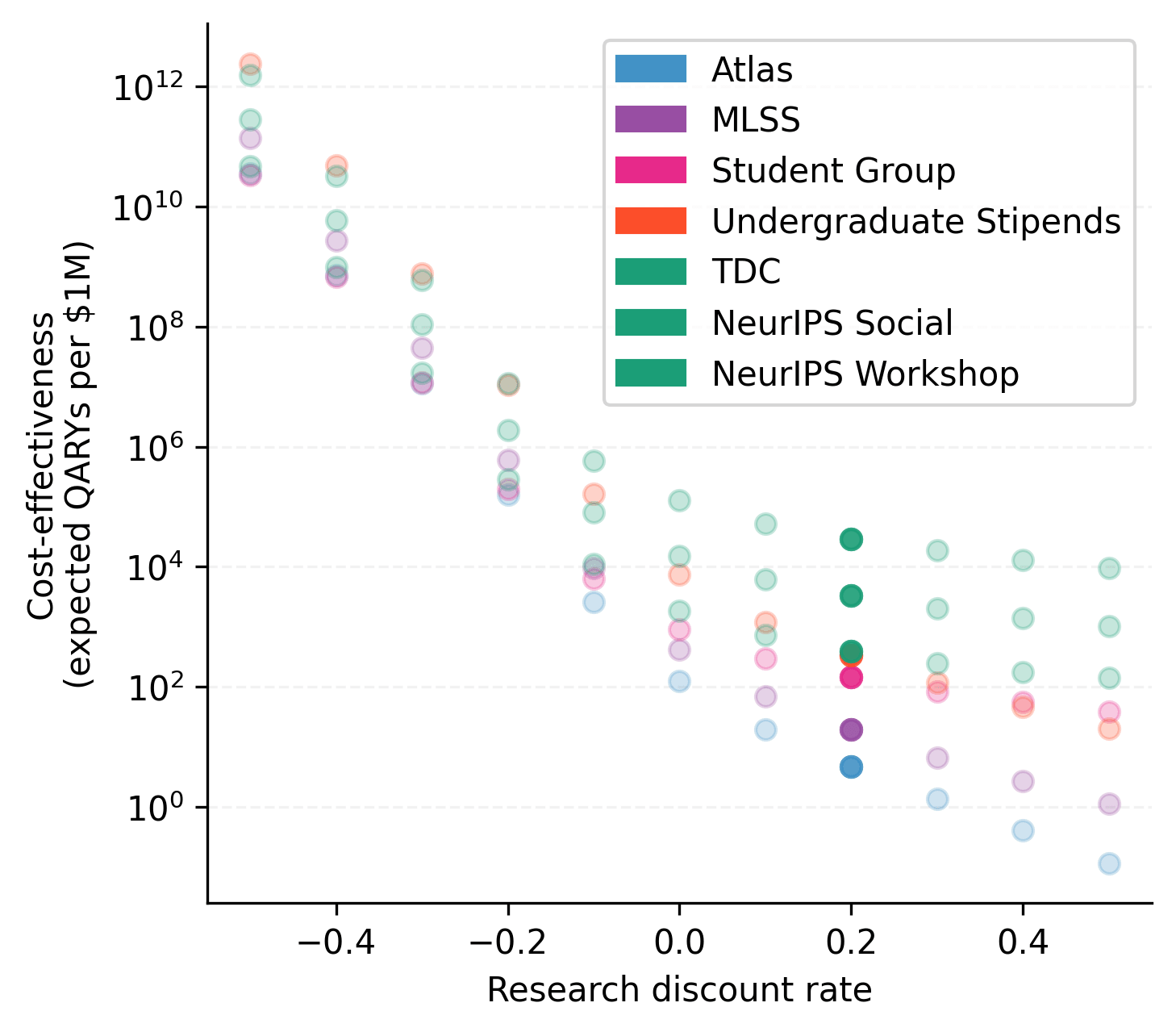
The plot below compares the cost-effectiveness of student programs with that of professional programs for different values of the research discount rate. 0.2 is our default; negative values represent a preference for research conducted in the future. (The cost-effectiveness ordering of the identically-colored professional programs never changes.)
Notice that:
The cost-effectiveness ordering of programs is not robust to changes in the research discount rate in general.
As expected, a higher research discount rate devalues student programs relative to professional programs.
Within student programs, Atlas is relatively disadvantaged by a higher research discount rate, whereas the Student Group benefits. (This disparity is due to Atlas having younger participants, and the Student Group having older participants, compared to MLSS and Undergraduate Stipends.)
For very low discount rates, Undergraduate Stipends emerges as the best-performing program.
There are a few other such AIS fieldbuilding impact assessments on the forum, eg this one of AISC, and more foundationally maybe Nuno's piece and so on. It would just be sad to see previous work go to waste.
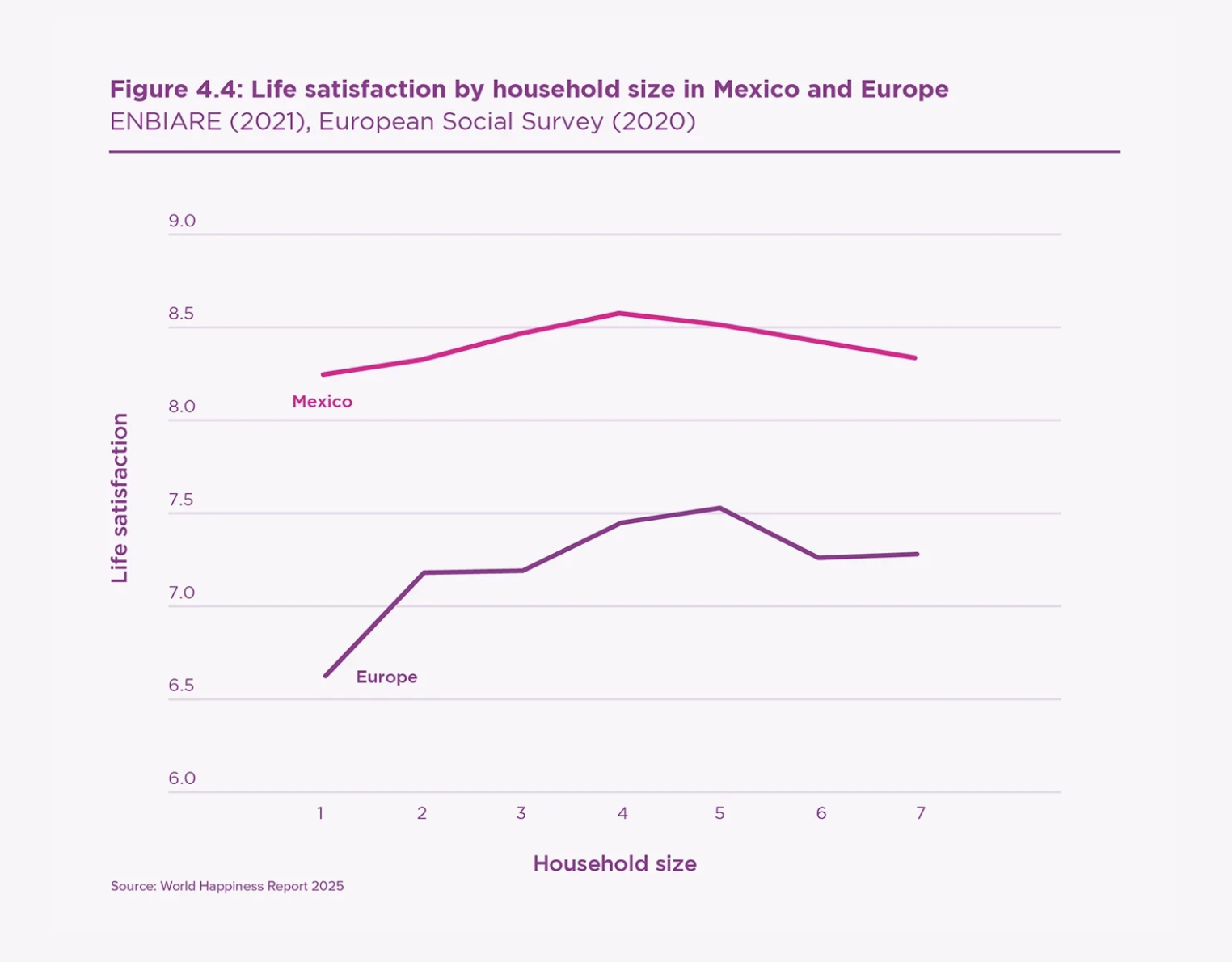
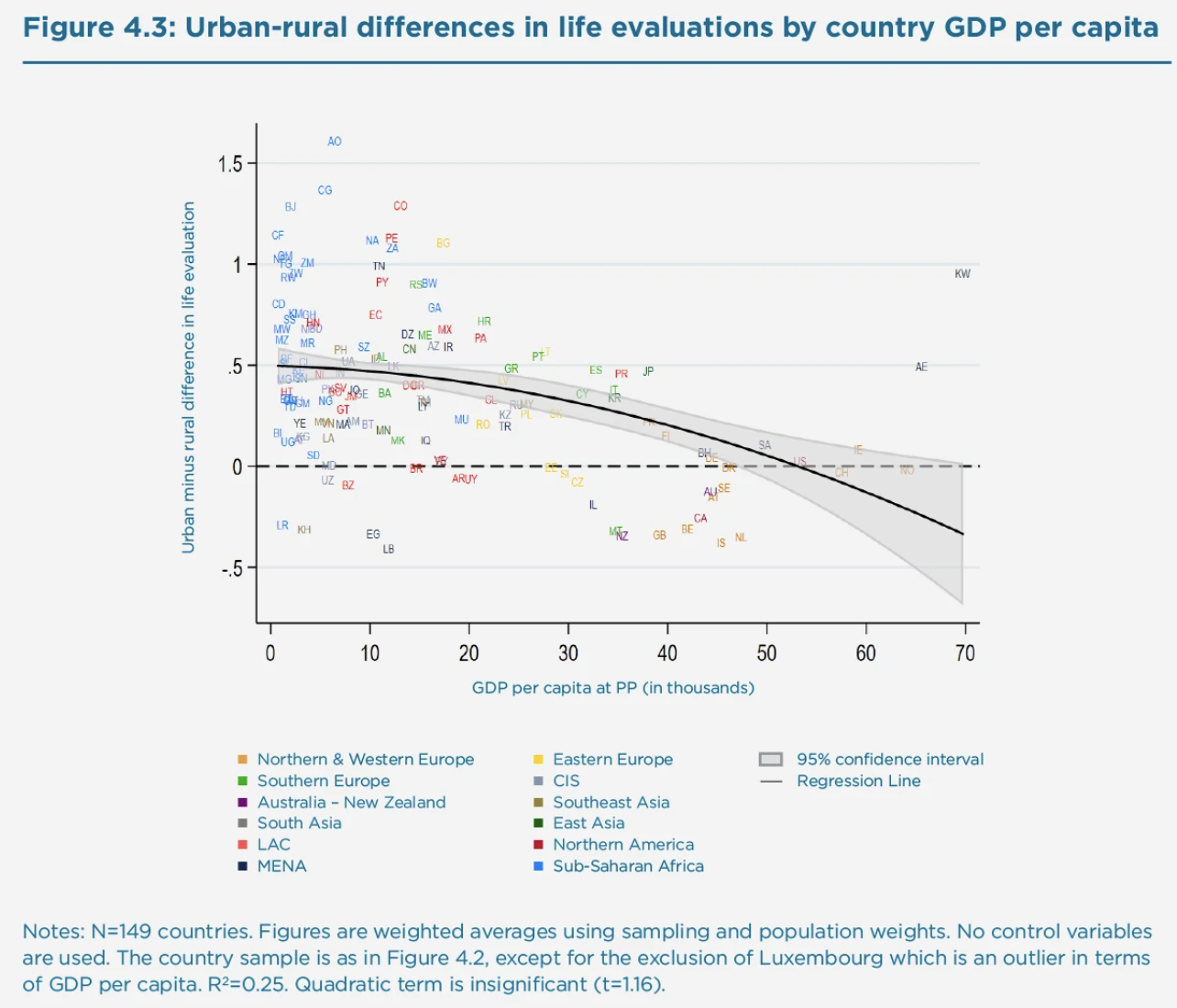
In this chapter, urban-rural differences in well-being were shown to be strongly dependent on development level, and as Figure 4.1 suggests the urbanisation experience in the more developed Western world can lead to lower rather than higher average levels of well-being in cities. In contrast to other parts of the world, in many countries in Northern and Western Europe, Northern America, and Australia-New Zealand, the relatively much smaller rural populations have higher average levels of well-being than urban populations. This can partly be explained by the fact that despite the larger urban areas having higher proportions of tertiary educated residents the tertiary educated are still in the minority. By comparison, the much larger less-educated majority face higher costs of living in cities relative to income, include a larger proportion of singles on low incomes (many of whom are students), and for a variety of reasons including reduced access to owner occupied housing and longer average commutes, experience return lower levels of well-being. The results are consistent with what we already know about the urban paradox, but local variations in such patterns warrant further research.
In this regard, our research has also shown that some groups are better able to reap the advantages of cities and are less exposed to the negative effects of cities than others. People with lower levels of education and/or lower income have fewer means of buying their way out of a poorer urban environment. In this research, we found that the urban happiness advantage is considerably larger for higher educated people than for lower educated people, both in Sub-Saharan Africa and Northern and Western Europe, Northern America, and Australia-New Zealand. Future research should in this regard examine more specifically which kind of living environment is best for which kind of people, specifically turning attention to lifestyles. Of particular importance in the Western world are the higher real housing costs the lower educated face in cities, resulting in longer commutes, which lowers time for leisure and time with family, coupled with compounding relative income effects in highly proximate environments. These are disadvantages generated from within the large conurbation rather than the result of selective in-migration from a relatively tiny rural population base.
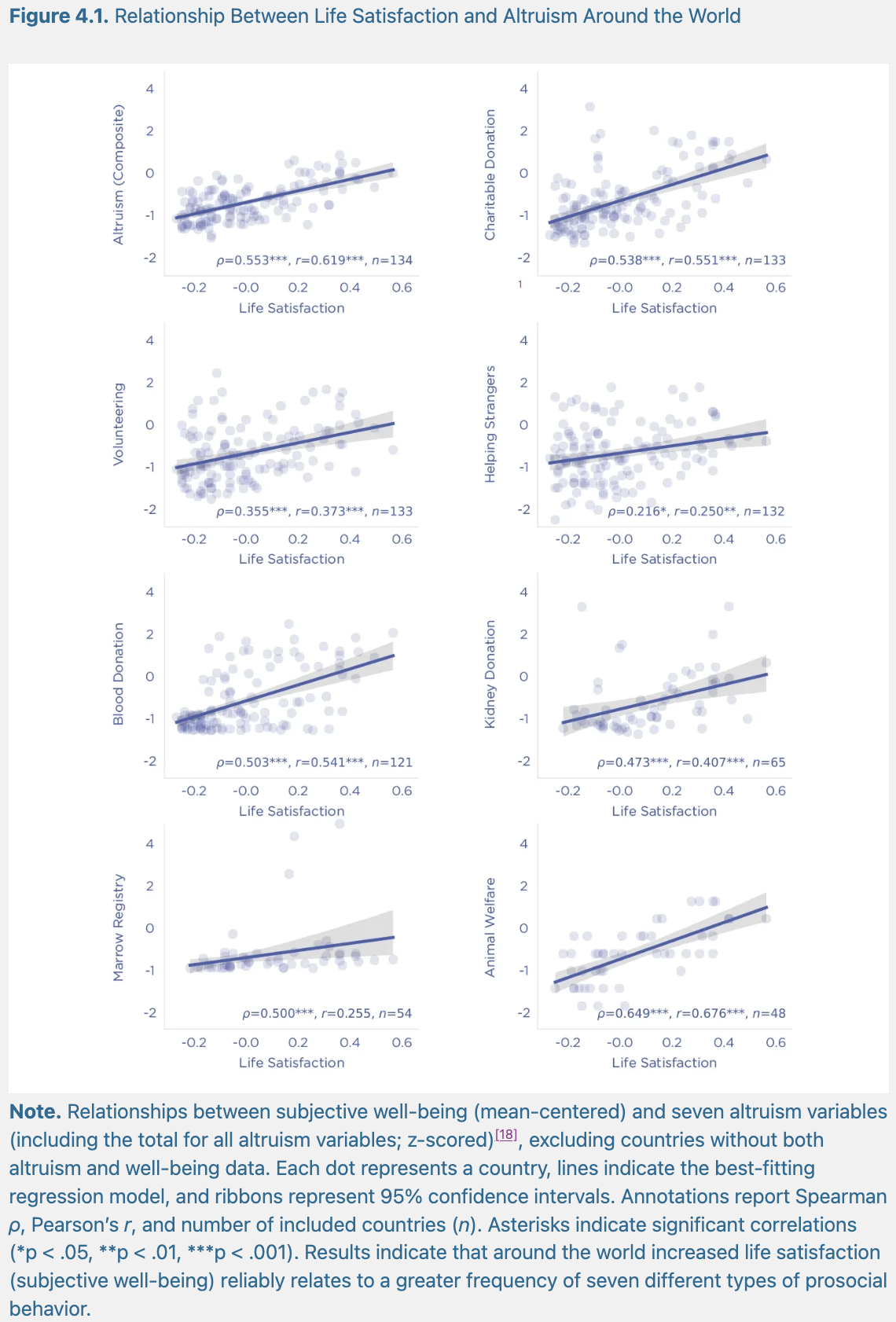
The altruism <> animal welfare thing is from this paper.
"Something something a vibrant society and culture" funnily enough immediately made me think "LatAm", so yeah I'm very keen to see an exploration of the hypothesis that we should Latinify the world!
This is awesome, I've been meaning to sort out my confusions around this topic and expect your review to be very helpful for this.
Preregistering my reactions to see how I change my mind later:
Does each doubling have the same return to wellbeing? Probably not, I expect η > 1. GiveWell's η = 1.59 seems to be James Snowden's best guess; he asked himself"How many people would I increase the consumption from $1,000/year to $2,000/year to be equally as good as increasing one person’s consumption from $500/year to $1,000/year?", intuitively answered "~1.5" and back-solved for η. Alexander Berger shared CG's reasoning on their η = 1, including that it seems to be suggested by LS data. RP gets η = 1.87 from back-solving the equation at the end of their review of GW's discount rate. SoGive rounded up some references suggesting η > 1. I liked these comments by Karthik Tadepalli and Michael Dickens on the topic
How effective are cash transfers in high income countries? Not sure, picture seems mixed. On the one hand there's stuff like this NBER paper on US cash transfers in the vein of what you alluded to, on the other hand this meta-analysis claims to empirically find η ≈ 1.5 for the UK and suggests current official UK govt guidance (η = 1) needs updating
Does economic growth make countries happier? Yes if most people benefit. The Easterlin paradox is a non-paradox once we look at the underlying data, or so OWID claims: in Japan the apparent paradox is due to survey questions changing over time, and in the US it's due to growth not benefiting most people. (I'm probably biased as someone from a country that's experienced plenty of growth in the last few decades)
People being happier in urban areas in developing countries and happier in rural areas in highly developed ones (those 2 outlier exceptions are Kuwait and the UAE):
25. I know this is also many people's least favorite part of EA: that it talks in spreadsheets rather than empathy. But the spreadsheets are an act of empathy. I want to help 100 times more humans, or a million times more animals, because I care about each one enough to want to help more of them.
I like Brian Tomasik's framing of triage as "warm and calculating":
But isn't this focus on efficiency cold-hearted? Doesn't strict triage neglect the pain of those who don't get preferential treatment? For example, people sometimes scoff at legitimate concerns about large pecuniary expenditures on the grounds that it's insensitive to care about money when lives are at stake. In the real world, though, we can't do everything. Resources are limited, and we inevitably face choices between helping one being or another. It is precisely the sympathy that we feel for those animals left homeless by a hurricane, for instance, that so fervently motivates us to devote our money toward more efficient ways of ameliorating animal suffering. Triage is not an act of harshness; it represents the highest form of mercy and compassion.
This pattern-matches to a common AI summarisation failure mode I've experienced often. The link says
Giving What We Can apparently climbed from $1.2 billion in donations in 2024 to about $2 billion in 2025. The CEO of Giving What We Can, Sjir Hoeijmakers told the FT his organization experienced “ a hit from FTX,” and “a drop in general enthusiasm” but has “more than recovered from that by now.”
Anthropic’s ties to EA appear to run deep. One of its co-founder’s, Daniela Amodei, is married to Holden Karnofsky, described by the New York Times as “one of the founders of the effective altruist movement.”
As noted last month by Wired, analysts have crunched the numbers on what philanthropy-heavy Anthropic’s expected IPO might mean for future donations. They expect an increase of $15 billion per year—a 2.5% increase in total U.S. giving—just from one company.
There's GWWC and $15bn/year in there, and I've found cheap subagents often get confused and just read this as "GWWC expects $15bn/year", and the smarter overseer agent often never checks this.
It was striking to me how agitated Bill Gates was (terrified even) when talking about (prosaic) AI risks with Ezra Klein, I've watched a few of his interviews over the years and I've never seen him this unsettled. "This is the most dangerous thing that humans have ever gone near" was repeated a few times.
I really appreciate your first-rate distillation (prev post) and "empirical philosophy"-flavoured work here with the survey analysis, both strong-upvoted. I find it personally valuable to be able to point to a survey with nearly 600 respondents and lower Lizardman's constant than I'd expect (1% not 4%) with these findings in particular:
45% of people familiar with population ethics leaned totalist vs only 10% of those unfamiliar. This is a ridiculously strong association
most people's responses don't cleanly match up with views from the philosophical literature (I'd suspected this but large-n empirical data is very nice)
many more people than I expected accepted the repugnant conclusion (35%) and denied that levelling up improves things (25%)
a third of responses were nonstandard (more than I expected)
fewer than a tenth were person-affecting (less than I expected)
most responses were internally consistent, even among folks unfamiliar with the repugnant conclusion (I expected the opposite)
I hope to find time to look into some of these myself. Thanks.



Tangentially, I found it useful to contextualise $514 billion of revenue by looking at the world's largest listed companies. It would put Anthropic ahead of every company today except Amazon and Walmart.
For what it's worth, there's this chart of Anthropic's ARR that's been circulating recently, from a company called TickerTrends. I have no idea how believable the (proprietary) underlying data is though.