

Nikita Solovev
Bio
Operations person — 15+ years in tech, most recently at Yandex, where I led "Help Nearby," a charity platform with 700K+ donors, and launched accessibility and social programs inside a ride-hailing product. Before that: co-founded a city newspaper with 2M monthly readers and a science-communication NGO. Currently making a mid-career transition into global health & development operations. Based in Tbilisi, aiming at Europe or remote.
How others can help me
I'm looking for an operations or program role at an EA-aligned organization (global health & development). Glad to hear about open roles, referrals, or a 30-minute chat if you've made a mid-career move into EA yourself — I'd like to learn how you did it.
How I can help others
Reach out if you have questions about scaling operations (marketplaces, payments, support), launching programs 0→1 inside a large company, or corporate philanthropy — I've run a donation platform used by hundreds of thousands of people. Also happy to share how I use AI tools to automate ops work.
Comments8
Meh, I really don't like the tonality of the essay.
I think that if an average person with money tried to read it, it would not convert them to donating more to effective charities. Quite the opposite, it would put them off donating altogether.
What I think is good:
- admitting that the warm feeling people get from helping others is alright and important;
- the idea of segmenting do-good instruments by the result they achieve: one for the warm feeling, another for prestige, a third for the actual impact.
However, I don't believe it is the donor's responsibility to understand this. This kind of self-reflection and dissection of one's inner workings requires a lot of effort, and we simply can't require it from everyone. This analytical, self-reflective approach could put a person off donating altogether: after spending some time thinking analytically about charity, whom to give and whom not etc., people lower their giving to everyone (Small, Loewenstein & Slovic 2007).
I believe the work of making EA appealing, sexy, and prestigious to the masses and to the few rich people is the responsibility of the organizers and ambassadors of the movement. So, using the terminology of the essay, I am pro "warm feeling" at the door and impact as the product of attracting people to that warm feeling.
A naive example: making Taylor Swift, Ronaldo, or some media influencer an ambassador of the EA movement and attracting some of their followers who come just for the warm fuzzies is, in my opinion, smart and good long-term. The MrBeast partnership with GiveDirectly is close to what I propose.
The closest counterpoint to my approach I found is the fidelity model. The basic idea, as I understand it: when you start appealing to a mass audience, you lose nuances that are important for understanding the idea, and the distortion can go so far that the idea stops working on the cause.
My take: this is real, this is a risk, but it doesn't mean you should not do it at all.
Distortion happens anyway — look at how EA is now deeply associated with Anthropic and doomsday scenarios amid the AI hype. What could the general audience get from it? Those people are a little bit crazy, they try to scare us, and they write hellishly long essays that are tiresome to read..
The bigger problem is that almost no one knows about EA — genuine awareness in the US is around 1–2%. So, for me, the only logical way to scale the impact is to raise awareness and make EA more appealing. It's better to try to control the narrative and get better at it than to avoid it altogether.
My speculation: a movement born in academia, led by PhDs and intellectuals, may simply be uncomfortable with people who don't read long texts and who distort complex arguments. But those people are most of the world, and they always will be.
So what?
- I would be really interested to hear opposing thoughts and the theory of change behind making donors more rational about how they think about doing good.
- I would love to explore ideas in both directions:
- how to make EA sexier and more appealing to the rich and the masses
- and why it is a bad idea, and why the traditional way of educating people through essays, lectures, and books is better.
On the point about people being ready to pay $80 / $78 / $88 to save 2,000, 20,000 and 200,000 birds:
- to me this is not about scope insensitivity, but about insensitivity in general;
- I think that if they had seen one bird, or a few, they would have been much more likely to donate — the same bias you mentioned about photos of people in need;
=> so the main problem is not scope insensitivity, but getting people to care more about others in general.
Also I opened the original report about the birds, and it holds even stronger evidence for this: the median amount was much lower ($25) in all the 3 options. The mean of ~$80 came from a few people naming much more.
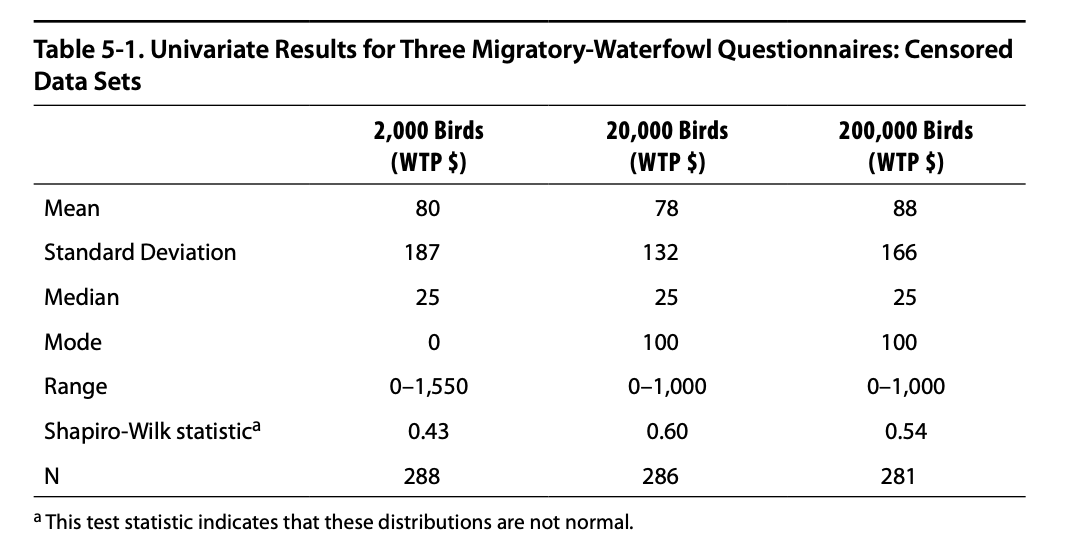
That raises several questions for me:
- Maybe it's worth targeting those people instead of trying to raise the median donation?
- What makes them different from the median person?
- My intuition is that it's not about them being more rational, but rather more emotional, kind and empathetic. And I wonder whether it's something we can influence, or whether it's innate.
- Or maybe they're simply wealthier and can afford to give more?
Another interesting research was found by Claude when I showed him the message above:
- Small, Loewenstein and Slovic (2007) primed people to think analytically before they donated. Donations to the identified victim fell, donations to the same need described as numbers did not rise, and total giving dropped. Teaching people to correct the bias made them care less in general.
Great depiction of the different realistic cases of how people get into charity. Those fictional cases, and especially Daniel's, got me thinking though.
- The text never shows what Daniel actually does after the mindset shift: he stops the $3 donation, gives nothing anywhere else, and and the essay only says in passing that he might find effective altruism later. I would argue that the less-thinking Alice, Bob, and Christine could end up doing more than the thinking person.
- => This "accounting for large numbers and cognitive bias" mindset alone is not enough — the equation also needs humility about one's ability to impact the world, and a bias to action. Otherwise it could lead to emotional and thinking paralysis and drive anxiety up. This is an extrapolation from my personal experience when I started thinking about a career path I want to pursue.
- => So although I respect the endeavour of cause prioritization and calculations, I would still advocate that ineffective altruism is better than no altruism. For a general person without many resources, it's a great mindset to just be kind, help others, and be content with the however small or big positive impact you make on the world.
Thanks for the post, really interesting and inspiring.
Some points:
- The post and the Our World in Data project reminded me of Hans Rosling's book Factfulness. For people who found this article interesting — I would recommend it.
- I really got inspired by the child mortality stats — in the sense that things got better, and that there's still a big room for improvement in developing countries. For me, it's the fact that we know how to achieve something good in a general sense, and we just need to implement it. It makes the whole thing feel doable.
- I also like the message that we just need to educate people on the facts to get them to feel better about the future (sorry for the implied causation, equally possible that optimistic people are better at learning). In my experience, the most educated people are usually the most pessimistic ones, so it's interesting to see the difference here.
- One technical comment: the link on "between 10-13%" didn't work; it probably needs to point to https://ourworldindata.org/grapher/child-mortality instead.
I was surprised to learn about the COVID human trials which were advocated for by the 1DaySooner project. The counterintuitive idea for me was advocating for infecting individuals with a disease with unknown consequences.
I went on a quick search to learn:
- It's not a usual practice to infect people with a new, unresearched disease (usually they do it only for well-researched ones):
- one recent case is the Zika virus in 2017, where the ethics panel of American health organizations NIAID and Walter Reed Army Institute of Research declined to allow it
- because of the unknown consequences for the participants
- and because, unlike the COVID case, it was harder to contain (it can be transmitted sexually to a partner, and from a pregnant woman to her fetus, and it stays in semen for weeks to months, so quarantine doesn't help
- one recent case is the Zika virus in 2017, where the ethics panel of American health organizations NIAID and Walter Reed Army Institute of Research declined to allow it
- The COVID trial went ok, with 18 out of 34 getting infected, everyone being young (36 people, 18–29 years) and noone dying or getting severely ill.
Overall, I seem to be ok with people taking on an additional risk for payment and signing informed consent, especially when the benefits outweigh the risks. I'm still a little uncomfortable when it's a new disease. At a limited scale it seems ok — there are much more stupid ways to risk people's lives, like wars — but it still made me think.
I'd be interested to learn about the philosophical approaches to these kinds of dilemmas. Trolley problem, anyone?
@Lizka Hi! Thanks for the post. My Claude Code suggested this post as a starting point, so here I am.
For a newcomer like me whose first language is not English it can be intimidating to start posting — as are perfectionism and the need to bring value from day one. Your post helps by encouraging me to write.
I saw that you have been contributing actively on the Forum since this post. As motivation for a newcomer like me, I would be grateful if you shared:
1) How did you progress from post to post? Did the quality improve — subjectively, or by any metric you could point to?
2) Did you have a routine that helped you write regularly?
3) One thing I noticed: you were already inside the EA network early on (research fellowship, then CEA). Did Forum writing add anything on top of that you can point to explicitly — a connection, an opportunity, the job switch — or is it hard to separate from working at CEA? I'm asking because I'm deciding whether Forum writing is a good investment of time for an outsider whose goal is to land a job at an EA organization.
I tried to imagine being the one responsible for a decision like this: deprioritize help to someone in a life-or-death situation because it's more rational to allocate the help elsewhere (higher probability of success, more people saved).
It's easy when I have never met the person and no one I know has met them. It's hard when it's someone I know, or someone known to people I know. So the key factor for me is proximity.
If I had to choose between helping someone I know and helping more people I don't, I would choose the first. Otherwise I would feel responsible for the bad outcome, and it would haunt me. No amount of rationalization would make me feel better. So I wouldn't judge a person who does the same.
Would I admire someone who follows the rational principle and doesn't help a friend or relative because it's more rational to help someone else? It depends. If the connection is weak, someone they just met, then doing the right thing while being seen as a jerk is admirable. But helping the closest people is one of the main responsibilities of a human being, so with a friend or relative I would judge it unfavourably.
Hard stuff! The essay is great, thank you for making me think.