

Tom Bry-Chevalier🔸
Bio
PhD - economic and environmental stakes of alternative proteins
Scientific Director - ONEI (French National Observatory on Insect Farming)
Cofounder of the first EA chapter in France (2015)
Posts 4
Comments19
Short answer: I don’t know of any study that weighs insect welfare against the environmental benefits of waste bioconversion in a single framework. But I’m not sure one is needed here. The two promises, producing protein and treating waste, pull against each other. Protein that is safe and sellable needs clean, consistent inputs, which aren’t really waste. Real waste brings contaminants and variability, and in the EU much of it can’t legally be fed to farmed insects at all. Operators end up trading one goal against the other, and rarely deliver both. And whichever goal you pick, there is usually an established alternative that does at least as well environmentally and costs less: anaerobic digestion or composting to treat waste, and for feed, soybean meal or simply giving clean side-streams to livestock directly. So the welfare concern isn’t up against a clear sustainability gain. It comes on top of a case that is already weak.
Some context on where I’m coming from: I’m the scientific director of ONEI (Observatoire National de l’Élevage d’Insectes), a French non-profit working on the impacts of insect farming. My PhD, in economics, was on alternative proteins, and I’ve published several academic papers on insect farming. Disclosure: I co-authored one of the reviews cited below (Biteau et al., 2025).
I’m not an expert on sentience, so I’ll keep this part short. As far as I know, though, several serious lines of work suggest insects are credible candidates for sentience:
- Jonathan Birch classes insects as “sentience candidates” in The Edge of Sentience , meaning the evidence is strong enough that ignoring the possibility in decisions that affect them would be irresponsible.
- Gibbons et al. (2022), a review co-authored by Birch and Lars Chittka, assessed six insect orders against eight criteria. Adult flies met six. Fly larvae met three or four, which the authors still count as substantial evidence for pain. Black soldier flies are flies, but the assessment was made at the level of the order, and the authors point out that evidence on juveniles has large gaps.
- The New York Declaration on Animal Consciousness (2024), now with more than 600 signatories, states that there is at least a “realistic possibility” of conscious experience in insects.
I’ll focus instead on the environmental and economic arguments, since those are the ones made for this route, and I have a lot of doubts about them.
- The benchmark should be the other ways of treating the same waste: anaerobic digestion (AD), composting and, for clean streams, direct feeding to livestock. Not soy or fishmeal. Diverting waste from landfill and recovering nutrients are real benefits, but composting and AD deliver them too, so they don’t set insects apart. On that comparison no advantage has been established. Across the twelve assessments we reviewed, treating a tonne of biowaste with insects came out anywhere between −432 and +877 kg CO2e, and the favourable figures usually leave out collection, pre-treatment, transport or construction (Biteau et al., 2025). Some studies do favour insects, but usually against weak comparators (landfill, unaerated composting) or thanks to a large credit for the protein. Unlike AD the process recovers no energy, and in temperate climates the larvae have to be kept warm. Modelling in Nature Sustainability (Javourez et al., 2025) found that feed-grade streams do best fed directly to animals, and that turning residues into novel ingredients such as insect meal is competitive only under certain conditions (decarbonised energy, and replacing meat rather than animal feed). So “lower emissions than composting or AD” doesn’t hold as a general claim.
- In Europe, most real waste is off limits. Farmed insects are farmed animals under EU law, so feed rules govern what they eat: catering waste, household biowaste, manure and former foodstuffs containing meat or fish are excluded. As I read the texts (I’m not a lawyer), calling the activity “waste management” doesn’t change that, and no insect process has been authorised as a waste treatment. The US is restrictive too, with feed-grade inputs only for black soldier fly larvae used in feed. Operators therefore end up on clean side-streams like brewers’ grains or unsold fruit and vegetables, much of which could go straight to livestock, which is where point 1 says the benefit is larger. Genuine waste is hard to handle anyway: Entosystem in Quebec runs incoming grocery waste through nine sorting machines before the larvae see it.
- The protein doesn’t rescue the climate case. In the life-cycle assessment Ricardo did for Defra (2025), black soldier fly meal reared on food waste still had a higher climate impact per kg of protein than fishmeal, and several times that of soybean meal. The report concludes that insect protein “may not currently be the solution to decarbonising the animal feed industry”, while warning that results are very sensitive to methodological choices (with low-carbon electricity and a different allocation method, insect meal can come out ahead). This protein also goes into feed for poultry, fish or pets. It replaces soy or fishmeal, not meat, so it doesn’t reduce the number of farmed animals. It adds insects to the count.
- Frass, the other output, is an immature fertiliser. Its composition isn’t standardised and large field trials are still scarce (same Defra/Ricardo work). It’s also hard to sell at a price that covers costs.
- The business model depends on being paid to take the waste. FlyBox’s CEO says the economics “only really make sense when you’re aligned with waste and getting paid to take it” (AgNavigator, 2026). One model finds that for insect products to compete in Dutch broiler diets, the substrate would need a negative value of about −109 € per tonne of dry matter in the best case (Leipertz et al., 2024). Goterra, the best-known operator built on this model, went into administration in June 2026 and liquidation in July (Startup Daily). AgriProtein, Enterra and InSeco, all relying on waste streams, failed before it.
- Escapes and contaminants. Mass-reared species are selected for traits that predict invasiveness, and escapes are frequently reported (Bang & Courchamp, 2021; Manfrini et al., 2026). Haplotypes typical of farmed black soldier flies have already been found in wild flies at four sites in France (Guilliet et al., 2022). On contaminants, cadmium bioaccumulates in the larvae, most other metals and pesticides end up in the frass, and pathogens can survive in both. Every fix, whether cleaner inputs, sterilising the substrate or heat-treating the frass, either removes the waste the model is sold on or degrades the products it depends on.
In your position, I would lead with the comparison on standard sustainability metrics, which the client will recognise, and then raise welfare as a further issue their analysis leaves out.
Questions I would put to the proposers:
- What exactly is the substrate, and is it legal to feed it to insects where your client operates?
- What is the comparator (landfill, unaerated composting, AD?), and is the functional unit a tonne of waste treated or a kg of protein?
- Are collection, pre-treatment and heating included?
- How much of the benefit comes from crediting the protein and frass?
- What gate fee do they assume, and what happens to the waste if the operator fails?
For something you can forward, Ricardo has a short summary of its Defra work, and section IX of Biteau et al. (2025) is the part on waste. We also wrote a note on insects as a waste-treatment technology whose first page is a one-page summary. Since you can’t share the details of the project publicly, feel free to send me a private message, whether you’d like the note or want to talk through the options your client is comparing.
Thanks for your reply, and for sharing something so personal. I'm sorry for what you went through.
You know the Berkeley scene far better than I do, and I don't doubt your experience. And of course I don't think women are helpless. My point is about power. When a man can influence your career, funding, or your place in a small community, saying no has a cost, even if he would never retaliate, because you can't know that in advance. Being smart and confident doesn't change that. A woman who flirts back with a powerful man instead of turning him down is making a rational choice to protect her career/place. The problem is that she has to make that choice at all. And the man, for his part, can't easily tell whether a yes is freely given.
For instance many universities now restrict relationships between supervisors and the students they supervise. Nobody thinks PhD students are helpless. But there's a long history of abuse in those relationships, so the rules put the responsibility on the person who holds the power. EA has similar asymmetries, even if they're informal: it's mostly male, and a small number of people control jobs, funding or simply are influential in a small community.
That's also why I'm uneasy with coaching as the main answer. I'm glad speaking up has been empowering for you. But coaching asks the people with the least power to carry the cost, which makes taking part in this community harder for women than for men. And it doesn't help when someone ignores a no.
You asked what shaped my view. Partlythe 2023 TIME investigation, in which several women described harassment, coercion and assault in EA circles. Some of them did say no. Some describe situations where they couldn't. Many spoke anonymously because they feared professional reprisals, and some say the community turned away from them after they spoke up. There have also been some alarming reports in the past few weeks. Some haven't been confirmed yet, but others seem well documented.
Even if EA were no worse than other communities, and I don't think the data can tell us that, I don't think it's the right bar. We're a movement built on doing more good than the default. I think that should also apply to how we treat each other and how we handle these cases.
I'm a bit confused that this came across as hostile, because that really wasn't my intention. English isn't my first language, so I may not always get the tone right. If it sounded aggressive, I apologize.
On the substance, though, I don't think this is just about preferred words. Sex norms and sexual abuse are two different things. Norms are about how consenting adults choose to live: polyamory, dating within the community, how openly people talk about sex. You can like or dislike them, but they're not wrong in themselves. Abuse is about what is done to someone without their real consent, sometimes by people who have power over them, and it is wrong whatever the norms of the community are.
Given what has been reported, limiting the discussion to sex norms seems problematic to me, because the stakes are not the same. If the conversation becomes about whether people like or dislike the rationalist sex scene, the question of what happened to the people who were harmed, and what should be done about it, risks getting lost.
That's all I meant: I disagree with the framing, not with your wish to get people to speak more openly. Sorry again if it came across as hostile.
I appreciate your initiative, Nathan. However, from what we’ve seen, it would appear that this isn’t just about sexual norms, but also about sexual abuse. And I’m afraid that the language you’re using tends to downplay what are potentially very serious issues.
But yes, it’s a subject that needs to be discussed. And as an EA member who is very far removed from Berkeley and its culture, several things I’ve read recently have made me question my allegiance to a movement in which I am involved for more than 10 years.
Thanks for your comment! Personally, I wouldn't consider insects as a desirable alternative protein either, especially on moral grounds. However, they are very frequently included in the scientific literature on alternative proteins, and I think that's actually part of the value of this paper: by explicitly incorporating the ethical dimension (alongside environmental, scalability, and consumer acceptability criteria), it helps highlight why insects stand apart from other alternative proteins in ways that a purely environmental or technical comparison would miss.
More broadly, the paper shows that insects are not a desirable option compared to other alternative proteins across most dimensions considered. I think this also constitutes a good argument for no longer including them in this category, as is still commonly done in the current literature.
Thanks for the comment! I did look into (micro)algae, but ultimately chose not to include them for two main reasons.
First, the vast majority of algae-based products currently on the market are supplements or ingredients (spirulina powder, chlorella tablets, etc.) rather than direct meat substitutes. There is some emerging research on using microalgae in meat analogs through high-moisture extrusion, but these efforts are still very niche.
Second, there is very little LCA literature specifically on microalgae as food protein (or studies on scalability, etc.). The studies that do exist often report high greenhouse gas emissions, primarily driven by the intensive energy requirements of cultivation, harvesting, and drying processes.
I haven't looked into leaf protein concentrates though.
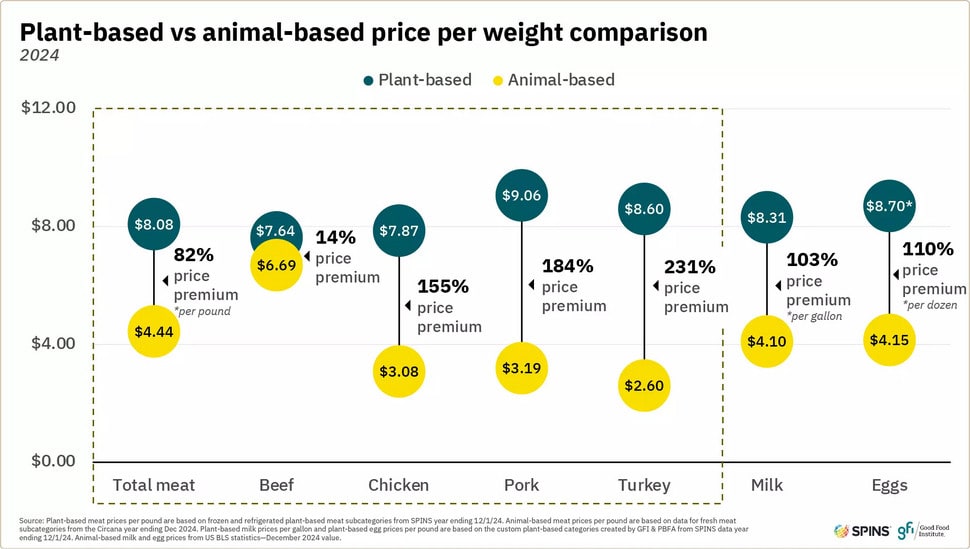
Regarding PBM pricing: the specific figures I cite in the paper and in the graph come from GFI's State of the Industry Report on plant-based meat which indicate: "Plant-based meat prices per pound are based on frozen and refrigerated plant-based meat subcategories from SPINS year ending 12/1/24. Animal-based meat prices per pound are based on data for fresh meat subcategories from the Circana year ending Dec. 2024."
Thank you for this interesting post on EA engagement with biodiversity funding.
However, I'm somewhat skeptical about the emphasis on cultivated meat as a default solution for biodiversity concerns. While I recognize its potential environmental benefits compared to conventional meat, there are several reasons to question whether it should be prioritized as heavily as suggested.
I've explored some of these concerns in a previous post, which I'd encourage you to consult. Briefly, the main arguments include:
The cannibalization problem: Available consumer data (Slade 2018; Bryant & Sanctorum 2021) suggests substantial overlap between consumers interested in cultivated and plant-based alternatives. This raises concerns that cultivated meat may primarily displace plant-based options, which often perform better environmentally, rather than conventional meat.
Timeline and plant-based trajectory: By the time cultivated meat achieves commercial viability, plant-based alternatives will have continued improving. Products like Beyond and Impossible burgers are already approaching taste parity in certain contexts, and the quality improvement trajectory over the past decade has been remarkable.
Cost considerations: Even optimistic techno-economic analyses project production costs around $20/kg or higher in the near term, while plant-based alternatives continue approaching price parity with conventional meat.
Strategic resource allocation: The substantial attention and funding directed toward cultivated meat creates potential opportunity costs within the alternative protein space, where resources and political capital are finite.
I'm not arguing against all cultivated meat research (maintaining diverse technological options has value). However, I believe the current enthusiasm within EA, as reflected in your post, may be disproportionate to the available evidence.
Thank you for your kind comment!
Regarding pets, I know that the company Meatly has marketed a product with cultivated cells in the United Kingdom. But I'm not sure how widely available it is. My opinion is that products that include small quantities of cells will exist, but will remain in the premium pet food segment, similar to how insect-based products are positioned today.
Thank you for your comment!
To clarify my position regarding your question: "It seems like you think that existing plant-based options are close to price/taste competitiveness already, was my above impression incorrect?"
In my assessment, plant-based meat still has significant ground to cover in terms of both price and taste parity when viewed holistically, despite notable exceptions in the market.
For taste parity specifically, we've made remarkable progress with certain products. Nuggets, for instance, have essentially achieved taste equivalence according to some studies. Fast-food burgers are also approaching this milestone. Additionally, we occasionally see standout products in various categories that come remarkably close to their animal-based counterparts, as exemplified by the examples I mentioned in my post.
Regarding price parity, while still distant overall, the gap continues to narrow, particularly for beef alternatives.
What often gets overlooked in this discussion—and what I'd like to emphasize—is the rapid advancement of plant-based alternatives. The quality improvement over the past decade has been extraordinary. Meanwhile, cultivated meat faces a lengthy timeline before achieving significant market presence (even in hybrid formulations). Therefore, comparing an idealized future cultivated product against today's plant-based options creates a false equivalence.
I'm confident that within the next 10-15 years, we'll achieve near-complete price and taste parity across numerous animal product categories through plant-based innovation. By then, the supposed advantages of cultivated meat may prove far less compelling than currently anticipated.
Thanks Denis, happy if it helps. A few quick reactions to your points.
On legality: you may well be right that they have it covered. FlyBox’s own guide to EU regulation is a useful reference: it says the main constraint is feedstock, with only pre-consumer, plant-based waste streams and specific animal by-products allowed, and no post-consumer waste, for larvae destined for the feed chain. The grey area is that last qualifier. Some operators argue that if the larvae don’t go into feed, they are treating waste rather than farming animals. FlyBox’s CEO put it bluntly: “If we call it insect farming, you trigger all the farming regulations. If we call it insect waste management, it’s a completely different thing” (AgNavigator, 2026). As far as I can tell, EU law doesn’t currently offer that route, and no insect process has been authorised as a waste treatment. But I’m not a lawyer and the texts aren’t very clear on this, so the simplest question for the proposers is: where do the larvae end up, and on what legal basis can they use the substrate they plan to use?
On credibility: I agree they are probably serious people. But Ÿnsect, which raised more than $600 million before being put into judicial liquidation at the end of 2025, also had credible experts, and so did the many insect companies that have failed over the last two years (ENORM, InSeco, FarmInsect, Goterra and others). There are several possible explanations. One is that a strong technical team can still have a blind spot on one part of the chain: substrate supply, regulation, scale-up costs, or what buyers will actually pay for the by-products. My job is to assess the scientific literature, and it is not kind to the promises of insect farming, especially once you look at real operating conditions rather than the early projections, which underestimated a lot of barriers.
On sentience as a PR risk: I think that’s a good angle, and the risk is already real. In August, Wakker Dier, one of the main Dutch animal welfare NGOs, filed a complaint with the Dutch advertising regulator over Protix’s green claims. Several Dutch newspapers picked it up (BN DeStem, De Gelderlander, Reformatorisch Dagblad), with headlines about billions of animals bred and killed. The next day, activists in Amsterdam held what they called the first protest against insect farming, urging the Dutch state investment fund Invest-NL not to put money into Protix.
Again, feel free to message me if I can be useful at any point.