
This is a linkpost for https://claude.ai/code/artifact/13264ce5-1e12-4443-a2e4-0b9515102681
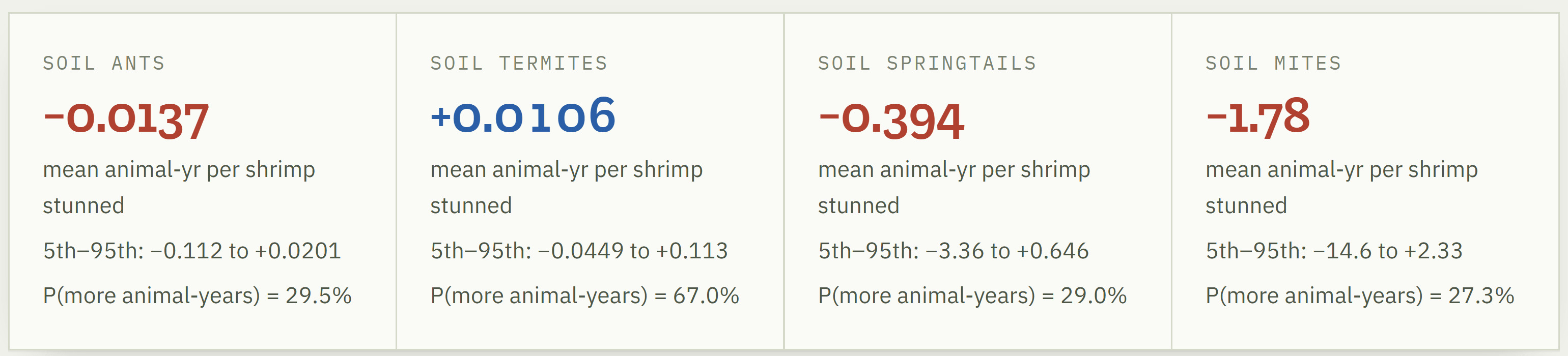
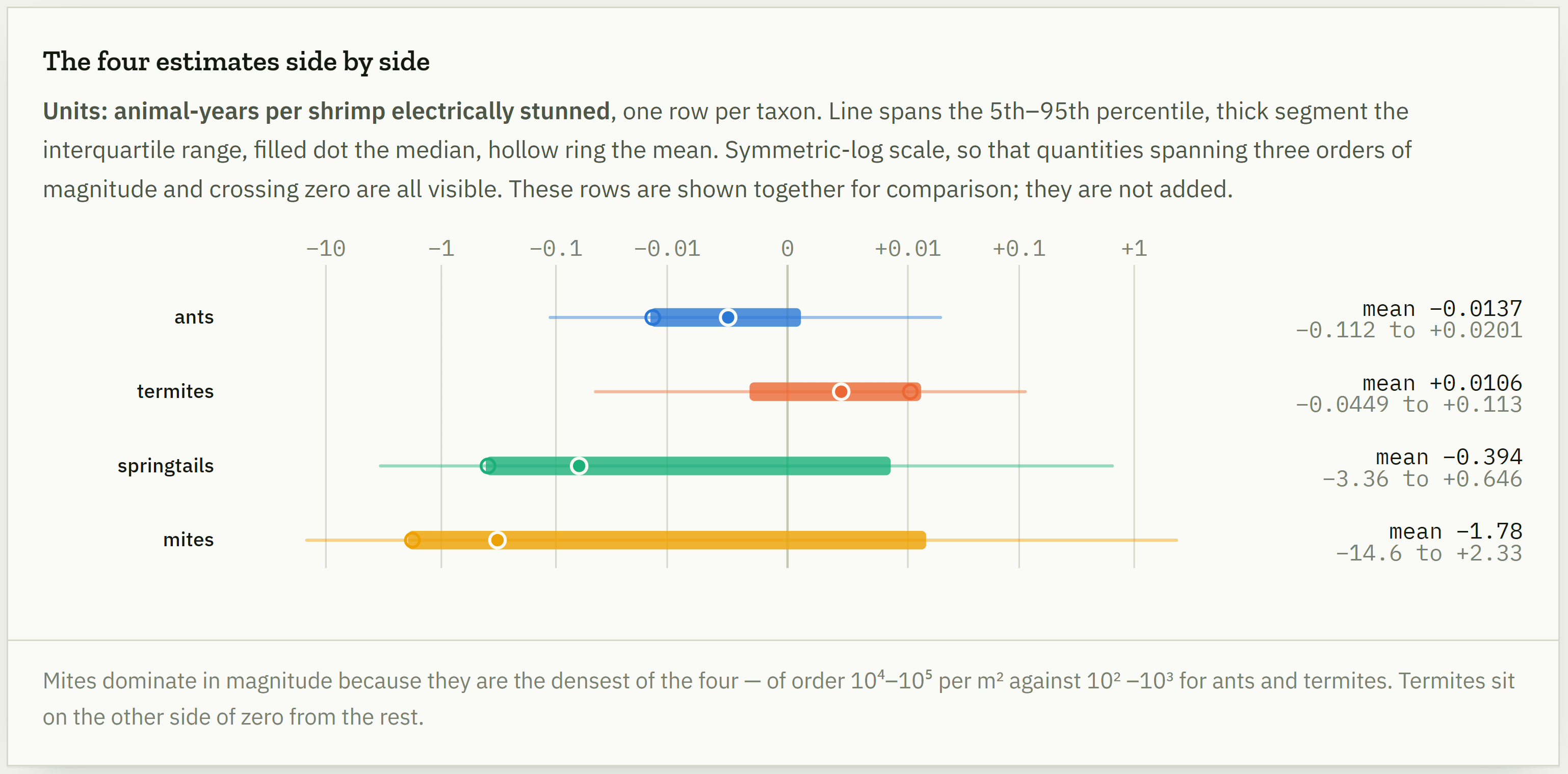
This is a linkpost to an artifact I built with Claude Opus 5 and 5.5 High analysing how electrically stunning farmed shrimps affects the living time of soil invertebrates. I looked into ants, termites, springtails, and mites. The main results are below. I believe electrically stunning farmed shrimps is the intervention that comes closest to robustly increasing welfare of those I am aware of. However, I continue to think it may change the welfare of soil invertebrates more or less than that of farmed shrimps. I can see a reduction of 0.394 soil-springtail-years, or 1.78 soil-mite-years changing welfare more than electrically stunning a shrimp.
Cool!
Though I found it a bit confusing to assume that the full price of the stunner is absorbed into the price, given SWP donate the stunners.
Hello. Thanks. Assuming the stunners are subsidised has a small effect on the change in soil-arthropod-years per electrically stunned shrimp.
Here are the details.
I assume the stunners are not subsidised in the baseline scenario because I am expecting subsidised stunners to stun a minority of the shrimps electrically stunned in the future. @Aaron Boddy🔸, who was the CEO of the Shrimp Welfare Project (SWP) until July 2026, commented the following on 7 Octoner 2024.