

Yarrow Bouchard 🔸
Bio
I got interested in effective altruism back before it was called effective altruism, back before Giving What We Can had a website. Later on, I got involved in my university EA group and helped run it for a few years. I joined the Effective Altruism Forum to try to figure out where effective altruism could fit into my life these days and what it means to me. You can read my latest thoughts on effective altruism here.
I write on Substack, and used to write on Medium.
Pronouns: she/her or they/them.
Posts 33
Comments783
Topic contributions13
Will anyone take the other side of this bet? By January 1, 2034, the New York Times, Wall Street Journal, Financial Times, and Bloomberg will all agree the AI bubble has popped. (As in, they will all report it as news, not just publish an opinion column saying so.)
The stakes: $20 to the charity of the winner's choice.
Why this bet? Mainly just for fun. But also to make a point.
I chose 7 years as the time horizon for the bet because I read that 5 to 7 years is the time horizon for many AI investments.
My hunch is that the AI bubble will pop within 3 years, but who knows. Markets can keep lending and investing in unprofitable ventures for a very long time.
Some may take the claims of a few experts or their own “vibes” as evidence that we should be very worried about existential risk, but it’s important to remember that humans have a natural proclivity towards believing that their generation could be the last. (According to Pew, “39% of adults believe that humanity is ‘living in the end times.’”)
On this topic, I can't recommend enough a talk given by sociologist and transhumanist James J. Hughes called "Avoiding Millenialist Cognitive Biases": https://podcasts.ox.ac.uk/avoiding-millennialist-cognitive-biases?video=1
Hughes also wrote an essay on the same topic in the anthology Global Catastrophic Risks.
Hi Vasco. I think we know for sure the probability that people who've been convicted of crimes will reoffend is far greater than for people who have never committed a crime. We don't have to ask what if.
Beyond the risk of Caroline Ellison committing illegal or unethical acts at Manifund, and beyond the risk of Austin Chen encouraging such acts or covering them up — which are both serious, rational concerns — there is also the corruption aspect. This hire is explicitly a reward, a show of thanks, an act of loyalty on Austin Chen's part to reciprocate the crimes committed by Caroline Ellison.
The corruption aspect would still exist if the hire were for a non-financial role or if the reward came in some other form, such as cash given by Austin to Caroline. Usually people don't admit corrupt intent out loud but Austin took the unusual step of writing a public confession.
In my view, the effective altruist community is still underreacting to this even though the reaction has been strong and negative. This is brazen financial corruption and outright encouragement of financial crime. The underreaction of the EA community makes it seem like everything said in defense of EA about the crimes at FTX was a lie. The corruption is now happening in plain sight. No one can pretend they don't know what's happening. Where is the accountability? Where are the consequences? The Centre for Effective Altruism's sanction of Manifund is a good first step, but it's not enough.
I don't know what the wider world's reaction will be if or when the news spreads of just how tolerant the EA community is of financial corruption. But I can say for me, my trust in the EA community has been decimated by this. I personally no longer trust the EA community to not engage in unethical (or even illegal) financial conduct, such as self-dealing with money from EA charities, or covering up improper acts committed by others at EA charities. When a community is so tolerant of such brazen corruption, how can I trust them?
As Maya Angelou is reported to have said, “When someone shows you who they are, believe them.”
As recently as April 2025, Austin defended Sam Bankman-Fried on a podcast. In response to a host's assertion that Sam Bankman-Fried "did [things] badly and hurt a lot of people", Austin said:
I don't know, still debatable. I don't know how much we should go into the object level here, but everyone made their money back. Yes, some things broke for that to be able to happen, but all the people got 120% of the value of the crypto holdings at the time...
He followed-up by saying:
...I think we should free SBF and put him to work.
Continuing on this thread a bit later on, Austin said:
...yes, [Sam Bankman-Fried] made like big mistakes, but there were things that he did really right. Oh, I think this is a piece I talked about a lot in my post, and is important to me.
Like in some sense Sam made a lot of really, good decisions and maybe a few really bad ones. And I think it's easy to focus on oh, those bad decisions, I would never have made those bad decisions. But I think I have a lot more sympathy for somebody like Sam because I am sometimes in a position making a lot of decisions too.
And I think oh, the hard thing is not to avoid the couple of bad decisions. The hard thing is to actually have figured out what all the right decisions you could have made, were such that you are in the position to then have to think hard about the one or two bad decisions too. I'm like, many people never get to that place for the goals that matter to them. And I think it is like something somewhat instructive to learn from the perspective of, Sam Bankman-Fried having won a lot at something. Of course.
Austin goes on further in that vein. You can listen or read the full transcript.
Austin's post about hiring Caroline reads, to me, as if he's still downplaying the extent of crime and wrongdoing that FTX and Alameda executives committed, similar to what he said on this podcast in April 2025.
My interpretation is that Austin's views on this topic have not fundamentally changed since April 2025.
For context, Austin also defended Sam Bankman-Fried in November 2022, lambasting people in EA who spoke out against him:
EA leaders have posted denunciations of fraud, and distanced themselves from Sam; the most upvoted all-time EA Forum post is a community condemnation; the entire Future Fund team up and resigned.
Austin wrote that this showed a lack of "loyalty":
...from EA folks, this behavior strikes me as cowardly, coldhearted, opportunistic, bandwagon-y, two-faced and distasteful. ... Whatever happened to loyalty? To supporting those who have helped you in the past?
To my knowledge, he has never retracted these comments. On the contrary. On the April 2025 podcast, he reiterated this same point, saying:
I think if you abandon people who have what I viewed as earnestly try to support you and your movement. If you just turn tail on them, be like, "oh yeah, no, actually SBF he was not acting according to our principles and we do not endorse this" and we like give up on all of the stuff that he did. Then when some future billionaire is looking at your movement, what will they think?
And:
Maybe I am a person who someday hopes to be a billionaire and I was looking at the actions of people l in this space and be like, do I want to be their friends, their allies? If I feel like in like cases when things go badly, they will just not stand by me.
My interpretation is that Austin's view is some combination of 1) crime and wrongdoing did not occur at FTX or Alameda to the extent that most people believe and 2) some amount of crime and wrongdoing is good or acceptable in the service of Austin's goals and EA's goals. He both downplays the extent of what happened at FTX and also makes an argument along the lines of you can't make an omelette without breaking a few eggs.
...I generally don't think it's unethical to make private hiring decisions based on whatever criteria you want.
It's unethical for Austin to give someone a job out of prison as a reward for her financial crimes, as a way of saying thanks or repaying a perceived debt (as he put it) because her crimes personally benefited him and his organizations. That's just straight-up corruption. That rewards and incentivizes, not to mention endorses, financial crimes.
This is a quid pro quo in some sense. It may not be a quid pro quo in the sense that this was the explicit arrangement from the outset, but it's a quid pro quo in the sense that the hire was made at least in part in exchange for the $1.5 million that Manifold and Manifund received from FTX.
The precedent this sets up is that if you commit crimes that benefit Austin, he'll reward you when you get out of prison (if you get caught).
In terms of what's illegal or not, I don't know (ask a lawyer, not me), but this is absolutely unethical.
Edited to add:
Given this precedent, Caroline has reason to believe that, while working in a financial capacity at Manifund, if she commits crimes or unethical acts that benefit Manifund, Manifold, or Austin, then Austin may cover her, cover up for her, defend her, not report her, etc. Austin has again and again emphasized — publicly! — that "loyalty" and "winning" are more important than the law or business ethics. At this point, Caroline has reason to believe Austin has her back even if what she does is illegal or unethical, as long as it directly benefits Austin and his organizations.
Bringing it back to EA: I understand the argument that Manifund and Austin do not represent most of the EA community. But it's reasonable that outsiders might think they do if EA orgs don't take steps to distance themselves. I'm glad to see CEA doing so.
If the EA community endorses or even just tolerates the decision and allows Manifund, Austin, and Caroline to participate in the community, e.g., through events hosted by EA orgs like the CEA (which as far as I know has not yet been ruled out), then in that sense Manifund, Austin, and Caroline will represent the EA community.
The sanction against Manifund that Zachary Robinson announced yesterday is a great start. But there are additional straightforward steps that can and should be taken to dissociate effective altruism from the financial corruption Austin just committed and the financial crime Caroline committed and served prison time for.
If the EA community can't agree that financial corruption or financial crime is an ethical red line and won't take decisive action to discourage it, the EA community should be correctly understood — by everyone, including both community insiders and outsiders — as ethically compromised.
It's not really about how things look. It's about how things are. Caroline really did steal money. Austin really did reward her for it.
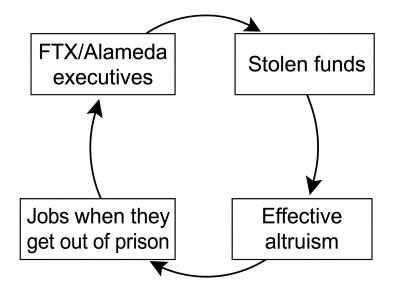
The EA community should not tolerate this:
Hi Bruce! I recently attended a Zoom book talk you gave and I really enjoyed it. :)
My answer to your question:
It can be frustrating when people just click disagree and don't explain why, but I don't know that making agree and disagree votes non-anonymous would make much difference. I assume if people want to explain why they disagree they'll write a comment, and if they don't they won't. If disagree votes were non-anonymous, would it result in more people writing comments explaining why they disagree? Well, why would it?
In my view, agree and disagree votes and karma upvotes and downvotes are not all that meaningful, anyway. I find them be a hard-to-ignore distraction from meaningful engagement with people through words, rather than votes. If you create a points system, everybody wants to go for a high score, but that's not the point of a forum.
Overall I would generally just caution people from investing much time or emotional energy in the EA Forum. It's a perfectly fine place to post announcements for organizations like the Good Food Institute and answer questions. In terms of actual deep, meaningful discussion, it's better to seek out — or even create — alternatives. The culture here is sour and trollish. Rather than enforcing norms of civility, the moderators encourage and even engage in the bad behaviour themselves. The only hope I can see of this changing would be if the Centre for Effective Altruism were to choose new people to run the forum who were committed to changing the culture. But what are the odds of that happening?
Anyway, that's a bit of a digression.