
I’m a bit concerned that the EA Forum is going to die a slow death. I don’t want this to happen as it has long been, in my opinion, the best place on the internet. I'd like it to stay that way. I personally have found myself engaging less, because the content is less interesting and relevant to me.
I also think some of the trends I highlight below are due to CEA investing less in the Forum (e.g., my impression is the Forum team is smaller than it used to be). I think a lot of what I critique below is downstream of community dynamics, rather than the Forum itself. But I also think injecting the EA Forum with a vibrant intellectual culture will be good for EA as a whole.
The point of this post is to open a discussion, and give my own ideas for what I think might help. I welcome people to disagree, share their own takes on what the EA Forum should be, and the purpose it serves.
EA Forum moderators — I think you all do an admirable job. My personal view is that there should be way more of you doing way more to keep the community vibrant. To the extent this is a critique of your work, it's coming from a place of thinking that you are doing an essential community service that I want more of.
It's possible that the death of the EA Forum is downstream from other community dynamics (like a massive shift to AI safety from previously highly engaged people). But the EA Forum could have been (and maybe still could be) a place where these ideas were discussed. My guess is that a strong EA Forum is actually a fundamental part of keeping EA thriving, as long as EA is going to be a global movement, and working actively to keep it strong is essential to the future of EA.
Is the EA Forum dying?
I think so. Here's 10 years of data on EA Forum engagement:
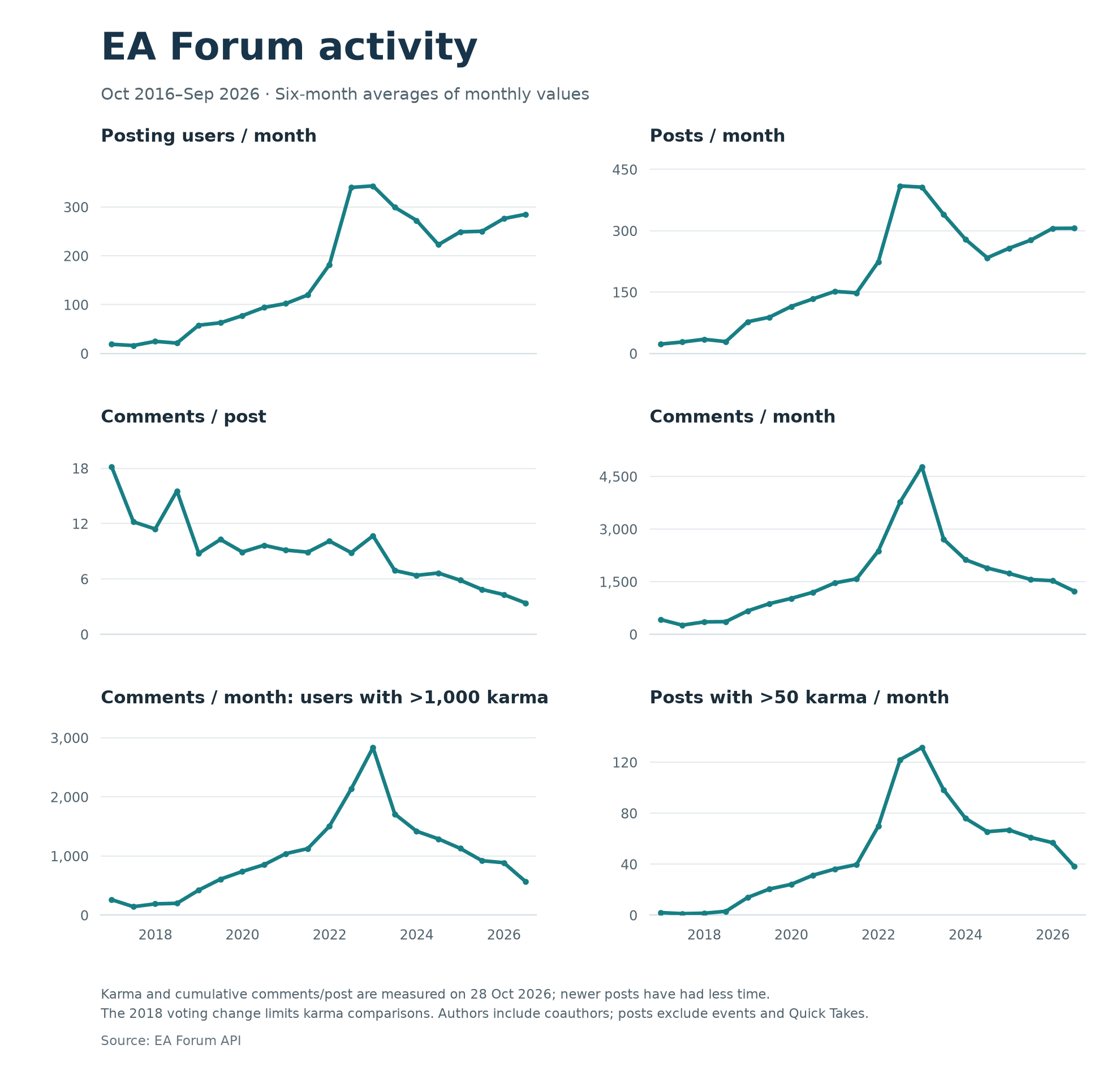
My interpretation of these data is that the number of users and top-level posts on the Forum has steadily increased, with a massive spike then decline around FTX, but otherwise the Forum just continues to grow. But until the post-FTX decline, other important metrics, like comments from high-karma users, highly-upvoted posts, and comments generally were also increasing. Post-FTX, these metrics have all declined precipitously. Comments per post, which I think is the most important EA Forum success metric (if we want to Goodhart anything), have declined across this entire period. I think this is especially bad — it means that more and more, the Forum is being filled with posts that readers don't find to be worth talking about!
I think the ideal version of the Forum is fewer, higher quality posts, and way more comments. Ideally, those comments are from highly engaged people, who are having useful discourse about disagreements and cruxes. These trends suggest the opposite: there are more posts from more people, but these posts aren't heavily engaged with (suggesting that they don't say anything useful?), and aren't engaged with by the highest context people.
What’s the value of the Forum?
I used to think the EA Forum was mainly fun and distracting, and didn't think it was that valuable. But I've realized in seeing it decline that it was actually core to EA succeeding as an intellectual movement, and meaningfully increased the quality of the community. I was wrong about it being a distraction — it was serving some important functions:
- It was a central conversation ground for the EA community.
- It provided a good way to disseminate information to EAs / share research that might be relevant to people.
- It was a place where you can be somewhat certain that ~most highly engaged EAs will see at least the title of your post, if not read it.
- It kept globally dispersed people engaged with the ideas of EA, and kept active intellectual discourse alive.
Currently, I think the weight is shifting:
- There isn't really a central conversation place for EAs — discussion seems to happen in disjointed private events, at EA Globals, or on Substack (though I think the discussion quality on Substack is much worse, even though many posts are good).
- I don't think many professional EAs read the Forum regularly anymore.
- The Forum seems to have a lot more people who are new to EA, and it is filled with content that seems to rehash old discussions, which doesn't get much engagement.
To me, the EA Forum was the core intellectual center of EA in the past. It was a place where there was reliably extremely high-quality discussion about difficult ideas. I think that the best version of EA maintains this, and getting the Forum to that place again is pretty important for the future of EA.
Ideas for saving the Forum
A lot of my thinking here is informed by LessWrong. I typically don't find LessWrong content as relevant to me as good EA Forum content, but LessWrong seems to have been much more successful at keeping their intellectual culture alive. It has much heavier moderation than the EA Forum, and they create bigger walls around new users posting. I think this post in particular highlights a philosophy that has kept LessWrong successful while the Forum has declined.
Here are a bunch of ideas that I think would help the Forum do a better job at keeping its own culture alive.
- Stop the posting of Substack slop.
- Substack pushes people to post a lot, which is good for their bottom line. But posting a lot drives down quality, because authors feel like they have to put something up even when they don't have much to say. As a result, most posts on Substack are worse than a good EA Forum piece, and authors cross-posting to the Forum are porting that bad outcome here.
- I'm am one of the people guilty of this. Many of these authors are great researchers or thinkers who have written thoughtful things in the past. They should save those pieces for the Forum, and stop using the Forum as a way to generate subscriptions on Substack. I might be in favor of fully moderated cross-posts just to prevent this.
- Note that Substack posts often are good and contain good ideas! I am calling them slop here because they don't really advance the conversations that are essential to EA, aren't interesting to discuss, and just flood the Forum with boring and obvious points in order to get Anthropic donors' eyes on them, or to generate subscriptions.
- Examples of Substack posts I don't consider to meet the bar I want to hold the EA Forum to (including my own because I'm naming names):
- I've purposely selected authors who regularly write content far above the bar for the Forum, to illustrate that it is not author quality that causes this dynamic, but post-frequency pressures or a cultural shift or something else. Substack rewards posting all the time, but the EA Forum shouldn't — it should reward posting really good stuff.
- Substack pushes people to post a lot, which is good for their bottom line. But posting a lot drives down quality, because authors feel like they have to put something up even when they don't have much to say. As a result, most posts on Substack are worse than a good EA Forum piece, and authors cross-posting to the Forum are porting that bad outcome here.
- Relatedly, we don't need a marginal millionth piece on how Anthropic donors should engage with philanthropic advisors or think about their giving.
- Generally discourage cross-posting
- I think that cross-posted things are sometimes useful, but I've noticed that most cross-posted things get little engagement, and just bury the Forum in less relevant content. Maybe the Forum should have a sidebar where people can submit relevant links that are voted on or commented on (more like Hacker News) that aren't primary posts? This could also help with the Substack slop issue — those posts can go there, and be voted on based on relevance.
- Generally don't post links to the EA Forum on Substack (to prevent random people from engaging without an understanding of the context).
- People shouldn't do this stuff — it just causes brigading / increases in low-quality accounts and comments. Advertising this post on Substack does nothing for the EA community, and degrades the quality of the Forum.
- Obviously there are times where linking to the Forum is useful, and this is mainly a cultural norm, not something the Forum team can enforce. But I think a stronger norm of being thoughtful about audiences on the Forum versus elsewhere would be good.
- Rate limit new posters until the acquire some amount of karma via comments.
- I think part of what makes the Forum great is that the people you engage with are good faith, say thoughtful things, and have a high degree of reasoning transparency. People are rewarded for doing this well via karma and upvotes. I think it is fine to rate-limit people who do this poorly, or haven't yet demonstrated that they can do this (e.g., new users) until they reach certain karma thresholds.
- LessWrong has better policies on this, and the EA Forum should do the same.
- Heavily down-weight or ban AI-generated content
- I think LessWrong's relatively strict LLM policing is much better than the Forum's. As time goes on, the Forum has gotten more low-quality AI-generated posts. They get labelled as such, but are still bad. Forcing that content into separate, labelled blocks within posts, and moderating out violations seems good for keeping the Forum high quality.
- Do more prizes, contests, and events.
- I think that running things like the EA Forum prizes, contests, and other events usually significantly improve post quality. The Forum could go back to doing way more of this!
- Addressing my personal pet peeve: let users choose how their content is licensed.
- Currently, all content posted on the EA Forum is licensed under a CC-BY license. That means it can be used commercially by anyone as long as there is attribution. I am free to, for example, sell and profit off a book that takes your posts and repackages them without your permission, as long as I attribute the authorship to you.
- I generally like Creative Commons licenses, but this specifically does cause me to post fewer things on the Forum, because I sometimes don't want to give people that ability! If this is true for other people, I think that either authors choosing their own license, or changing the default to CC-BY Non-Commercial would be better.
- Additionally, in past roles, this sometimes led to issues (e.g. if a contract funds me to write something, and the contract-holder owns the copyright, even if they are okay with me sharing the post, they might not want me to allow it to be used by others commercially). LessWrong just allows users to own their posted work and license it how they please, which seems much cleaner.
One of the most obvious objections to what I'm saying here is that it is creating a gate-kept version of EA where newcomers don't have any way to get involved. But I think the EA Forum should not be a tool for community growth, and therefore shouldn't be optimized for that purpose. There need to be places for people new to EA to learn and talk about these ideas, but I think it is okay for the Forum to not be that, and instead be a place where highly-engaged people can push these ideas forward.
- I think the Forum works best when everyone has some baseline of shared knowledge, context, and vocabulary. That means it shouldn't be a place where people brand new to EA share their ideas without historic context on how they've been discussed.
- The EA community has tons of introductory reading materials, fellowships, and ways for newcomers to get involved. The Forum should cater to insiders and more heavily engaged people. Things like the Featured page push the other direction.
- If this is right, there are a variety of adjustments that could be made to prioritize discussion between relative experts, rather than introductory content.
- Make the Forum invite only — give existing users, maybe based on karma, the ability to invite new people, and don't let people freely register (you can also give fellowship organizers, student organizers, core organizations, etc. the ability to invite people freely, to ensure there are a diversity of pathways in).
- Have people apply to get accounts, and discuss their engagement with EA in that application.
- If the Forum doesn't make registration invite-only, I think it could consider having introductory sequences for people to read through when they register. Often, new users will post ideas that have been discussed extensively before, and would benefit from seeing big hits and discussion from the past before posting.
A second objection might be that more content is better, and more content drives engagement more than quality. For example, Seth Ariel Green recently called for a lower bar to posting, because they feel that their community is letting the perfect be the enemy of the good.
The question is, what is growth and engagement for? If community building, see above. But if idea generating and refining, then I disagree -- high quality posts do this a lot better than high volume. I don't think that should mean a strong conceptual piece sits in drafts for ever because it's not stylistically polished. But I do mean: post when you have something interesting and important to say, and you've thought about it a lot!
I basically agree with the observation, but I'm less sure about both diagnosis and management. I would primarily attribute forum decline to structural developments (vs. say, the 'golden age' ~10 years ago):
1. Specialisation: If the last decade or two of work has 'made progress' on EA topics, we might expect it to get progressively harder for newcomers to usefully increment the state of the art. So you might also expect something like the specialization we see in science: it takes years for someone to get up to speed on astronomy, astronomers mostly discuss their work with fellow astronomers, a little with related disciplines (e.g. sometimes physicists, very rarely oncologists), and their channel to the general public is education/comms/service rather than 'invite all comers to our conferences'.
The price of this progress is there are fewer valuable discussions to have on a general forum. Specialized venues are more attractive to subject-matter experts as they select for a higher quality audience than a '101-space'. Perennial 'cause prio questions' have been tilled over extensively (and most old hands have resiliently made up their minds), so the prospects of the n+1th discussion of (say) the poor meat eater problem finding the consideration which settles the matter looks increasingly remote.
So the 'evergreen' topics get tightly circumscribed to: 1) General-ish topics which are still niche enough not to inspire a funder to employ a small army of analysts to attack (perhaps my own 'epistemic self-help' oeuvre). 2) Community drama/gossip: no barrier to entry to pile in, and at least the particular gory details are novel. 3) 'Community engagement' through press-release/announcement/ad.
2. Competing options for contributor time: Harking back to my glory days, my archetype then was shared by many other 'EA forum grandees': 20-something, early-career job outside EA, writing here as an unpaid hobby. That archetype has largely evaporated. These people are now 30-something (and the incipient-middle-age dividends of spouse/kids/ailing parents seldom grant oodles more 'free time'), are now mid-career+ (ditto), and - perhaps most importantly - are often 'doing something EA(/adjacent)' as their job.
The latter competes with forum activity: their day job both pays much more (i.e. at all) and is better matched to whatever their strengths may be than labouring to contribute on an online forum. Even those who are especially well-suited to online writing have much easier opportunities to 'go pro' or try and monetize themselves rather than provide their surplus for free than back in times of yore.
--
If the above is most of the story, then 'intellectual culture'-style tweaks can only really help around the edges. In essence, the forum thrived at a time when amateurism was the norm, and inefficiency alongside altruism collectively generated a public surplus (e.g. 'investment banker spends their evenings on an early write-up for AI giving opportunities'). Although hopefully altruism has not faded, efficiency has improved, and so energy which was once spent on the forum now gets redirected to more effective ends.
I agree that those specific people are now 30-something, but I still see a lot of this archetype on twitter, substack, etc.
I definitely agree about the specialization being a factor, but I guess I wonder why LessWrong continues to thrive (and many formerly prolific EA Forum contributors continue to post there). I don't think the solution here, to be clear, is "woo back LessWrong users," but I guess I see LessWrong's thriving as evidence that there might be ways to recover the EA Forum as a place for useful discourse, including from busier/more senior people.
I would consider LessWrong one of the 'specialized venues', given most of its current activity is 'about AI'. So insofar as many(/most?) 'senior EAs' consider their cause prior settled to 'AI for the forseeable future, and I'm confident other things are less important - and even more confident they are less urgent', migration of their activity from an 'EA forum' to 'AI forum(s)' follows fairly naturally.
+1 and I'd further add a few points:
As someone who used to post here a lot I have mixed feelings about it. On the one hand, I think writing that much did sharpen my communication and made me better (read: more efficient/transparent, but also more boring) writer. Having an avenue to post where I would get feedback was a pretty decent motivator.
On the other hand, it was also very inefficient because a lot of time was wasted on the incredibly high bar for posting (e.g. in the extremes, failing to make my points clear because I was worried about push back and criticism). I feel conflcited though because I don't see a clearly better or faster path for me to learn what I did - and even just 3 years after I joined it became much less important (in community building at least) to do this - more paid positions, internships etc.
1a) even in its heyday, there were real problems with the EA forum: Many people with really interesting takes that I thought the community should be disucssing were simply too intimidated or shy to post to the to um. I don't know if Substack fixes this. But from a writers perspective i think it's the better product: more freedom, control, les pressure to write like an EA, and be judged. I distinctly remember my very first comment on the EA forum got a very typical and critical response. I was not expecting it, and if someone else had a similar experience and was put off from posting I'd totally understand.
So much to say in response to this. First of all, thank you for caring, and for writing this appeal.
I want to start by reassuring you that I agree. Not necessarily with all of your prescriptions (though they are all worth considering) but with the diagnosis. I agree that the Forum has been marginally too focused on 'growth'.
As Sarah writes in another comment, CEA, or a lot of CEA work is indeed focused on community growth. We are proposing an alternative goal for the Forum - roughly 'effectiveness for engaged EAs'. In practice (I'm working on finalising metrics today) this means measuring some proxy metrics - like % of people in "EA" jobs who visit the Forum at least monthly (relevance), number of words in comments (loose proxy for quality of discussion, especially if tempered by karma and ignoring AI), and some measure of ultimate impact, probably surveys of engaged EAs to find out when posts change their donation or career decisions. We've been testing this new theory of change out over the last few months.
Unfortunately, since we've started experimenting with the new ToC, we've had a lot of capacity issues - Sarah left, Agnes is on Maternity, I had to take two months of unscheduled leave for family reasons etc... the bottom line is that right now we are one dev, and one me (who has just got back to work). Despite this we have been able to make some moves in the direction of this ToC:
This new direction for the Forum came from me thinking about two things you mentioned.
That second point is what I called in some memos the 'social reproduction of EA'. We could easily grow an EA movement that is overly attached to the current institutions and beliefs of EAs - a movement that takes current 'cause areas' as fixed, and gets a lot of people into great jobs. This would be very impactful in the short term. But if we want there to be an EA movement existing into the future (i.e. in the next decade) that is capable of coming up with new ideas, and pivoting to the new most impactful cause areas when that's what the world needs - we need to continually recreate EA as an intellectual community, as well as a practical one. This isn't a unique problem to our time, it's in the natural life cycle of a highly committed EA to be excited by a range of causes and ideas, then over time make more commitments such that it is harder, emotionally and likely fiscally, to change direction.
I'm not sure whether the Forum has been successful in the social reproduction of EA in the past - there are some examples of people who become contributing EAs through engagement just with the Forum, but I'd guess that more people become EAs through in-person communities in concert with the Forum, and without the Forum, 'EA ideas' will by default come from orgs which have constrained charitable purposes, and are therefore more sticky and less able to pivot than individuals.
Much more to say but the point is I agree, and I'm very interested in making and keeping the Forum as the intellectual core of EA.
Quickfire on some of your suggestions.
Thanks again for writing it, and let me know if you (or other commenters) want to find a time to chat about the Forum on a call. I'm especially keen to hear more ideas, like these, for achieving the vision of the Forum that I think we share.
Caveat here that I'm representing only my views, as EA Forum Product Lead, and not the considered views of CEA the organisation.
Thanks so much Toby, and for everything you all do!
This sounds very good to me — I think the contests and debate weeks, etc. seem like they've been really productive for spurring more discussion. I also think metrics more focused on how the Forum serves engaged people seems really good (though I see the tension with CEA's strategy that Sarah mentions)
RE the CCBY - I think this is very much my pet peeve, and might not apply to other people. It would cause me to post some things I haven't, but no idea if it matters to anyone else.
RE gatekeeping - I think I'd be pretty hesitant to see the Forum not be a public one (though there are some advantages to this), even if posting is invite only - this might be a bit weird, but could help by giving people the ability to read the content still? Or applying to make unreviewed top-level posts. I think I like rate limiting best of these ideas personally, because it has the lowest downside risk, but I actually don't have a great sense on how it would change post/comment volume.
On Substack — I feel pretty confused about this. There are clearly many things posted to Substack that should be on the Forum too and are worth discussing here. But I also am maybe acutely feeling that as Substack grows, it is much more rapidly getting lower quality on average, and having the Substack crossposts seems like it's bringing some of that over. The Forum team cross-posted ones I've seen are often great and relevant, but then I also post my kinda-relevant-but-really-only-here-for-more-eyes stuff.
Always happy to chat about this!
I'm a more frequent Substack poster than I am an EA forum poster and I see the two serving pretty distinct needs. I think if I were to thread this needle (in your shoes and had unlimited labor), I'd also opt for "a weekly links and discussion thread". It could be separated by subject matter or something. Then again ,the Hive newsletter already kind of does this for EA posts that are related to animal welfare. so what additional need is being met?
But also, we’re still figuring out what these relatively new mediums are fundamentally for. My own vote: I think the EA forum should be for things aimed at other EAs by EAs. Substack is aimed at reaching a broader audience. I don't see the two as potential substitutes.
Just my 2c.
By the way, if I wanted to filter out bots, I'd probably do something like, you have to post three comments before you can write your first post or quick take, and all three comments should pass some automated check of substantiveness. But I have not thought this through at all.
Thanks so much for writing this. I broadly agree with your post, and I've been concerned about this ever since I took over the Forum team a little over 2 years ago. I still believe that the most important thing the Forum team should do is proactive/intentional community building, i.e. cultivating a community around a specific group of people and culture that will generate valuable discussions, which could involve many of the specific interventions in your list. Measure progress based on the value of all the discussions rather than the number of people participating.
Based on my experience as team lead I'm not that optimistic about things turning around while the Forum is still at CEA, especially while CEA is focused on growth and brand. With Rory and Amy leaving, it feels like there are fewer and fewer people in CEA leadership who "get" the Forum. I seriously considered spinning the Forum out of CEA — I left before anything came of that but there's maybe a small chance that still happens. I think it's plausible that's the only real way to preserve the intellectual community version (although who knows, maybe CEA will hire someone in a year or two who can turn things around).
@Toby Tremlett🔹 and I worked closely on Forum strategy and I trust him to care about this as well. However, he is at a significant disadvantage relative to when I was team lead (ex. he basically has to do 3 jobs, no one was hired to backfill any loss of Forum capacity and there are no open JDs for the project) so I think it will be an uphill battle.
Thanks for sharing this! Yeah, I think that the Forum team is in a really hard position RE navigating this, and I can imagine that CEA's current goals could be in direct conflict with (what I think) is good for the Forum, though I'd argue that also having the Forum do what I'm imagining here would be very good for retention and keeping EA attractive to the most promising people.
Nod. For what it’s worth, here’s a copy-paste of something I wrote internally around 18 months ago (context: I’m a Forum moderator). Along with Sarah’s comment above,[1] it might shed some light on what’s gone on behind the scenes.
(I deeply appreciate Sarah’s efforts during her time as Forum lead, in what looked to me like an exhausting uphill battle.)
E.g., most versions of the Forum changing in order to achieve ‘improving the EA brand’ seem actively pretty terrible to me. IMO, the Forum being more appealing to outsiders would likely come at the cost of truthseekingness and willingness to engage in thinking that is deep, weird, and sometimes controversial (i.e., the kind of thinking that’s needed to make intellectual progress toward doing the most good).
Agreed that it's worth trying to improve the EA Forum. Most of your suggestions are about how to screen out low-quality posts. What I really care about is how to get more high-quality posts and comments.
Why aren't there more high-quality posts?
Why aren't there more high-quality comments?
"Get people to write more good content" is sort of a hard problem in general—there is no "good content dial" that you can turn. One answer that comes to mind is that grantmakers should pay more people to write, and especially to write comments / engage with other people's work. I don't know if anyone in history has ever gotten a grant solely for the purpose of writing forum comments, but it seems like the sort of thing that's totally worth funding under the right circumstances.
Or there could be weekly comment prizes for the top 3 comments of the week, or something like that.
Inkhaven is an attempt at getting people to write more. Few Inkhaven residents post on EAF. Why is that?
One point against the "the best posters are now busy" argument is that LessWrong seems to still get large amounts of engagement from extremely busy people (e.g. execs of AI safety orgs, lab employees, etc). So I suspect relevance of the Forum to their day-to-day work is a more important factor for busy people engaging than how busy they are, or something like that.
Hmm, I think a factor here is that AI safety orgs have more of a culture of writing a lot, and a lot of them have grievances against the EA community which is why they don't post on EAF. I think their grievances are largely justified in the sense that they can correctly point to prominent EAs who have acted badly, but I disagree that "stop engaging with the EA community" is the correct response. EA is the only community that's dedicated to cause-neutrally doing good; if EA dies, there will be zero such communities. If you care about cause-neutrally doing good, then I think the move is to engage with the community and try to be a model EA.
This is a hard problem to fix because there's a network effect. If AI safety people mainly post on LessWrong and not EAF, then other AI safety people don't have much reason to post on EAF—although I'm not sure that's really true because cross-posting is easy.
There's also a question of why AI safety people write a lot. I don't know the answer to that one.
I think another reason is EA being so much in the news these days. People might not want to associate with the forum because association with EA might harm their reputation or their other career goals.
People could always post anonymously, but speaking from firsthand experience, that feels a little weird in the beginning. There's also worries about AI de-anonymization in the future.
This is a good point. I guess one question is why (at least from my perspective) was there previously a lot more high quality engagement? I guess people might have been less busy, but I also think that the standard for making a post was just higher, and so people were more likely to find something useful in it.
One thing I noticed is that early in their launch, Forethought was doing a ton of public engagement on the Forum (and their own staff were leaving comments on the Forum on each others' work). This seemed pretty useful and could be something organizations encourage more? Forethought seemed to stop doing this for whatever reason (maybe because others didn't engage as much).
You mention that people might be less busy, but also I imagine (aka speculate without evidence) that some of the people doing these effort posts/effort comments were doing so with the desire to get hired to an EA role.
Once that happened, they transferred that energy to their new role and/or have a position where it doesn't make sense for them to be writing publicly on the EA forum.
Not that this is a perfect comparison, but this happens fairly often in the NBA draft community. The best hobby scouts, those writing detailed evaluations or developing new analytics, end up getting hired by teams to do it professionally and as a result the average insightfulness of public content degrades over time.
I think many of the people I'm thinking of (though definitely not all) already worked in EA roles at the time, so I'm not sure! But it wouldn't surprise me if that was a motivation at times.
You can just do things
My experience is that people often don't post for the mundane reason that they didn't really think about it.[1] Contests are a good way of counteracting this, but the monetary reward is usually not very motivating, it's just that it makes "posting about X" become a Thing with a Deadline etc.
An implication of this is that anyone (even you, dear reader) can solve this problem with a couple days of work:
This is basically all I did for the AI Pause Debate, for example, and that seemed to go fairly well.
For example: I am commenting here because someone messaged me to suggest that I do so. Otherwise I likely wouldn't have seen this post.
Would be interested in disagreement, fwiw here are my misc. thoughts on the forum and my experience with it:
"don't feel like I have a sense of where the main GH&W and animal welfare conversations happen, so someone else would need to speak to that."
On the global health front, I'm pretty confident there is no central place to have really good, open logical conversations about global health stuff. There are just places where people write opinion articles on things like devex and Stanford social review which have no critical way of engaging. The center for global development which is a big thought leader had no interest in truth seeking when I pushed back on an inaccurate article there, it took a popular forum post here to force them to engage.
I really like the new magazine InDevelopment - but my attempt to engage the one time I saw genuinely bad content flopped pretty badly although the editor seemed to do their best. The author has all the power in any official published context even if they are blatantly wrong. Academics and thought leaders like to protect themselves behind firewalls and it's hard to break through that publicly at least. That's why you won't see them in the forum here much. I'm impressed when they do wade in. Academia is often more a status game then a search for truth.
An active, moderated forum is the best way to discuss things meaningfully, and I hope we can still do that here.
I similarly think that animal welfare discourse is also not really centralized, and lots of things that are very insidery happens in Google Docs that are just shared around, etc.
I agree with the existence of a problem, but mostly don't think the proposed solutions will lead to major wins. My guess is that, roughly, "Constellation/Anthropic Slack killed EA Forum" - in that there's been a lot of evaporative cooling of the most high context people towards private chats and docs, and also specifically towards AI safety (as Fran notes).
I am quite interested in pushing against this gradient - see https://manifund.substack.com/p/total-safety-transparency about the importance of posting in public.
For now, I'm trying other initiatives to increase the amount of great writing and discussion - https://justwrite.club/ is one example, and I think an "EA Inkhaven" might also be pretty great if anyone wanted to facilitate that.
With a lot of love in my heart: I'm also uncertain that CEA is the right org to steward the EA Forum. From the outside it seems like the CEA online team has been losing great people, both technical and community/cultural talent. (Also I would guess the right format of a new "forum" looks completely different from the classic internet forums, given new AI capabilities - eg maybe more moltbook, or something even more wild.)
Yeah, I've appreciated that you / Lighthaven, etc. have done lots of pushes to get more writing into the world! My impression is that EA Meta funding has focused so heavily on career placements/growth in recent years that ideas like EA Inkhaven have been harder to get off the ground (but do seem really useful).
Because I like you and like your writing and you included yourself and you sort of paid me a reverse compliment with your subsequent bullet point, I am magnanimously choosing not to be offended by you calling my "more than 90% human-written" post "half-AI generated".
But yes, I kind of agree with your diagnosis of the problem.
I would also note that the incentives are still there to post on the forum even if you get no engagement or comments or karma. So even if nothing I wrote on my Substack ever generated any useful engagement here, there are still reasons to do it for GEO and a few referrals per post.
I would also note for the record that my Substack is free, so it doesn't directly affect my bottom line, but obviously traffic and cross-referrals help in other ways, and so this incentive is still there.
I haven't thought too much about your proposed solutions, but some sort of gatekeeping or rate limiting seems like a good idea. The issue is, as you say, rewarding bright new young thinkers sufficiently that they can gain a lot of karma and a following.
I would personally be fine with a world where it was somewhat hard to get something published on the forum, which would force me to create specific posts that cleared a bar, and completely discourage unedited cross-posting.
I agree that was too far! I updated the text. I debated not including specific posts, but then decided to include posts from people who I very much want to be active contributors to the EA Forum because it felt like it was the highest-risk-to-myself way for me to be specific. And, this might be a self-tell, but I think when I posted what I view as useful-but-below-EA-Forum-bar things on the Forum from my Substack, I was partially motivated that I like it when people subscribe to my Substack (despite it also not being monetized). Sorry if it landed rudely to you or other people I linked.
On lab donor facing stuff specifically, I think one worry I have is that part of the reason that lab donors read the EA Forum (or engaged with EA) was due to the vibrant intellectual culture and availability of high-quality content, so it having less of that and more Substack cross-posts, etc. makes them less likely to be here, and less likely to engage with high-quality EA ideas!
I wasn't offended, but thanks for following up :)
Late to the party but one way to solve this could be to set a norm in EA organizations to move internal discussions to the EA forum. A lot of us work remote already and we are used to written discussions. Moving them here wouldn't add that much friction and would do a lot to transparency/community engagement.
At a meta-level, it seems very hard to tell if a forum is falling from in-the-moment subjective experience: I feel like every online forum I've ever interacted with for nontrivial amounts of time (EA Forum, LessWrong, Quora, Facebook, Twitter, ACX comments, substack, reddit?, even the comments sections of my own blog) always constantly feels like they're in freefall and it always feels like the discussion forum in question is dying. This is true even if in retrospect the active period in question is looked back upon as a (relative) golden age of deep thought and inquiry (eg Quora in 2013-2014).
And yet at some point most of those forums really were dying, and at some point most of these forums truly did die[1]. This is probably true even if it's hard to see it from obvious metrics -- websites can have a zombified existence for a long time (Eg if I go to the front page of my Quora today, most of the posts aren't even Q&A posts, just vague clickbait/slop and images that is probably AI generated. A far cry from the halcyon old days).
Regardless, being around the block a few times, I've grown somewhat cynical of my ability, and that of other users, in discussion forums to pinpoint the likely causes and solutions to dying forums until long after a forum has died.
Still worth trying, naturally.
This has happened often enough that occasionally I wonder if I'm the common factor, though I currently lean against.
I'm fairly certain you aren't the common factor :).
I think that I agree — I guess there is some possibility that EA just had way more low hanging fruit in the early days, so it was easier to write pieces that significantly moved discourse forward, or be the first to explicitly state an idea that might look obvious in retrospect, and this was good for conversation.
There are a few Forum-relevant things I could have posted in the last 3 months which I chose to keep to the form of google docs that I share with the main people who'd want to read it, because I worry about the irreversibility of putting things on the open internet.
"It's probably time to stop using a public forum to discuss things" is a refrain I've heard 3+ times (and personally relayed, to be fair) at EA event since July. I think recent Op-eds, a growing proportion of orgs hiding EA affiliations, and the rise of LLMs making it very easy for anyone to check the wackiest things you've said online if you don't have a pseudonym, have had a chilling effect (perhaps justified, imo) on EA Forum posting. Irrelevant as it may be, seeing my account on Data Republican didn't help.
It's a painful tradeoff. I think the Forum is good for the commons, but on a personal level, being a top 1% reader of the Forum has strongly shaped my cause prioritization, and it's probably been a major indirect contributor to getting hired for all the jobs I've had in EA. But I am definitely more worried about preserving the norm of constantly putting ourselves out there while public scrutiny is increasing.
For a nitpick: as of late 2025, I had a pretty clear impression that many professional EAs, at least in animal welfare, read the Forum, at least every other month or so. And even for 2026, I find that many professional EAs in animal welfare are familiar with the 3-4 most discussed posts of the year.
I think it would very likely be good on net if you published the posts you decided to keep private. I’m at a disadvantage in arguing for this, since I don’t know what they are, and so all I can say is that there is some high chance they are net positive to make public. The rest of this comment will try to make a general argument as to why people should be less afraid to post.
I think you and I both agree that the quality and volume of serious discussion on the Forum has been impactful for the growth and development of many EAs. Personally, I think my community-building takes and models are 3-6 months ahead of where they would be without the public writing on the subject.
For those that are less sure, I think there are a large number of people outside of your immediate professional circle who can benefit by reading what you write. As EA grows, this number will probably increase. One of the great things about EA is that it’s possible to learn so much by just being online. Keeping this true will mean that serious engagement with EA is possible for many more people from many more places, rather than just those people who are already knowledgeable and well connected enough to set up the right conversations and calls.
I think the downsides of public posting are minimal for the vast majority of people, which probably includes animal welfare researchers. I believe pretty much everything posted on the Forum has pretty much no capacity to harm EA as a whole.
In order for a Forum post to harm EA by being public, one of two things have to happen.
1. People who dislike EA or parts of it are active on the Forum, read it, and dislike EA more.
2. The post goes viral or gets spread around, and many non-Forum users read it and dislike EA.
My very rough impression is that there aren’t many people hate reading the Forum, and that EA Forum posts really don’t go viral among anti-EA audiences. I imagine the exceptions to this lack of vitality are scandals and purposefully inflammatory posts (see much of Bentham’s Bulldog’s output).
And this is to be expected, because even if you dislike EA, or would dislike EA if you learned more about it, this just probably isn’t that much of priority for you. EA dislikers are going to spend much less time engaging with and thinking about EA than the EAs themselves. If this doesn’t feel true, I have an exercise:
Read this piece in the Economist.
The first thing to note is that there is so much summarization happening. So many parts of EA don’t receive a mention at all, and those that do are not explained in depth.
But reading this as an EA, you might still feel like the article has a lot of informational power amd valence, even a dangerous amount. If you think this, I don’t think you’re entirely wrong, but I suspect you’re overstating things, since you already care a great deal about EA in general and can connect every sentence you read in the article to something you already know and care about. The average skeptical reader can not do this, and so their experience of the article is much diminished compared to yours.
The Economist article is just one piece about EA, and it is notably more detailed and less emotionally charged than some other pieces, but I think the same points about summarization and how much less the average audience cares hold true in a variety of cases.
And I’m sort of guessing why Jo_ in particular is not interested in posting publicly, and it’s possible I guessed wrong, or that the arguments I’m presenting are missing the point for many people. Still, it seems likely that people post publicly less than they should because the barriers to public posting are high to start with, they underestimate the benefits, and their model of the harms is vague and overstates the risks.
I agree with most of what’s been said already. Some not-yet-mentioned (and probably half baked) thoughts:
I agree about the community drama! I sometimes wonder if the explicit carving out of the community section, while probably good for reducing some kinds of fatigue, also isolated interesting posts that kept people engaged with the Forum.
One explanation that I don't think has been mentioned - and is more of just an impression or hypothesis - is that as EA has become bigger and more professionalized, there may be more posts being made either in order to get a job (a way of advertising oneself), or as a means for orgs to promote themselves/their message. I think this leads to more posts with simple, less original messages, and fewer posts with really thoughtful messages. But happy to hear if others share this impression or not.
I have really felt this specifically with the Anthropic upcoming funding thing. Bunch of good articles, but mostly angling at a funding strategy which would benefit their org. This is fine but makes the posts seem a bit less valuable even if they are sincere.
Do you have any examples?
I agree that EA Forum seems to be declining.
There seems to be a problem with who is willing to pay the search costs to read and evaluate EA forum posts in the time that they would naturally be on the front page. People are naturally incentivized to free-ride on the efforts of previous readers who upvote or comment on the posts. But the initial evaluators would be spending time on less interesting/valuable posts on average. When you have a high enough readership population, you will probably get enough people who are interested to occasionally evaluate new posts, which provides enough signal to the rest of the readership to provide further evaluation, and creates virtuous cycles. But without sufficient readership, there likely will not be enough people engaging with posts that are not easily legible (and accessible and popular). Potential writers of EA forum posts then notice that it is unlikely that their forum posts will be read during the time that they are generally viewable (on the first page or two), and then either may decline to generate the writings or share it on the forum.
I notice that I have been less incentivized on the margin to do EA forum posts, simply because I find it unlikely that people will read it during the front page period where it would be generally viewable.
One solution would be to have people dedicated to performing that initial evaluation of posts function, either in a paid or volunteer capacity. That initial signal could facilitate follow on reading and engagement from the community by paying the initial discovery costs that are not adequately incentivized with our current level of readership.
As a single data point in support of your argument, I used to read the EA Forum a few times per week. According to a data from the EA forum, I was a ~98% percentile user. I commented on lots of posts and recognized the names of frequent users. I had a long list of potential posts to write (that are gathering virtual dust), at least some of which probably would have been good posts. These days, I'll visit the EA Forum once a month or less.
Why is this? In roughly descending order of importance:
Maybe I should be more forgiving of people trying to build their reputation through online publications. After all, I did that somewhat. I wouldn't have gotten a job in EA if I hadn't posted to the EA Forum. And it isn't a morally horrendous thing to try and get your writing discovered. I guess I can't really gesture to anything more than a hazy sense that some recent writings seem less genuine/sincere.
Miss your input bro great to hear from you again :)
👋 I will mull on this. Quick first response:
1) I agree people should be posting when they have something to say rather than just to post. Perhaps I should have qualified that. I had in mind people who have things to say but who sit on their posts for a long time.
2) I also agree that I don't want to see the EA forum filled with marketing-esque nonsense from other platforms.
3) I think the core problem for the EA forum is that interesting high-quality novel posts are inherently rare and likely to stay that way because writing a very good post is effortful and not compensated in any kind of first-order way. Four potential solutions:
I think part of the reason I like some level of gate-keeping is it makes what I see as the risk of lowering the bar for posting lower. Basically, I'm a lot more excited to read the low effort posts from Seth Ariel Green then I am from someone brand new to the Forum, usually.
I found your post on "How to start a 501(c)3 nonprofit as quickly as possible" valuable and interesting, much more than most forum content.
I agree that it is useful! I think it is also just niche to some specific people's needs, and I probably should have just kept it on my Substack (e.g. I like the Forum being about cause prioritization and making the world better, and while starting nonprofits is tangentially related, it isn't really on topic). I think I like the idea of a linkpost sidebar type thing for this sort of content.
AI safety orgs have more of a culture of writing a lot, and a lot of them have grievances against the EA community which is why they don't post on EAF.
I have really enjoyed the debate weeks, and I think the forum would benefit from having them >3x more frequently.
I discovered the EA movement and specifically this forum thanks to my growing interest in AI Safety that lead me here, so my case was the other way around. Maybe this compensates the trend you described.
Anyway, your points sound quite reasonable and hope most of them land within the forum managers! I might not know much of the forum history, but most members I have read and talked with seem great. You surely are an open-minded, well intended and welcoming community. That is rare nowadays on the internet and is especially what attracted me to enter this place.
Fascinating post and discussion - I'm impressed by the level of candor.
I had not seriously considered a bunch of the concepts in the post, which feel obvious in retrospect. Generally, I was thinking "more engagement = better." But of course that's not true.
For me, if I post something here but nowhere else (as is the case with my most recent post), it felt worthwhile (increased reach, discussion, etc.) to promote it across other venues. But I can see how that might not be the right way to think about it.
The post updated my thinking, and the comments even more so. Thanks.
Also worth explicitly noting that it seems good that you're posting on the Forum a bunch lately! I think people in leadership roles at organizations engaging with the discourse actively is so good for EA, so thanks for doing that!
Thank you so much for your post! I always enjoy your writing and get excited when I see another post from you. :) I’ll keep my thoughts relatively brief:
-As a relatively new EA-er, I urge everyone to not minimize the risks that some of your proposed solutions might present to new EAs. I think it’s PARAMOUNT that newer EAs have meaningful ways to engage and learn; not sure if that means a separate place for new people to read/comment/etc., but I fear that would make new people feel “othered” and lead to more rapid attrition.
-Additionally, I think newcomers are terrified to engage (whether posting or commenting) for fear of saying “the wrong” thing, making a bad reputation for themselves within EA (especially if career hunting), and/or we want to engage in a limited capacity but worry that it’s only “worth it” if the pieces/comments are deeply thought out. I generally lean away from that and think that even less deeply considered comments and posts are worthwhile so long as there’s some thought put into them.
-As many have said, I’m definitely in the camp that thinks engagement is lower quality because strong, thoughtful engagement takes time and effort from very busy people. (It’s why even my comment is a bit half-effort if I’m being honest).
-I strongly agree with limited or refusing cross posting due to diluting forum content
The forum died for me around 2024. The EA Forum is a trash fire.
The link does not provide any argument or evidence that EAF is a trash fire? It's just a comment by Buck saying that EAF is a trash fire. This is also a very non-specific and unhelpful sort of criticism.
My attempt at interpreting "trash fire" is something like
Mostly these are criticisms I see people make of "EA", not the EA Forum specifically, so I'm trying to extrapolate.
No, imo it's just that most of the good posters left and some bad posters joined.
(Obviously this isn't supposed to be helpful criticism; it's just supposed to be true.)
Like, I'm not really trying to yuck your yum, but if we're talking about how good the forum is and how to make it better, I think it's important to understand that circa 2024 there was an exodus — there was a cascade of the forum getting worse and good people leaving. At least for AI stuff. (And in particular, AI discussion moved to LW.)
I do find the AI-related discussion on LW to be much better than EAF. But the LW vibe isn't particularly altruistic and it's definitely not cause-neutral. EAF, even with all its flaws, remains the only home for discussion of cause-neutral altruism. Given that EAF is the only game in town in that respect, I don't want to give up on it; I want to make it better.
At least we're fire?